The Duckworth-Lewis-Stern Method Explained
Why rain-hit limited-overs matches need a method, how DLS uses overs and wickets as "resources," and how par scores and revised targets are set.
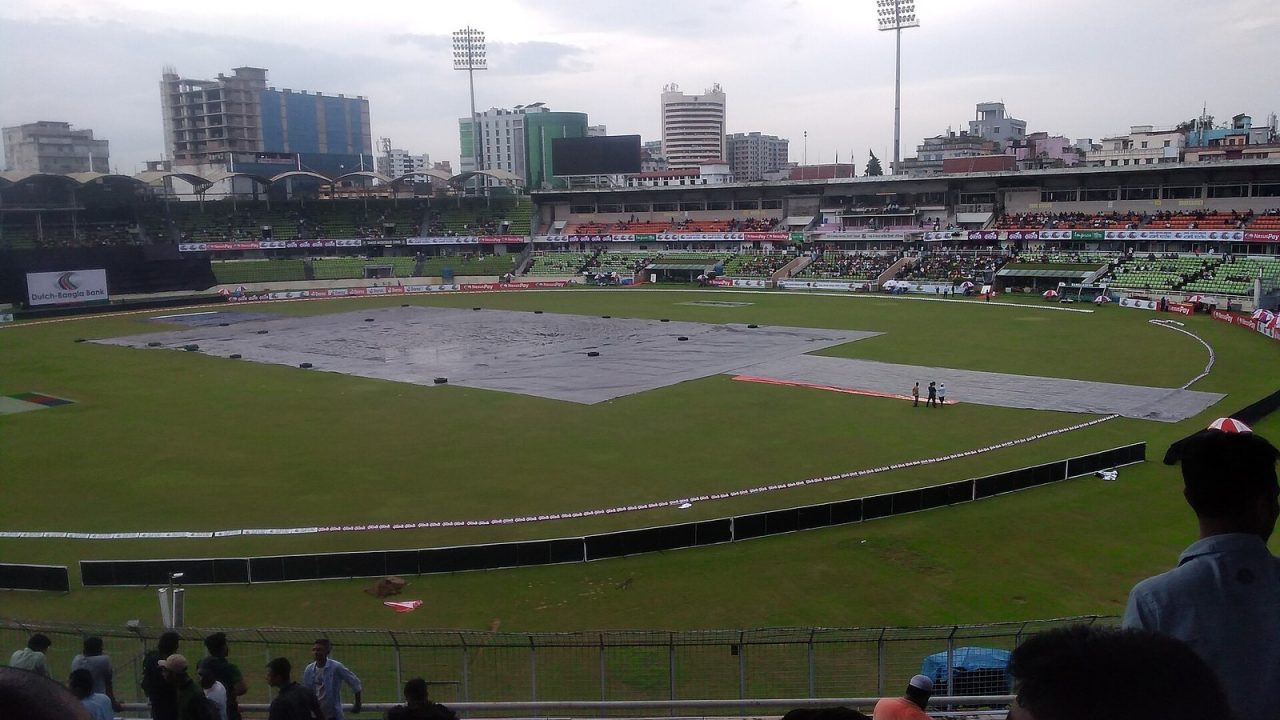
Rain and cricket have never got along. In a Test match, lost time simply makes a draw more likely. But in one-day and T20 cricket, a result is expected on the day, and if rain takes overs away from one or both teams, someone has to decide what a fair target looks like. Since the late 1990s, that “someone” has been a mathematical method devised by two English statisticians, refined by a third, and known today as the Duckworth-Lewis-Stern method, or DLS.
This guide explains the problem DLS solves, the core idea of “resources,” how par scores and revised targets work, and how the method evolved. It uses a simple example with invented numbers to illustrate — real DLS calculations rely on tables and software that are not reproduced here.
The Problem: Why Simple Rules Fail
Imagine Team 1 bats its full 50 overs and scores 250. Rain then cuts Team 2’s innings to 25 overs. What should Team 2 need?
The obvious answer — half the runs, 125 — is wrong. Team 2 would have 25 overs to score 125 with all 10 wickets in hand, which is far easier than Team 1’s task, because batters can take more risks when they know they have plenty of wickets for a short innings. Any fair method has to account for both overs and wickets.
Earlier methods failed in different ways:
- Average run rate: the target was simply scaled by overs. It ignored wickets entirely and tended to favour the team batting second.
- Most productive overs: used at the 1992 World Cup, this method took the first team’s highest-scoring overs to set the target, which effectively penalised the team that had bowled well in its tight overs.
The 1992 World Cup semi-final between England and South Africa is the famous case. South Africa were chasing and needed 23 runs from 13 balls — difficult, but very possible — when rain stopped play. Under the most productive overs rule, the overs lost were taken away by deducting the least productive overs of England’s innings. Removing a maiden left South Africa needing 23 from 7 balls; removing the next least productive over, which had cost just one run, left them needing 22 from a single ball. England went through to the final, where they lost to Pakistan.
The absurdity of that finish — a realistic chase turned into an impossible one in a few minutes, with the target barely moving while the balls disappeared — became a byword for the need for something better. Frank Duckworth and Tony Lewis developed their method in response. The point was not to help any particular team, but to make sure that rain changed the size of the task without changing who was ahead.
The Big Idea: Runs Come From Resources
Duckworth and Lewis started from a simple observation: a team’s ability to score runs depends on two resources — the overs it has left and the wickets it has in hand. At the start of a 50-over innings, a team has 100% of its resources. As overs are bowled and wickets fall, those resources are used up.
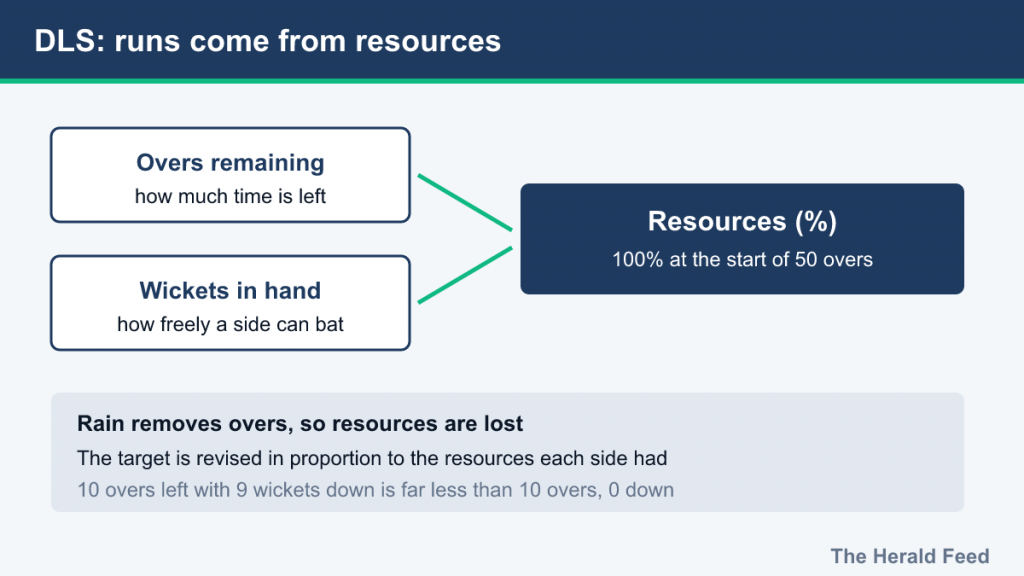
The key insight is that the two resources interact. Losing a wicket early costs more than losing one late, because it affects how freely the rest of the innings can be played. Ten overs left with nine wickets down is a much smaller resource than ten overs left with no wickets down.
Duckworth and Lewis turned that idea into tables. For any combination of overs remaining and wickets lost, the table gives the percentage of the team’s total resources still available. When rain removes overs, the method calculates how much resource each team has lost and adjusts the target accordingly.
Par Scores and Revised Targets
Two terms appear in every rain-affected match:
- Par score: the score Team 2 would need at that point to be level with Team 1, given the resources each team has had. Broadcasters often show the par score after each over when rain is threatening, because if the match is abandoned, the team ahead of par wins.
- Revised target: the new target for Team 2 after overs have been lost. It is the par score for the full (reduced) innings, rounded up; the score to tie is the par score rounded down.
In its basic form, Team 2’s par score equals Team 1’s score multiplied by the ratio of Team 2’s resources to Team 1’s resources.
An illustrative example (invented numbers)
The figures below are made up purely to show the logic; they are not taken from the real DLS tables.
- Team 1 bats its full 50 overs and scores 250. It used 100% of its resources.
- Before Team 2 starts, rain reduces its innings to 30 overs. Suppose the table says 30 overs with 10 wickets in hand is worth 75% of a full innings.
- Team 2’s par score is 250 × 75 ÷ 100 = 187.5.
- The target to win is 188 (par rounded up). A score of 187 (par rounded down) would tie.
Notice that 30 overs is 60% of 50, but the hypothetical resource figure is 75%. That reflects the core idea: with all ten wickets still available for a shorter innings, Team 2 has more than 60% of its scoring potential.
When Team 1’s innings is interrupted
DLS also handles interruptions to the first innings. If Team 1 loses overs part-way through, it may have batted more cautiously than it would have done had it known its innings would be short. The method can therefore give Team 2 a target higher than Team 1’s actual score — a result that surprises many viewers but is consistent with the logic of resources.
From D/L to DLS: A Short History
| Year | Development |
|---|---|
| 1992 | World Cup semi-final controversy highlights flaws in existing rain rules |
| 1997 | Duckworth-Lewis method first used in international cricket (1 January, Zimbabwe v England ODI) |
| 1999 | Formally adopted by the ICC |
| 2004 | Professional Edition, with score-dependent tables, adopted for international matches |
| 2014 | Renamed Duckworth-Lewis-Stern (November) after Steven Stern took over as custodian |
| 2015 | DLS used at the Cricket World Cup |
Australian statistician Steven Stern took over responsibility for the method when Duckworth and Lewis retired, and updated it to reflect modern scoring patterns, including the much higher run rates seen in the T20 era.
The method is now so embedded that it is easy to forget how recent it is. Revised targets in rain-hit international limited-overs matches — including at the 50-over event described in our guide to how the Cricket World Cup works — are set under it, and many domestic and franchise competitions use it too. For the fans watching, it has turned “where are we against par?” into one of the most common questions on a cloudy day.
Standard and Professional Editions
There are two versions of the method:
- Standard Edition: uses a single published resource table and can be applied with a printed sheet and a calculator. It includes an adjustment based on G50 — the average first-innings score in an uninterrupted 50-over match — for cases where Team 2 ends up with more resources than Team 1. It is still used at lower levels where computers may not be available.
- Professional Edition: used in international and top-level matches. It uses score-dependent calculations that better reflect high-scoring games and does not rely on G50. Its full values are not published; officials use dedicated software.
Minimum Overs for a Result
DLS cannot produce a result from just a handful of overs. Under international playing conditions:
- In a 50-over match, each side must face at least 20 overs for a result to be possible.
- In a T20 match, each side must face at least 5 overs.
If those minimums are not reached, the match is a no-result (unless the playing conditions for a particular tournament provide for a reserve day or a super over). For the differences between ODI and T20 cricket generally, see our guide to cricket’s three formats.
Criticisms and Common Misunderstandings
“DLS favours the team batting second”
The method was designed to be neutral, and the Professional Edition was introduced partly to correct biases in very high-scoring matches. Individual results can still feel harsh, but the method’s aim is to preserve the balance between teams as it stood when play stopped.
“Why is the target higher than Team 1’s score?”
Usually because Team 1’s innings was interrupted after it had paced itself for a longer innings. Team 2 knows from the start how many overs it has, so it has an advantage the method compensates for.
“Wickets don’t matter if you’re ahead on run rate”
They matter enormously. A team can be ahead on run rate but behind the DLS par score because it has lost more wickets. Watch the par score, not the run rate, when rain is around.
“It’s too complicated for fans”
The calculations are complex, but the principle is simple: runs are scored from overs and wickets, so a fair target must account for both.
Following a Rain-Affected Match
- Check the par score shown by broadcasters after each over when weather is threatening.
- Note how many wickets each team has lost — that is where par and run rate diverge.
- Remember the minimum overs: before 20 overs (ODI) or 5 overs (T20) of the second innings, there can be no DLS result.
- After a long delay, look for the revised target and the revised number of overs; both appear on the scoreboard and in the scorecard. Our guide on reading a cricket scorecard explains where.