The All Blacks: History, the Haka and a Winning Culture
The story of New Zealand's All Blacks: where the name came from, the Ka Mate and Kapa o Pango haka, three World Cup titles and a remarkable winning record.
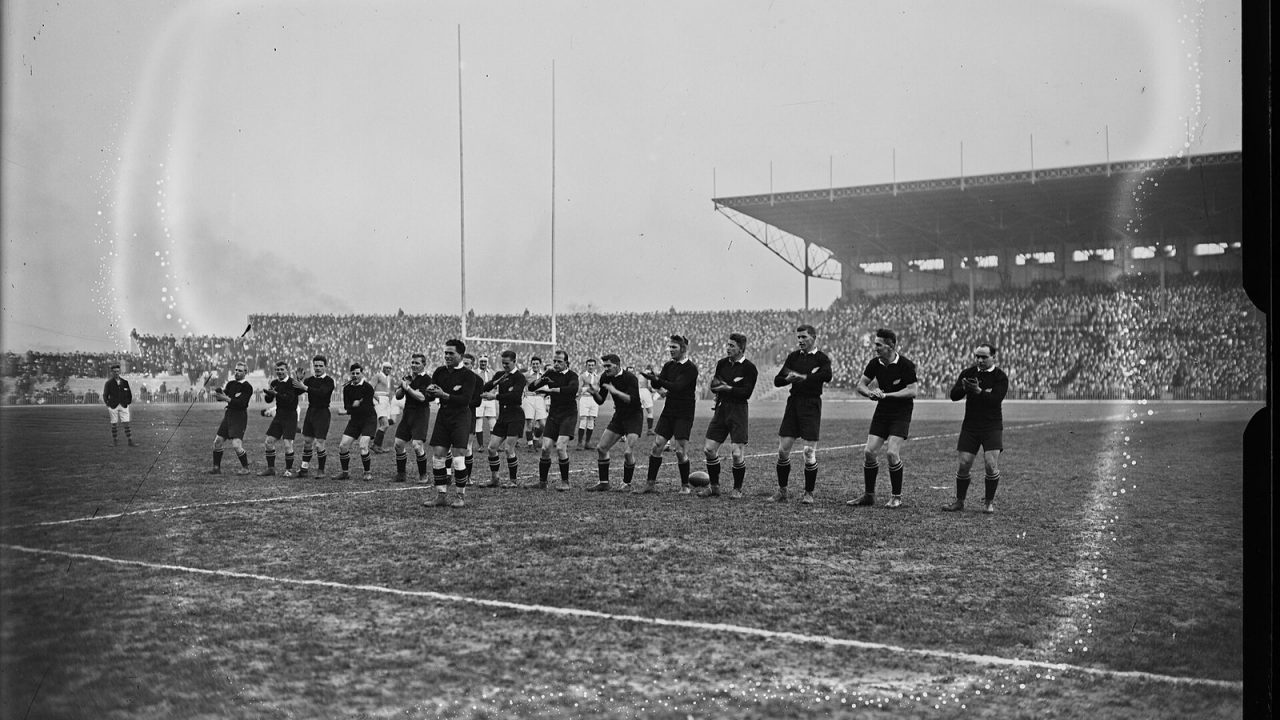
Few teams in any sport carry the aura of the All Blacks. New Zealand is a small country with a population of only a few million, yet its national rugby union team has spent much of the professional era at or near the top of the world game and holds one of the best winning records of any national side in international sport. Before kick-off, the team faces its opponents with a haka, a Māori challenge that has become one of rugby’s most recognisable rituals.
This article looks at where the All Blacks came from, the origins and meaning of their haka, their World Cup history, and some of the players who shaped their reputation.
Early history: from 1884 to the first test
A New Zealand representative rugby team first played in 1884, on a tour to New South Wales in Australia. Rugby had spread quickly through the colony in the second half of the nineteenth century, and inter-provincial competition was already strong.
The first official test match came on 15 August 1903, when New Zealand beat Australia 22–3 at the Sydney Cricket Ground in front of more than 30,000 spectators. That match began a rivalry that remains one of the cornerstones of the New Zealand rugby calendar, now contested for the Bledisloe Cup and played in part within the Rugby Championship.
The Originals and the birth of a name
The team’s identity was forged on its 1905 tour of the British Isles, a side remembered as “the Originals”. The Originals were astonishingly successful, winning all but one of their matches. Their only defeat was a 3–0 loss to Wales in Cardiff, a game so famous it is still called the “Match of the Century”.
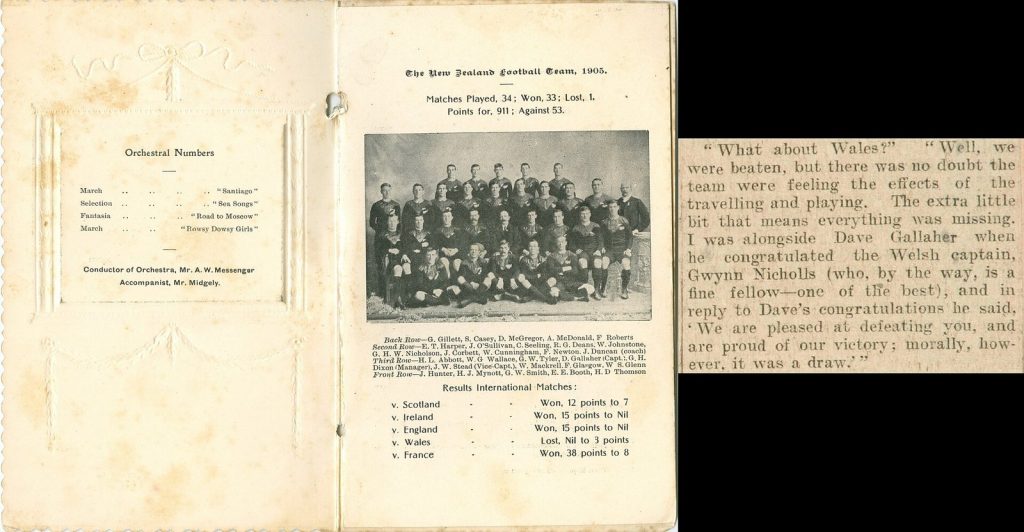
It was also on this tour that the name “All Blacks” became established. A popular story, told by Originals player Billy Wallace, claims that a London newspaper described the New Zealanders as playing as if they were “all backs”, and that a printing error turned this into “All Blacks”. Historians regard that story as most likely a myth. The more probable explanation is simpler: the team wore a black strip and had already been referred to as “the Blacks” before leaving home, and the 1905 tour popularised the full name.
The kit itself has changed little in spirit. Early uniforms featured a black jersey with a silver fern and white shorts, and the silver fern remains the team’s emblem today.
The 1924 Invincibles
Two decades later, the 1924 team toured the British Isles and France and won every game, earning the nickname “the Invincibles”. Scotland declined to play them, which denied the tourists the chance of a clean sweep against all four home unions.
The haka: Ka Mate and Kapa o Pango
A haka is a traditional Māori ceremonial dance or challenge. It combines chanting, rhythmic movement, stamping and facial expression, and it has many forms and purposes in Māori culture, including welcoming guests, marking important occasions and preparing for battle. The All Blacks perform haka before test matches, facing their opponents on the field.
Ka Mate
The haka most associated with the All Blacks is “Ka Mate”. It was composed around 1820 by Te Rauparaha, a leader of the Ngāti Toa iwi (tribe). According to the traditional account, Te Rauparaha composed it to celebrate his survival after escaping enemies who were pursuing him; he hid in a kūmara (sweet potato) storage pit on Motuopihi Island in Lake Rotoaira, protected by a woman named Rangikoaea. Ka Mate is a celebration of life overcoming death, rather than a simple war cry.
Ngāti Toa’s connection to Ka Mate is formally acknowledged. The iwi sought to trademark the name in the late 1990s and early 2000s, which was declined, but in 2009 the New Zealand government agreed to record Ngāti Toa’s authorship and the haka’s significance to the iwi. Players who lead the haka have spoken about performing it with respect for Te Rauparaha.
Kapa o Pango
In August 2005, before a Tri Nations test against South Africa at Carisbrook in Dunedin, the All Blacks unveiled a second haka, “Kapa o Pango”, meaning “Team in Black”. It was composed by Derek Lardelli and was designed to reflect New Zealand’s modern, multicultural identity, including the influence of Polynesian cultures. It was not intended to replace Ka Mate but to be used on particular occasions.
Kapa o Pango drew criticism for its closing gesture, which some observers interpreted as a throat-slitting motion. Lardelli explained that the movement represents drawing vital energy into the heart and lungs, and a review by New Zealand Rugby concluded that, in Māori culture, it signifies hauora, the breath of life. The gesture has been modified at different times since, and was withdrawn for the 2019 Rugby World Cup.
Respecting the haka
For fans, it is worth remembering that the haka is not a piece of pre-match entertainment invented for television. It comes from a living culture, and its words and movements carry meaning. Opponents respond in different ways, from standing in a line facing it to advancing in formation, and how a team “answers” the haka is often discussed as part of the drama of a big test.
World Cup history
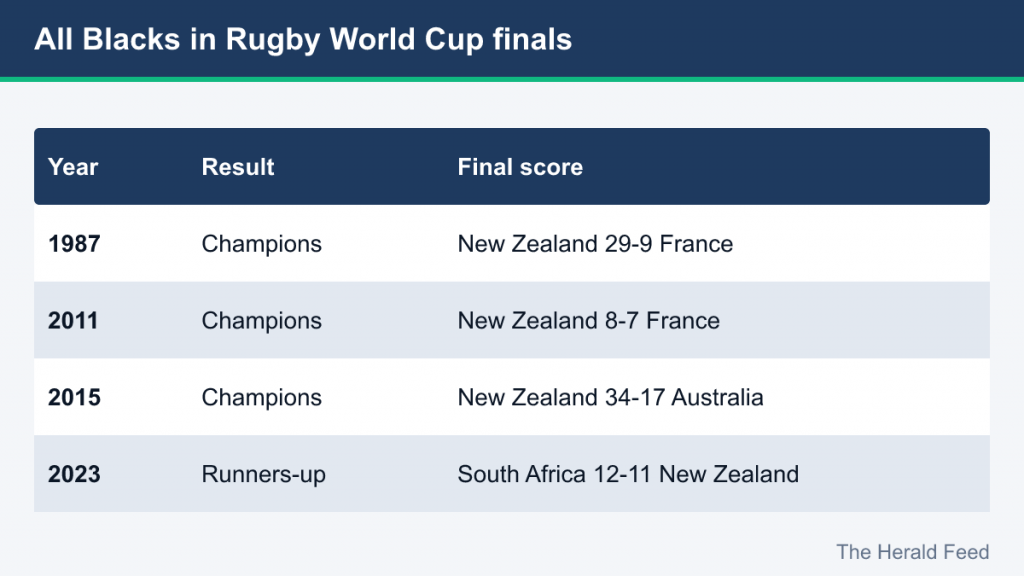
The All Blacks have won the men’s Rugby World Cup three times, a tally bettered only by South Africa. Their finals tell much of the team’s modern story.
| Year | Result | Final score |
|---|---|---|
| 1987 | Champions | New Zealand 29–9 France |
| 2011 | Champions | New Zealand 8–7 France |
| 2015 | Champions | New Zealand 34–17 Australia |
| 2023 | Runners-up | South Africa 12–11 New Zealand |
1987: the first champions
The inaugural tournament was co-hosted by New Zealand and Australia, and the All Blacks won it, beating France 29–9 in the final. It made them the first world champions in rugby union.
The long wait
For the next five tournaments the All Blacks did not win the trophy, despite often being favourites. That period included the 1995 tournament, in which winger Jonah Lomu scored four tries in a 45–29 semi-final win over England, a performance that made him a global star.
2011 and 2015: back-to-back titles
On home soil in 2011, New Zealand ended the drought with a tense 8–7 victory over France in the final. Four years later in England, they beat Australia 34–17 to become the first team to retain the Webb Ellis Cup. Richie McCaw captained both winning sides.
2023: the narrowest of defeats
In 2023 in France, the All Blacks reached the final again but lost 12–11 to South Africa, one of the closest finals in the tournament’s history.
Legends of the black jersey
Any list of great All Blacks will provoke debate, but a few names illustrate different eras and qualities.
- Richie McCaw. The openside flanker won 148 test caps and captained New Zealand in 110 tests. He led the team to World Cup titles in 2011 and 2015, retired in 2015, and was named World Rugby Player of the Year three times, a joint record.
- Dan Carter. The fly-half is New Zealand’s leading test points scorer with 1,598 points. He was World Rugby Player of the Year in 2005 and was part of the 2015 World Cup-winning side.
- Jonah Lomu. The winger’s size and pace changed perceptions of what a back could be, and his performances at the 1995 World Cup remain among the most replayed in rugby history.
- The Originals and Invincibles. The 1905 and 1924 touring teams are remembered collectively as the foundation of the All Blacks’ reputation.
Since the award was established in 2001, All Blacks have been named World Rugby Player of the Year ten times, a reflection of how consistently New Zealand has produced the world’s leading players.
What explains the winning culture?
New Zealand’s success is often attributed to a combination of factors rather than any single secret. Commentators and former players commonly point to:
- Depth of participation. Rugby is the national sport, played widely in schools and clubs, which creates a large pool of talent relative to the population.
- A clear pathway. Players progress through schools, provincial teams and Super Rugby franchises before reaching the national side, and they develop in a style of rugby that values handling skills and decision-making.
- Standards and continuity. The All Blacks place heavy emphasis on the jersey’s history. New players are made aware that they join a long line, and the expectation to maintain standards is part of the culture.
- Skills across positions. New Zealand forwards are known for their passing and running ability, and backs for their work at the breakdown, so the team can play at pace.
The numbers support the reputation. According to Wikipedia’s summary, the All Blacks have won around 76 percent of their test matches, a remarkable figure across more than a century of international rugby.
Rivalries that define the All Blacks
Australia and the Bledisloe Cup
Matches against the Wallabies are contested for the Bledisloe Cup, and the rivalry dates back to that first test in 1903. New Zealand has dominated the trophy in the professional era.
South Africa
The Springboks are widely seen as the All Blacks’ fiercest historic rival. The two nations have met in World Cup finals in 1995 and 2023, with South Africa winning both.
The British & Irish Lions
Lions tours to New Zealand come around only once every twelve years, and the All Blacks have a strong record in those series. The 1971 Lions are the only touring side to have won a series in New Zealand. Our guide to the British & Irish Lions covers that rivalry in more depth.