Test, ODI and T20: Cricket’s Three Formats Explained
Test, ODI or T20? How cricket's three international formats differ in length, overs, innings, fielding restrictions and tactics, with a side-by-side table.
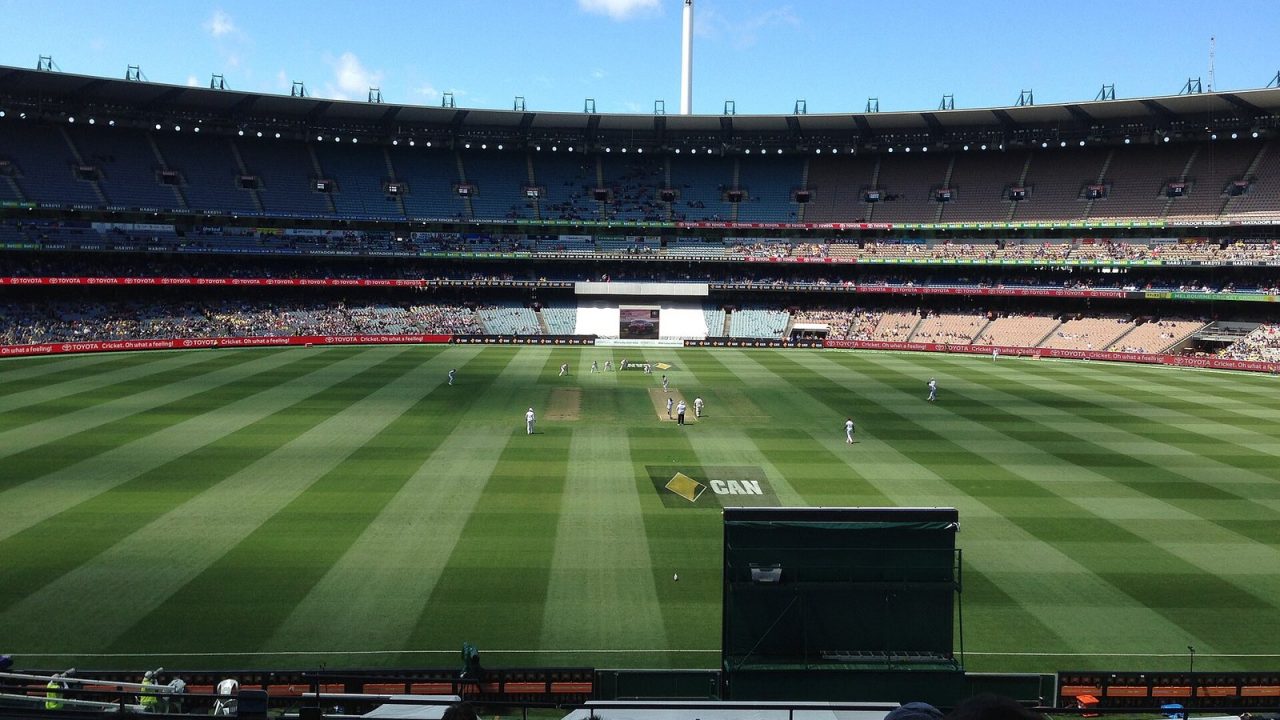
Few sports offer the same game in such different packages. A Test match can last five days and still end in a draw. A one-day international is done in a single day. A T20 game is over in about the time it takes to watch a film. The bat, the ball and the basic laws are the same, but the formats reward different skills and produce very different contests.
This guide compares the three international formats — Test, ODI and T20I — explaining how long each lasts, how many innings and overs are played, how fielding restrictions work, and why each exists. If you need a refresher on overs, innings and wickets first, start with our beginner’s guide to cricket rules.
Test Cricket: The Original Format
Test cricket is the oldest form of the international game. The first Test was played at the Melbourne Cricket Ground in March 1877, between a combined Australian XI and James Lillywhite’s England touring side; Australia won by 45 runs. Twelve teams currently hold Test status, all of them full members of the International Cricket Council (ICC).
How a Test works
A Test is scheduled for up to five days. Each team has two innings, and there is no limit on how many overs an innings can last. A typical day has three two-hour sessions separated by lunch and tea, with at least 90 overs scheduled per day.
To win, a team generally has to bowl the opposition out twice while scoring more runs in total. If time runs out before that happens, the match is a draw — even if one side is far ahead. That possibility gives Test cricket its unique tactics. Captains declare innings closed to give their bowlers enough time, and teams facing defeat can bat for hours simply to survive.
Under the Laws of Cricket, in a match of five days or more a side that bats first and leads by at least 200 runs on first innings may ask the opposition to follow on — bat again immediately. Smaller leads apply in shorter first-class matches.
Slow over rates have long been a problem in Tests, and the ICC has responded with a stop clock. Under playing conditions in force since June 2025, the fielding side must be ready to bowl the first ball of a new over within 60 seconds of the previous over ending. After two warnings in an innings, each further failure costs the fielding team a five-run penalty, and the warnings reset after every 80 overs. The stop clock was already used in white-ball internationals before it reached Tests.
Why Tests still matter
Many players regard Test cricket as the ultimate examination of technique, temperament and fitness. Pitches change over five days, so batters face fresh seam movement early on and spin on a worn surface later. Bowlers have to plan dismissals over many overs rather than merely contain. The format also carries a century and a half of history, including famous rivalries like the Ashes.
Since 2015, some Tests have been played as day-night matches with a pink ball; the first was Australia against New Zealand at Adelaide Oval in November 2015. A small number of Tests have been scheduled for four days, such as England against Ireland at Lord’s in 2019, but five days remains the norm.
One-Day Internationals: 50 Overs a Side
The first ODI was played between Australia and England at the Melbourne Cricket Ground on 5 January 1971. Early one-day matches varied from 40 to 60 overs per side, but the format has been fixed at 50 overs since the mid-1990s.
How an ODI works
Each team bats once, for a maximum of 50 overs. The side batting second chases a target. There are no draws in the Test sense: the team with more runs wins, and if the scores are level, the match is a tie. Rain-affected matches use the Duckworth-Lewis-Stern method to set revised targets, and if too few overs are possible — usually 20 per side — the match is declared no result.
Each bowler may bowl a maximum of 10 overs, so a team needs at least five bowlers (or part-time bowlers) to complete its quota. ODIs are played with a white ball and coloured clothing, a change that followed the World Series Cricket era of the late 1970s.
Fielding restrictions
Limited-overs cricket uses fielding restrictions to stop teams packing the boundary. In an ODI, the innings is split into three phases, known as powerplays:
- Overs 1–10: a maximum of two fielders outside the 30-yard circle.
- Overs 11–40: a maximum of four outside the circle.
- Overs 41–50: a maximum of five outside the circle.
The ball
ODIs have long used two new balls per innings, one from each end, to keep the white ball hard and visible. Under ICC playing conditions introduced in July 2025, two new balls are used for the first 34 overs; after that, the fielding side chooses one of the two and uses it at both ends for overs 35 to 50. The ICC’s stated aim was to readdress the balance between bat and ball: an older ball in the closing overs gives bowlers a little more to work with. If an ODI is cut to 25 overs or fewer per side before the first innings starts, one new ball is used for the whole innings.
Why ODIs exist
The 50-over game was created to deliver a guaranteed result in a single day. It sits between the other two formats: long enough for a batter to build a substantial innings, short enough to demand aggression at the end. The men’s Cricket World Cup is played in this format.
T20 Internationals: 20 Overs a Side
Twenty20 cricket was proposed by the England and Wales Cricket Board as a format lasting around three hours. The first men’s T20 international was played between Australia and New Zealand on 17 February 2005. In April 2018 the ICC announced that T20I status would be granted to all of its members from 1 January 2019, making it the format with by far the widest international reach.
How a T20 works
Each side bats once for a maximum of 20 overs, and each bowler may bowl no more than four. The fielding restrictions are simple: during the first six overs (the powerplay), only two fielders may be outside the 30-yard circle; after that, up to five may be.
Because there are only 120 legal balls per innings, wickets matter less than in other formats and scoring rate matters more. Batters attack from the first ball, and bowlers specialise in phases: swing in the powerplay, variations through the middle, yorkers and slower balls at the death.
Why T20 exists
T20 was designed to attract new audiences with a short, evening-friendly game. It succeeded beyond expectations and now underpins a global network of franchise leagues. It also lets associate nations play official internationals regularly, which helps the sport grow.
Side-by-Side Comparison
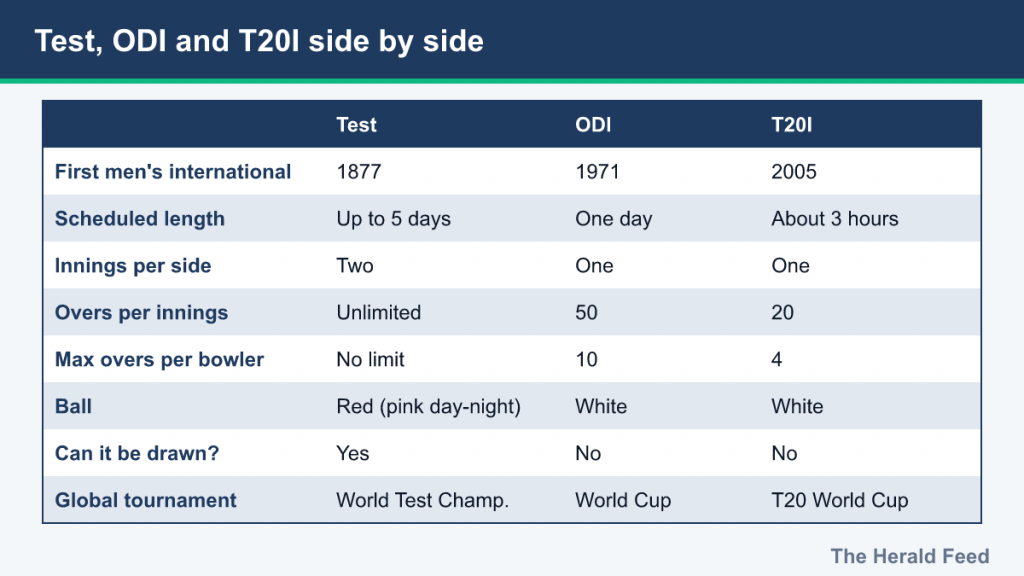
| Test | ODI | T20I | |
|---|---|---|---|
| First men’s international | March 1877 | 5 January 1971 | 17 February 2005 |
| Scheduled length | Up to five days | One day | About three hours |
| Innings per side | Two | One | One |
| Overs per innings | Unlimited (at least 90 per day scheduled) | 50 | 20 |
| Max overs per bowler | No limit | 10 | 4 |
| Fielding restrictions | None (beyond the Laws) | Three powerplay phases: 2, 4, then 5 outside the circle | 2 outside the circle for overs 1–6, then 5 |
| Ball | Red (pink for day-night) | White | White |
| Can it be drawn? | Yes | No (tie or no result possible) | No (tie or no result possible) |
| Global tournament | World Test Championship | Cricket World Cup | T20 World Cup |
How Tactics Change from Format to Format
Batting
In Tests, a batter’s first job is survival: leave balls outside off stump, wear down the bowlers, and cash in later. In ODIs, the classic template is to lay a platform in the first ten overs, rotate the strike through the middle, and accelerate at the end with wickets in hand. In T20, the risk calculation flips — a quick 30 off 15 balls can be worth more than a slow 50.
Bowling
Test bowlers aim to take wickets by building pressure over long spells, often bowling the same line for an hour. White-ball bowlers balance wicket-taking with containment, because economy rate decides limited-overs matches. Over limits per bowler also force captains to plan who bowls when, saving their best death bowlers for the closing overs.
Fielding and captaincy
Test captains can place as many catchers as they like — four slips and a gully is not unusual early on. In limited-overs cricket, field settings are dictated partly by the powerplay rules, so captains juggle where to put their limited number of boundary riders.
A Note on The Hundred and Other Variants
Domestic competitions experiment with new formats. The best-known is England’s The Hundred, first played in 2021, in which each innings lasts 100 balls. Bowlers deliver sets of five balls, and a bowler can bowl a maximum of 20 balls in an innings. It is not an international format, but it shows how the shortest end of the game keeps evolving.
Common Questions
Which format is “real” cricket?
All three are. Tests test endurance and technique; ODIs reward pacing an innings; T20 rewards power and innovation. Most top players switch between formats, though many now specialise.
Why does a Test sometimes end in three days?
Five days is the maximum, not a requirement. If one team bowls the other out twice quickly — on a pitch that helps bowlers, for example — the match ends early.
Do the same Laws apply?
Yes. All three formats are played under the MCC Laws of Cricket, with the ICC’s playing conditions for each format adding specific rules on overs, fielding restrictions, the ball and other details.