Super Rugby Explained: History and Format
From the Super 12 to Super Rugby Pacific: how the southern hemisphere's top club competition grew, shrank, and works today, with every champion through 2026.

Super Rugby is the leading professional club competition in southern-hemisphere rugby union. For three decades it has been the stage on which New Zealand, Australian and, for many years, South African players built their reputations before stepping into test rugby. It has also been one of the most frequently reshaped competitions in world sport, expanding from 12 teams to 18, then contracting again as the professional game in the region changed.
This guide explains how Super Rugby began, why its shape kept changing, how the current Super Rugby Pacific format works, and which teams have dominated, through the 2026 season.
Before Super Rugby: the 1980s and early 1990s
Provincial and state teams from New Zealand, Australia and Fiji had met in cross-border competitions before the professional era. The South Pacific Championship ran from 1986 to 1990. A Super 6 tournament was played in 1992, and the Super 10 ran from 1993 to 1995.
These competitions were the testing ground for a bigger idea: a regular, fully professional tournament linking the three major southern-hemisphere rugby nations.
Super 12, Super 14 and Super Rugby: the expansion years
Super 12 (1996–2005)
When rugby union went professional in the mid-1990s, New Zealand, South Africa and Australia formed SANZAR to run a new competition alongside the Tri Nations series. Super 12 began in 1996 with 12 teams drawn from the three countries.
Super 14 (2006–2010)
In 2006 the competition expanded to 14 teams, adding the Western Force from Perth and the Cheetahs from South Africa.
Super Rugby (2011–2019)
From 2011 the competition was renamed simply Super Rugby and expanded to 15 teams. A further expansion in 2016 took it to 18 teams with the addition of the Jaguares from Argentina and the Sunwolves from Japan. The larger competition stretched across five countries and many time zones, which made scheduling and travel far more demanding.
The great contraction: 2020 to 2022
The COVID-19 pandemic forced the cancellation of the 2020 season, and the disruption became a turning point. In September 2020, the South African teams withdrew from Super Rugby to join the northern-hemisphere competition that is now the United Rugby Championship. The Sunwolves and Jaguares also left.
In 2021, with international travel restricted, New Zealand and Australia ran separate domestic competitions followed by a trans-Tasman crossover, and no official overall Super Rugby champion was crowned.
In 2022 the competition relaunched as Super Rugby Pacific with 12 teams: the five New Zealand franchises, five Australian sides, and two new Pacific Island teams, the Fijian Drua and Moana Pasifika. The new name reflected a deliberate shift towards the Pacific region.
Further changes since 2022
- Melbourne Rebels. Rugby Australia shut down the Rebels in 2024 following financial difficulties, reducing the competition to 11 teams.
- Moana Pasifika. In April 2026, Moana Pasifika announced it would disband, and New Zealand Rugby confirmed its withdrawal in June 2026. From 2027 the competition is due to have 10 teams.
The teams
For the 2026 season, Super Rugby Pacific had 11 teams. With Moana Pasifika’s departure, the line-up from 2027 is set to be the following ten:
| Country | Teams |
|---|---|
| New Zealand | Blues, Chiefs, Crusaders, Highlanders, Hurricanes |
| Australia | ACT Brumbies, Queensland Reds, NSW Waratahs, Western Force |
| Fiji | Fijian Drua |
The New Zealand franchises are aligned with groups of provincial unions and draw their players from those regions. The Australian teams represent their states or territories. The Fijian Drua give Fijian players a professional pathway at home.
Super Rugby teams also provide opposition for touring sides. When the British & Irish Lions toured Australia in 2025, they played the Western Force, Queensland Reds, NSW Waratahs and ACT Brumbies.
How the current format works
The 2026 season gives a clear picture of the modern format.
Regular season
All teams sit in a single table. In 2026, the regular season ran over 16 rounds, with each of the 11 teams playing 14 matches, seven at home and seven away, and having two byes. Teams earn competition points for wins and draws, and bonus points can also be earned.
Finals
In 2026 the top six teams qualified for the finals. The qualifying finals pitted 1st against 6th, 2nd against 5th and 3rd against 4th. The three winners, plus the highest-ranked losing team, went through to the semi-finals, and the semi-final winners met in the final.
The format has been adjusted several times since 2022, so it is worth checking each season’s rules. The direction of travel, however, has been consistent: a single table that is easy to follow, followed by a short knockout series.
The 2026 final
The Hurricanes won the 2026 title, beating the Chiefs 60–5 in Wellington on 20 June 2026 in front of 34,500 spectators. It was the Hurricanes’ second Super Rugby title, a decade after their first in 2016.
Champions and the Crusaders dynasty
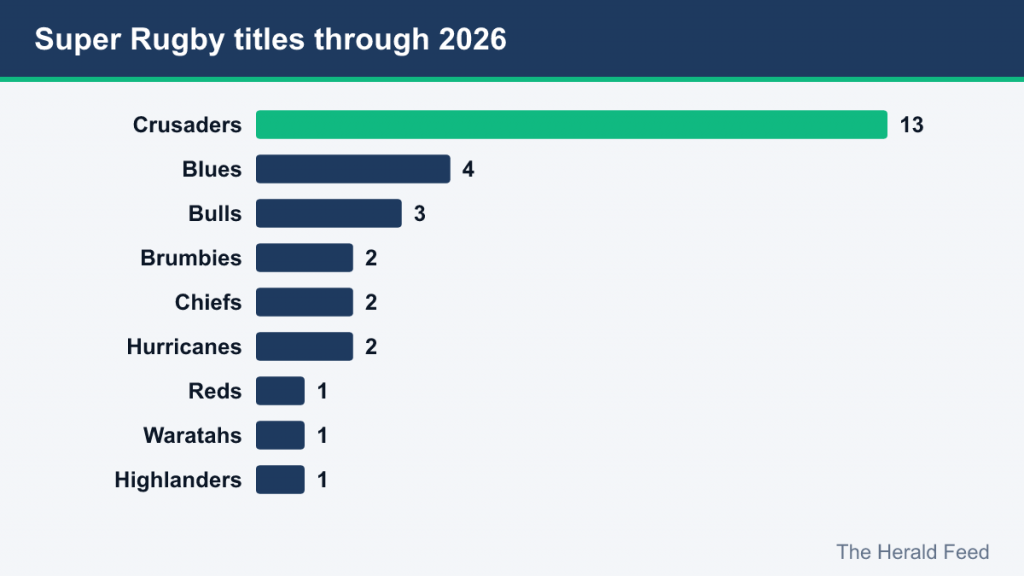
One team stands above all others in Super Rugby history: the Crusaders, based in Christchurch. Through 2026 they have won 13 titles, more than three times as many as any other team.
| Team | Titles (through 2026) | Years |
|---|---|---|
| Crusaders | 13 | 1998, 1999, 2000, 2002, 2005, 2006, 2008, 2017, 2018, 2019, 2022, 2023, 2025 |
| Blues | 4 | 1996, 1997, 2003, 2024 |
| Bulls | 3 | 2007, 2009, 2010 |
| Brumbies | 2 | 2001, 2004 |
| Chiefs | 2 | 2012, 2013 |
| Hurricanes | 2 | 2016, 2026 |
| Reds | 1 | 2011 |
| Waratahs | 1 | 2014 |
| Highlanders | 1 | 2015 |
New Zealand sides have dominated the competition overall. South Africa’s only titles came from the Bulls, and Australia’s from the Brumbies, Reds and Waratahs. The Chiefs have had a frustrating recent run, losing the final in 2023, 2024, 2025 and 2026.
Why the Crusaders have been so successful
Whatever the explanation, their three-titles-in-a-row runs (1998–2000 and 2017–2019) show a sustained ability to win finals, not just regular-season matches. Many of their players have also formed the backbone of New Zealand teams; for more on that culture, see our article on the All Blacks.
Memorable finals
Thirty seasons of finals have produced blowouts and one-point thrillers. A few stand out in the record books.
- 1996: the first final. The Auckland Blues beat Natal Sharks 45–21 to become the first champions, and retained the title the following year against the ACT Brumbies.
- 2000: a one-point decider. The Crusaders completed their first three-peat by edging the Brumbies 20–19.
- 2007: South Africa’s first title. The Bulls beat the Sharks 20–19 in an all-South African final, the first time a South African side had won the competition. The Bulls added further titles in 2009, with a 61–17 win over the Chiefs, and 2010.
- 2011: Australia’s breakthrough. The Queensland Reds beat the Crusaders 18–13, ending a run in which New Zealand and South African teams had shared the titles since 2005.
- 2014: the closest of all. The NSW Waratahs beat the Crusaders 33–32 for their only title.
- 2019: Argentina’s only final. The Crusaders beat the Jaguares 19–3, the only final featuring a team from Argentina, completing their second run of three titles in a row.
- 2026: the biggest margin. The Hurricanes’ 60–5 win over the Chiefs was the most one-sided final on record.
Looking at the list as a whole also shows how the competition’s centre of gravity has moved. In the first 15 years, finals regularly featured South African and Australian teams. Since 2022, every final has been contested between two New Zealand franchises.
How to follow a Super Rugby season
- Watch the table, not just the results. With a single table and a top-six cut in 2026, a couple of bonus points can decide who reaches the finals.
- Note the derbies. Matches between New Zealand franchises are often the toughest fixtures on the calendar, since they feature many current and future All Blacks.
- Follow the Pacific story. The Fijian Drua bring a distinctive, high-tempo style and give Fijian players a professional path at home.
- Keep an eye on selection. Coaches of New Zealand and Australia watch Super Rugby closely ahead of the July internationals, so strong form in May and June can earn a test call-up.
Super Rugby’s place in the rugby calendar
Super Rugby runs in the first half of the year, with the final in June, before the international window in July and the Rugby Championship later in the southern winter. For New Zealand and Australian players it is the main proving ground for national selection.
The departure of the South African teams changed the competition’s character. Super Rugby lost one of its fiercest rivalries, between New Zealand and South African franchises, but gained a more compact, trans-Tasman and Pacific identity with shorter travel and simpler scheduling. South African teams now play in the United Rugby Championship and European cup competitions instead.
Frequently asked questions
Is Super Rugby the same as the Rugby Championship?
No. Super Rugby is a club (franchise) competition. The Rugby Championship is an international tournament between national teams.
Why did the South African teams leave?
After the 2020 season was disrupted by COVID-19, the South African sides withdrew in September 2020 and moved to the competition now known as the United Rugby Championship, which is played largely in the northern hemisphere.
Is there a women’s equivalent?
Yes. New Zealand runs Super Rugby Aupiki, a women’s competition linked to the Super Rugby franchises.