The NRL Explained: How Australia’s Rugby League Competition Works
How the NRL works: its roots in the 1908 NSW premiership, the Super League war, 17 clubs, a 27-round season, the top-eight finals and the Grand Final.
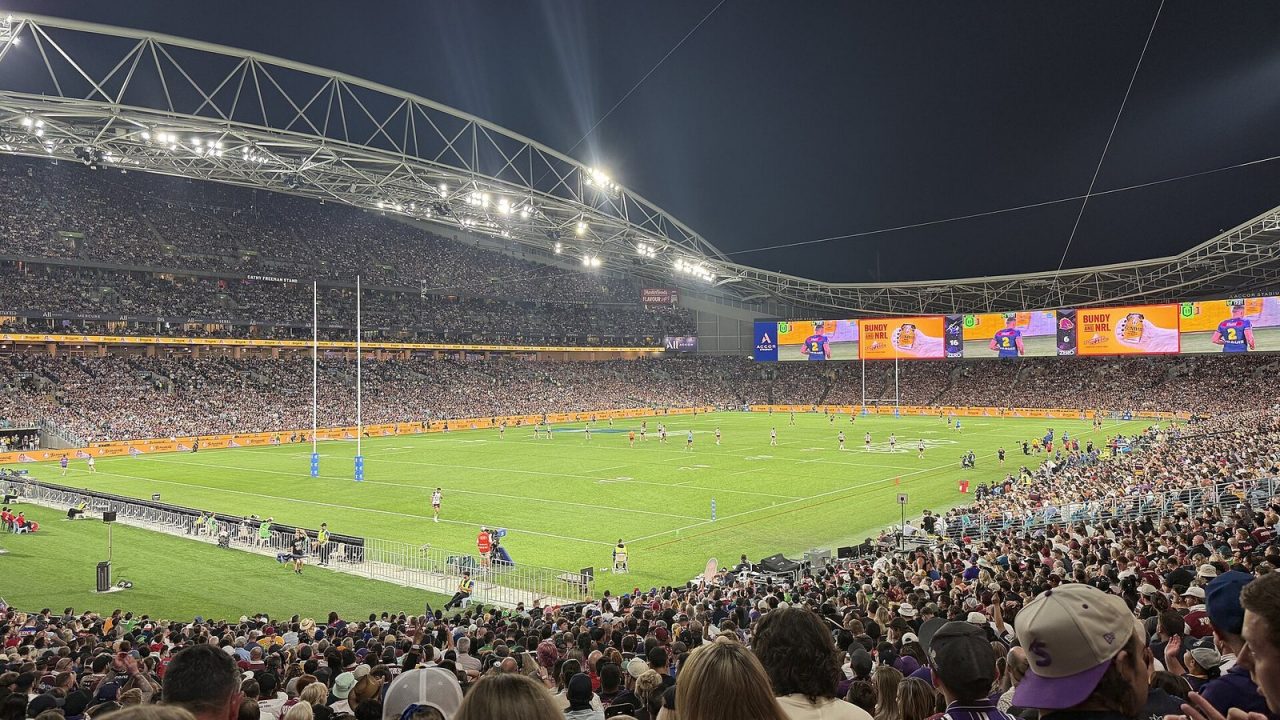
The National Rugby League (NRL) is the top professional rugby league competition in Australia and New Zealand, and one of the most watched sporting competitions in the region. Every winter, from March to October, its clubs play a long regular season that builds towards the finals and a Grand Final in Sydney. Along the way it shares the calendar with State of Origin, the interstate series that grips Queensland and New South Wales.
This guide explains where the NRL came from, which clubs play in it, how the season and finals work, and what newcomers need to know to follow it, as of the 2026 season.
From the NSW premiership to the NRL
The NRL’s history reaches back much further than its name. Professional rugby league in Australia began with the New South Wales Rugby League premiership, which ran from 1908 until 1994. That competition was centred on Sydney clubs, several of which still play in the NRL today. Over the decades it expanded to include teams from outside Sydney, and later from outside New South Wales.
The Super League war
In the mid-1990s the sport went through its most turbulent period, known as the Super League war. A breakaway Super League competition backed by News Corporation challenged the Australian Rugby League (ARL) for control of the game and its broadcast rights, and for a time the sport in Australia was split between rival competitions.
The peace deal produced a single competition, the National Rugby League, formed in 1998 as a joint partnership between the ARL and News Corporation’s Super League. The reunification left more clubs than the new competition wanted, and the number of teams was reduced through mergers and exclusions in the years that followed.
The modern governance
The partnership between the ARL and News Limited was dissolved in 2012, when control passed to an independent body, the Australian Rugby League Commission (ARLC), which governs the game today.
The clubs
As of 2026, the NRL has 17 clubs: 16 based in Australia and one in New Zealand, the New Zealand Warriors. The most recent addition is the Dolphins, based in Redcliffe in the Brisbane region, who joined in 2023.
| Club | Base |
|---|---|
| Brisbane Broncos | Brisbane, Queensland |
| Canberra Raiders | Canberra, ACT |
| Canterbury-Bankstown Bulldogs | Sydney, NSW |
| Cronulla-Sutherland Sharks | Sydney, NSW |
| Dolphins | Redcliffe, Queensland |
| Gold Coast Titans | Gold Coast, Queensland |
| Manly Warringah Sea Eagles | Sydney, NSW |
| Melbourne Storm | Melbourne, Victoria |
| Newcastle Knights | Newcastle, NSW |
| New Zealand Warriors | Auckland, New Zealand |
| North Queensland Cowboys | Townsville, Queensland |
| Parramatta Eels | Sydney, NSW |
| Penrith Panthers | Sydney, NSW |
| South Sydney Rabbitohs | Sydney, NSW |
| St George Illawarra Dragons | Sydney and Wollongong, NSW |
| Sydney Roosters | Sydney, NSW |
| Wests Tigers | Sydney, NSW |
The heavy concentration of clubs in Sydney is a legacy of the old NSWRL premiership. Expansion has gradually spread the competition into Queensland, Victoria, the ACT and New Zealand.
Expansion: Perth and Papua New Guinea
The NRL is set to grow further. The Perth Bears are scheduled to enter the competition in 2027, giving Western Australia an NRL club, and a Papua New Guinea team, the Chiefs, is due to join in 2028. That would take the competition to 19 clubs. Expansion plans can change, so check the NRL’s official announcements for the latest position.
How the regular season works
The NRL regular season runs from March to around early September. In 2026 it spanned 27 rounds, with each team playing 24 matches and having three byes. Byes are necessary because an odd number of teams means at least one club must sit out each round.
Teams earn competition points for wins and draws, and the ladder is sorted by those points. The team finishing top of the ladder after the regular season is the minor premier and receives the J. J. Giltinan Shield. Winning the minor premiership is a significant achievement, but in Australian sporting culture the real prize is the premiership decided in the Grand Final.
Magic Round
One of the most popular fixtures on the calendar is Magic Round, when an entire round of matches is staged at Suncorp Stadium in Brisbane over a single weekend. In 2026, Magic Round was Round 11, and it drew 147,751 fans across its three days, with a Friday double-header and triple-headers on Saturday and Sunday. A Women’s State of Origin match was played at the same stadium on the Thursday night before the round.
For fans, Magic Round is a chance to see every club in action in one place. For the NRL, it is a showcase event that brings supporters from across Australia and New Zealand to Brisbane.
State of Origin and the club season
State of Origin, the three-match series between Queensland and New South Wales, is played in the middle of the club season. Clubs lose their Origin players for those weeks, which can have a big effect on results and on the ladder. Our guide to State of Origin explains the series and its selection rules.
The finals series
The top eight teams on the ladder qualify for the finals. Since 2012, the NRL has used a four-week system that rewards the top four with a “double chance”.
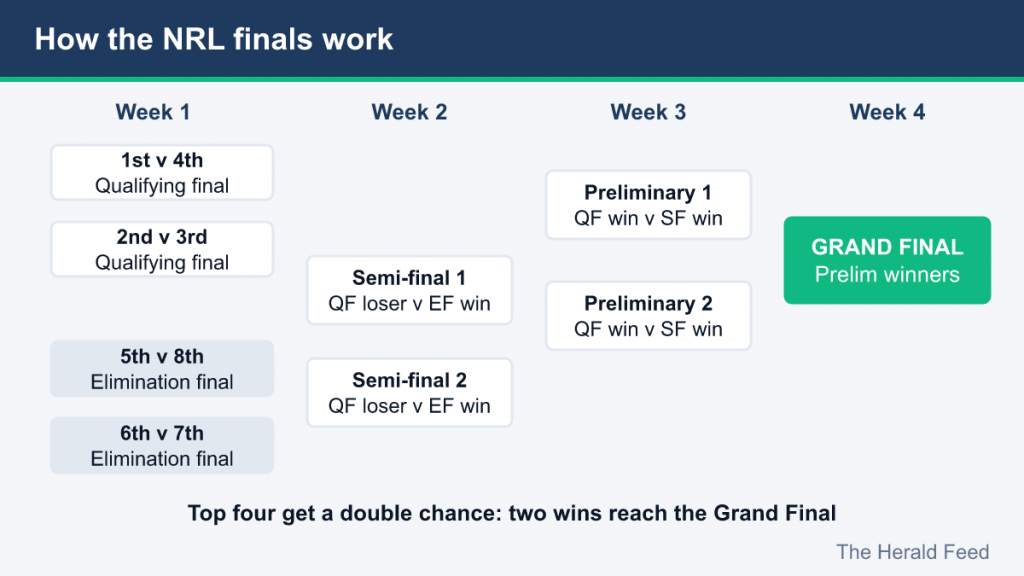
- Week one. Two qualifying finals are played: 1st v 4th and 2nd v 3rd. At the same time, two elimination finals are played: 5th v 8th and 6th v 7th. Losers of the elimination finals are knocked out; losers of the qualifying finals survive.
- Week two. The semi-finals: the qualifying final losers host the elimination final winners. The losers are eliminated.
- Week three. The preliminary finals: the qualifying final winners, who earned a week off, host the semi-final winners.
- Week four. The Grand Final between the two preliminary final winners.
The structure means that a team finishing in the top four needs to win two finals to reach the Grand Final, while a team from fifth to eighth needs to win three. Home advantage also matters: the top two teams host both of their first two finals.
The Grand Final
The NRL Grand Final is held at Stadium Australia (currently known as Accor Stadium) in Sydney, usually in early October. The winners receive the Provan-Summons Trophy.
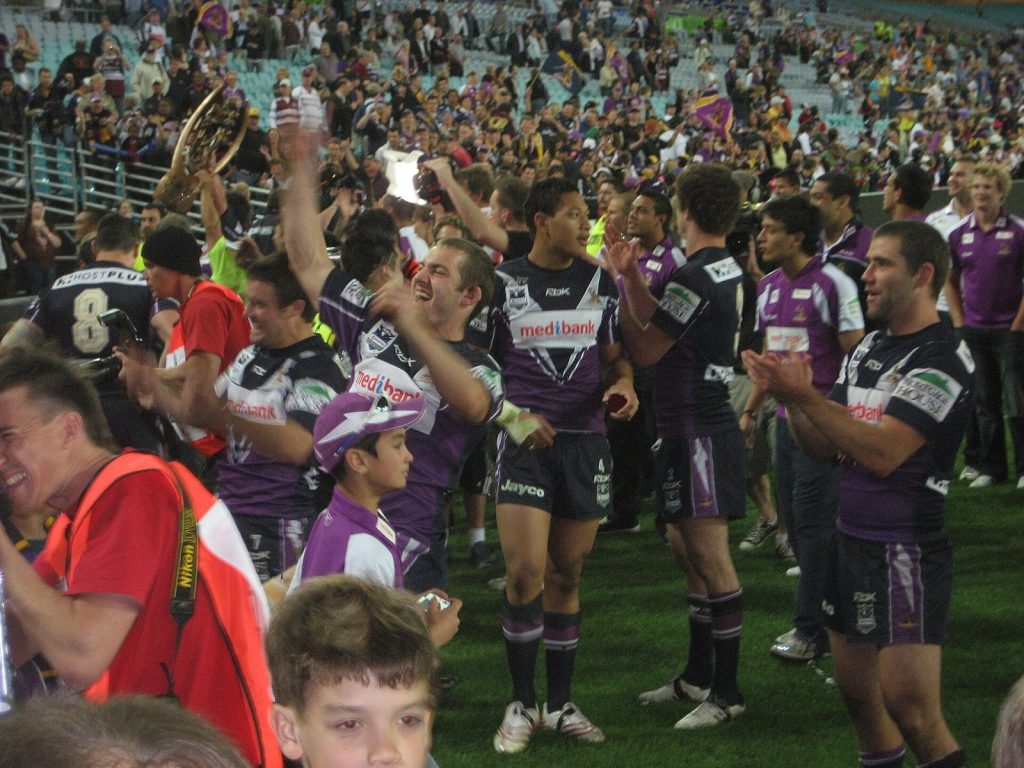
Recent premiers have included the Penrith Panthers (2024), the Brisbane Broncos (2025) and the Sydney Roosters (2026). The Roosters beat the Newcastle Knights in the 2026 Grand Final on 4 October to claim their 16th premiership. Across the full history of the competition, including the NSWRL era, the South Sydney Rabbitohs hold the record with 21 premierships.
The Grand Final is one of the biggest days in Australian sport, with a pre-match entertainment programme and a national television audience.
Women’s rugby league: the NRLW
A national women’s competition, the NRL Women’s Premiership (NRLW), was established after the 2017 Women’s Rugby League World Cup. Its first season began in September 2018 with four teams aligned to existing NRL clubs. The competition has since expanded, and the women’s game has its own State of Origin fixture; in 2026 a Women’s Origin match drew 23,846 fans to Suncorp Stadium on the eve of Magic Round.
How to follow the NRL as a newcomer
- Learn the basics first. If the tackle count and play-the-ball are new to you, start with our beginner’s guide to rugby league rules. If you come from rugby union, our comparison of union and league covers the key differences.
- Watch the ladder, but watch the top eight more closely. Finishing in the top four is far more valuable than finishing fifth because of the double chance in the finals.
- Keep an eye on the Origin period. Results during these weeks often reflect which clubs have lost the most players to representative duty.
- Pick a club with a story. Many NRL clubs have long histories reaching back to the NSWRL era, with traditional rivalries and local identities. Following one club through a season is the best way to understand the competition.
A quick glossary of NRL terms
- Ladder. The league table. Australians almost always say “ladder” rather than “table” or “standings”.
- Bye. A round in which a club has no match. With 17 clubs, byes are built into the draw for every team.
- Minor premiers. The team that finishes first on the ladder at the end of the regular season, winning the J. J. Giltinan Shield.
- Premiers. The Grand Final winners, who lift the Provan-Summons Trophy. When Australians ask who “won the comp”, this is what they mean.
- Double chance. The safety net enjoyed by the top four in the finals: lose in week one and you still play in week two.
- Prelim. Short for preliminary final, the last step before the Grand Final.
- Magic Round. The single round staged in its entirety at Suncorp Stadium in Brisbane.
- Origin period. The weeks of the club season that overlap with the State of Origin series, when clubs can be without their representative players.
Frequently asked questions
Is the NRL the same as Super League?
No. Today, “Super League” usually refers to the top professional competition in England and France, which is entirely separate from the NRL. The Australian Super League of the 1990s was the rival competition that merged with the ARL to create the NRL.
Why does a New Zealand team play in an Australian competition?
The NRL is a trans-Tasman competition. The New Zealand Warriors, based in Auckland, are one of its 17 clubs and play home matches in New Zealand, travelling to Australia for away fixtures.
What is the difference between the minor premiership and the premiership?
The minor premiership goes to the team that finishes top of the regular-season ladder. The premiership goes to the Grand Final winner.