DRS in Cricket: How the Decision Review System Works
How cricket's Decision Review System works: player reviews, how many each team gets, ball-tracking, edge detection, umpire's call and the third umpire.
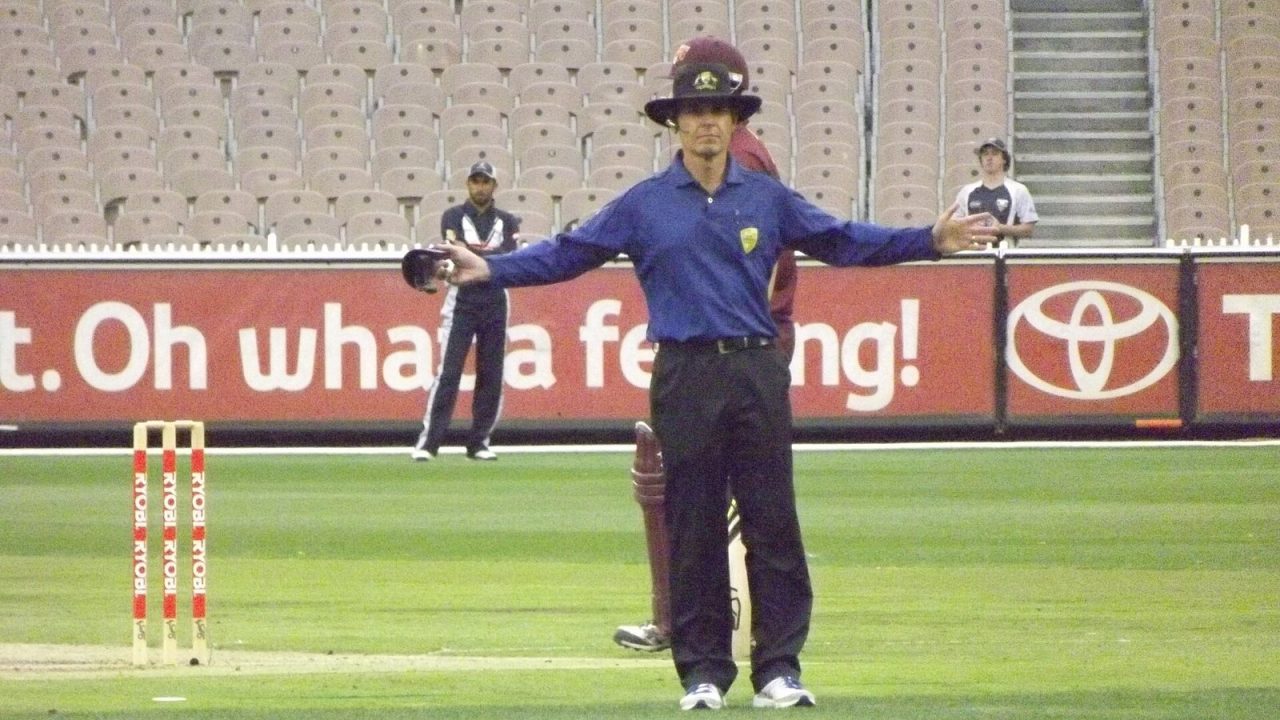
Few things in modern cricket produce as much drama as the moment a captain makes a “T” sign with their hands. The Decision Review System — DRS — lets players challenge an on-field umpire’s decision and hand it to the third umpire, who uses replays, ball-tracking and edge-detection technology to check it. Used well, it corrects obvious errors. Used badly, it wastes a precious review and sometimes leaves a batter walking off muttering about “umpire’s call.”
This guide explains how DRS works in international cricket: who can review, how many reviews teams get, what technology is used, how umpire’s call operates, and the tactics behind good and bad reviews. It builds on our explainer of the LBW rule, since LBW is where DRS is used most.
A Short History of DRS
Television replays were already being used for line decisions such as run-outs and stumpings before DRS arrived, but letting players challenge an LBW or a caught-behind decision was a much bigger step. The player-review system was first tested in a Test series between India and Sri Lanka in 2008. It was officially launched by the International Cricket Council on 24 November 2009, in the first Test between New Zealand and Pakistan in Dunedin.
DRS was then extended to One-Day Internationals from January 2011 and later to T20 Internationals. The technology and rules have been refined many times since — most notably in 2017, when the ICC changed the system so that a team does not lose a review when the outcome is “umpire’s call,” and again in 2021, when the zone used to judge whether the ball would hit the stumps was raised to the top of the stumps.
Two Kinds of Review
It is important to distinguish two different routes to the third umpire.
Umpire reviews
The on-field umpires can refer certain decisions to the third umpire on their own initiative. These include run-outs, stumpings, whether a catch was taken cleanly, boundary decisions and checking for no-balls. These referrals do not use up any team’s allocation.
Player reviews
The fielding captain, or the batter who has been given out, can ask for a review of an “out” or “not out” decision that did or could result in a dismissal — most commonly LBW and caught decisions. This is what most people mean by “DRS.” The player signals by forming a T with their arms.
A review must be requested quickly: under the playing conditions, the challenge has to be made within 15 seconds of the umpire’s decision. Teams often consult briefly — the bowler and wicketkeeper with the captain, or the batter with their partner — before committing. A timer is often shown on screen during broadcasts.
How Many Reviews Does Each Team Get?
The allocation is counted in unsuccessful reviews per innings. If a review overturns the on-field decision, the team keeps it. If it fails, one review is lost.
| Format | Unsuccessful reviews per team per innings |
|---|---|
| Test matches | 3 |
| ODIs | 2 |
| T20 Internationals | 2 |
The Test allowance used to be two per innings. It was raised to three as a temporary measure during the COVID-19 period, and the increase was later made permanent. Between 2013 and 2017, Test teams were also “topped up” to two reviews after 80 overs of an innings; that top-up was abolished in the 2017 changes.
For the differences between the formats themselves, see our guide to Test, ODI and T20 cricket.
The Technology Behind DRS
When a review is called, the third umpire works through the available evidence in a set order — typically checking first whether the delivery was a legal ball, then looking for an edge, then using ball-tracking for LBW.
Ball-tracking
Ball-tracking systems — Hawk-Eye and Virtual Eye are the best known — use multiple high-speed cameras to record the path of the ball and predict where it would have gone had the batter’s pad not intercepted it. For an LBW review, ball-tracking answers three questions:
- Where did the ball pitch? (A ball pitching outside leg stump cannot result in LBW.)
- Where did it hit the batter — in line with the stumps or not?
- Would it have gone on to hit the stumps?
Edge detection
Did the ball touch the bat? Sound-based systems answer this. The original Snickometer has been replaced by real-time versions, such as Real Time Snicko and UltraEdge, which sync audio spikes with slow-motion video. A spike just as the ball passes the bat suggests an edge. Edge detection matters both for caught decisions and for LBW, because if the ball hit the bat first, the batter cannot be out LBW.
Hot Spot
Hot Spot uses infrared cameras to show a bright mark where friction from contact has generated heat — on the bat, pad or glove. It has been used in some series but is not available everywhere, so it should not be treated as a standard part of every DRS review.
Replays
Ordinary slow-motion replays remain essential, for example to see whether a catch carried to the fielder, or whether the bowler’s front foot was behind the popping crease.
Umpire’s Call Explained
Umpire’s call is the most misunderstood part of DRS. It exists because ball-tracking is a prediction with a margin of error, and because the system is designed to correct clear errors rather than to re-umpire marginal ones.
For an LBW review, if the technology shows the decision is marginal, the original on-field decision stands. In the ICC’s framework:
- Impact: if less than half of the ball is judged to have hit the pad in line with the stumps, the impact is umpire’s call.
- Wickets: if less than half of the ball is projected to hit the stumps within the defined zone, it is umpire’s call.
The practical consequence is that the same delivery could be “out” or “not out” depending on what the on-field umpire originally said. If the umpire gave it out and the ball is clipping the stumps, it stays out. If the umpire gave it not out, the same projection keeps it not out.
Since 2017, a team that reviews and receives an umpire’s call outcome keeps its review, because the review was not clearly wrong. And in 2021 the ICC raised the top of the “wicket zone” to the top of the stumps, so more deliveries projected to clip the top of the bails count.
A Review, Step by Step
To see how the pieces fit together, follow a typical LBW review from start to finish. This is a general walkthrough rather than a description of any particular match.
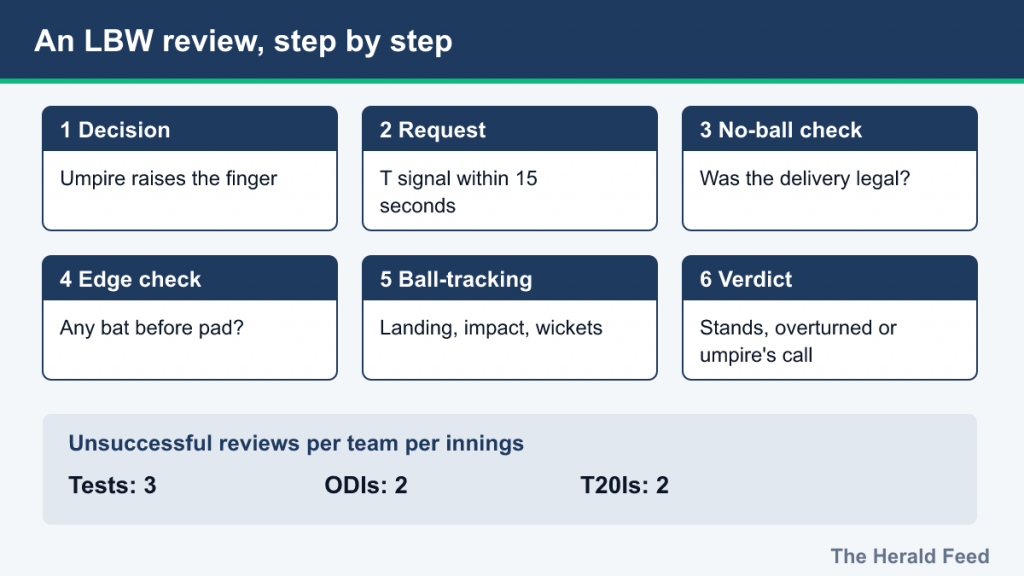
- The decision. A right-handed batter is struck on the pad, the bowler appeals and the umpire raises the finger.
- The request. The batter glances at the non-striker, then signals a T inside the 15-second window.
- Legal delivery check. The third umpire first confirms that the delivery was not a no-ball. If it was, the batter is reprieved immediately and the batting side receives the no-ball penalty.
- Edge check. Replays and edge detection look for any contact with the bat before the pad. A clear inside edge means not out, whatever ball-tracking says.
- Ball-tracking. If there is no edge, the projection shows where the ball pitched, where it struck the pad and whether it would have hit the stumps.
- The verdict. If all three components clearly favour the bowler, the decision stands and the batter’s team loses a review. If any one clearly favours the batter — say the ball pitched outside leg — the decision is overturned. If the result is marginal, it is umpire’s call and the original out decision stands, but the review is retained.
The end of the soft signal
For several years, when an on-field umpire referred a low catch to the third umpire, they also had to give a “soft signal” of out or not out, which stood unless replays were conclusive. That requirement was scrapped from 1 June 2023, so the third umpire now judges such catches on the evidence without a pre-set starting point from the field.
Reviewing Tactics: When to Use DRS
With only a few unsuccessful reviews per innings, teams think carefully before using them.
For the batting side
- Trust your partner: the non-striker often has a better view of the line than the batter.
- Know what can’t be overturned: if the ball clearly pitched in line and hit you in front, reviewing on hope rarely works.
- Protect reviews for the top order: a team that wastes reviews early may have none left when a set batter gets a poor decision.
- Edges matter: if you are sure you hit the ball before the pad, reviewing an LBW is usually worthwhile.
For the fielding side
- Listen to the wicketkeeper on line, and to the bowler on how the ball behaved — but bowlers are notoriously optimistic.
- Beware height and bounce: deliveries that hit the pad high on a bouncy pitch often go over the stumps.
- Late in an innings: with a tail-ender batting and reviews in hand, captains may be more willing to gamble.
Common Myths About DRS
“If ball-tracking shows it hitting the stumps, it should be out”
Not if the hit is marginal and the umpire said not out. Umpire’s call deliberately leaves marginal predictions with the on-field official.
“A review is always lost if the decision isn’t overturned”
Not since 2017. If the outcome is umpire’s call, the reviewing team keeps its review.
“DRS is identical in every match”
The core rules are consistent across international cricket, but the exact technology available — for example, whether Hot Spot is used — can differ between series and broadcasters. Domestic competitions and leagues also set their own policies.
“Only the captain can review”
For a not-out decision, the fielding captain makes the request. For an out decision, the batter who has been given out can review, usually after a quick word with their partner.