How to Read a Cricket Scorecard
Learn to read a cricket scorecard: the batting card, dismissal notation, extras, fall of wickets, bowling figures, economy and Test match summaries.
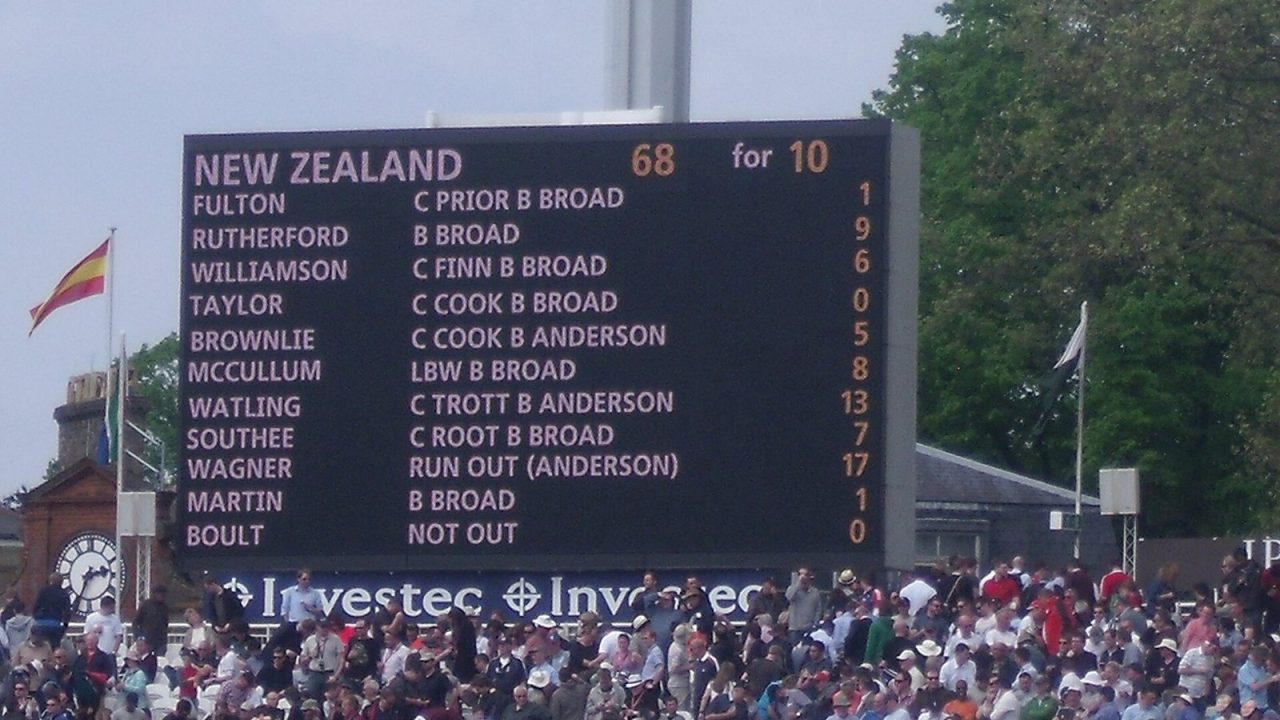
A cricket scorecard packs an entire innings into a small table. To the trained eye, it tells the story of a match: who built the innings, who collapsed, which bowler did the damage and how quickly the runs came. To a newcomer, it can look like a page of abbreviations and stray symbols.
This guide walks through a scorecard section by section, using a fictional example so you can see every element in context. If you are new to the game, our beginner’s guide to cricket rules explains runs, overs and wickets first.
The Batting Card
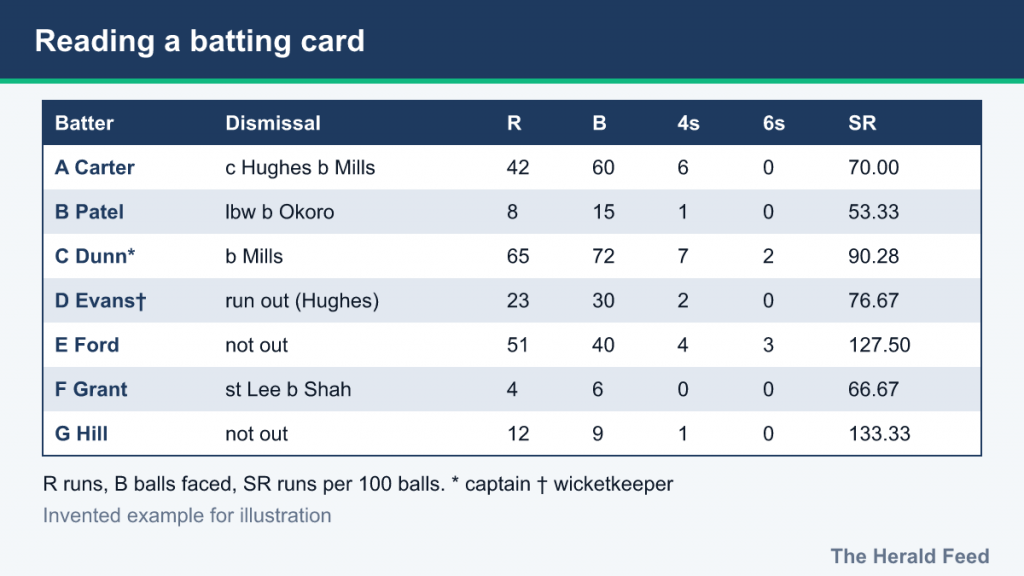
The top half of a scorecard is the batting card, listing each batter in the order they came in. The example below is invented for illustration — the players and numbers are not from a real match.
| Batter | Dismissal | R | B | 4s | 6s | SR |
|---|---|---|---|---|---|---|
| A Carter | c Hughes b Mills | 42 | 60 | 6 | 0 | 70.00 |
| B Patel | lbw b Okoro | 8 | 15 | 1 | 0 | 53.33 |
| C Dunn* | b Mills | 65 | 72 | 7 | 2 | 90.28 |
| D Evans† | run out (Hughes) | 23 | 30 | 2 | 0 | 76.67 |
| E Ford | not out | 51 | 40 | 4 | 3 | 127.50 |
| F Grant | st Lee b Shah | 4 | 6 | 0 | 0 | 66.67 |
| G Hill | not out | 12 | 9 | 1 | 0 | 133.33 |
The columns
- R — runs scored by the batter.
- B — balls faced. Wides do not count as balls faced.
- 4s and 6s — boundaries hit.
- SR — strike rate: runs per 100 balls faced, calculated as runs × 100 ÷ balls. A strike rate of 100 means a run a ball.
- Some scorecards add M, minutes batted, especially for Test matches.
Symbols next to names
Two symbols are near-universal on modern scorecards: an asterisk (*) next to a name marks the captain, and a dagger (†) marks the wicketkeeper. In our example, Dunn is captain and Evans keeps wicket. Be careful: in a player’s statistics, an asterisk after a score — 51* — means not out.
Reading the Dismissal Column
The dismissal column records how each batter got out, naming the fielder (if any) and the bowler credited with the wicket. The traditional notations are:
| Notation | Meaning |
|---|---|
| b Mills | Bowled by Mills |
| c Hughes b Mills | Caught by Hughes off the bowling of Mills |
| c & b Mills | Caught and bowled — Mills took the catch off their own bowling |
| c †Lee b Mills | Caught by the wicketkeeper (some scorecards write “c Lee” with a † elsewhere) |
| lbw b Okoro | Leg before wicket to Okoro |
| st Lee b Shah | Stumped by the keeper, Lee, off Shah |
| run out (Hughes) | Run out, with the fielder(s) involved in brackets; no bowler is credited |
| hit wicket b Mills | The batter broke their own stumps while playing at Mills |
| not out | Still batting when the innings ended |
| retired hurt | Left the field injured, not out |
The bowler’s name appears after “b” only when the bowler earns credit for the wicket — bowled, caught, LBW, stumped and hit wicket. Run outs, and rarer dismissals such as obstructing the field, are not credited to the bowler. Our guide to the LBW rule explains that dismissal in detail.
Batters listed below the last dismissed or not-out player with no entry are marked “did not bat” (DNB) — they were never needed.
Extras and the Total
Below the batting entries comes the extras line. Extras are runs not credited to any batter, and they are usually broken down by type:
- b — byes: runs taken when the ball misses bat and body;
- lb — leg byes: runs taken after the ball hits the batter’s body;
- w — wides;
- nb — no-balls;
- pen — penalty runs awarded by the umpires.
So “Extras (b 4, lb 6, w 7, nb 2) 19” means 19 extras in total. In our example, the batters scored 205, so with 19 extras the team total is 224.
The total line shows runs and wickets, plus the overs used: “Total 224/5 (50 overs)”. In most of the world, scores are written runs first — 224/5 or 224–5, “224 for 5”. In Australia, the convention is reversed: 5/224, “five for 224”. Both mean the same thing.
Fall of Wickets
Below the total, the fall of wickets (FoW) line records the team score each time a wicket fell, often with the batter’s name and the over:
FoW: 1-15 (Patel, 4.2 ov), 2-79 (Carter, 18.1 ov), 3-130 (Evans, 29.5 ov), 4-180 (Dunn, 40.3 ov), 5-195 (Grant, 43.6 ov)
Read “2-79” as “the second wicket fell with the score on 79”. The FoW line is how you spot partnerships and collapses. Here, the stand between the second and third wickets added 51; between the fourth and fifth wickets, the team lost two batters for 15 runs in about three overs. A cluster of wickets at similar scores — say, 4-180, 5-182, 6-185 — signals a collapse.
The Bowling Card
The bottom half lists each bowler from the fielding side:
| Bowler | O | M | R | W | Econ |
|---|---|---|---|---|---|
| Mills | 10 | 1 | 48 | 2 | 4.80 |
| Okoro | 10 | 0 | 39 | 1 | 3.90 |
| Shah | 10 | 0 | 51 | 1 | 5.10 |
Only three bowlers are shown here to keep the example short; a full 50-over innings needs at least five.
The columns
- O — overs bowled. A figure such as 7.3 means seven overs and three balls — not seven and a third overs in decimal terms.
- M — maidens: overs in which the bowler conceded no runs.
- R — runs conceded. Under the Laws, a bowler is charged with runs scored off the bat plus wides and no-balls; byes and leg byes are not charged to the bowler.
- W — wickets credited to the bowler.
- Econ — economy rate: runs conceded per over.
Bowling figures are often quoted as O-M-R-W: Mills’s spell would be written 10-1-48-2. In shorthand, a bowler’s figures are given as wickets and runs, such as 2/48 or “two for 48”. Scorecards may also list wides and no-balls bowled in extra columns.
Reading a Test Match Summary
Test matches have two innings per side, which produces summaries such as:
Team A 350 & 220/5d; Team B 280 & 150
Here is how to read it:
- & separates a team’s first and second innings.
- A number on its own, such as 350, means the team was all out for that score.
- 220/5d means the team declared its innings closed at 220 for 5. A “d” or “dec” marks a declaration.
- If the follow-on was enforced, Team B would have batted twice in a row, and the summary usually notes “f/o”.
In this example, Team A scored 570 runs in total and Team B 430, so Team A won by 140 runs. Had Team A won while batting last, the result would be expressed in wickets: “won by 6 wickets” means they reached the target with six wickets still standing. If Team A had won without needing to bat a second time, it would be “won by an innings and X runs”.
The Scorebook Behind the Scorecard
The printed or online scorecard is a summary. Behind it sits the scorebook, where official scorers record every delivery. Traditional scorebooks — known in the game as “the book” — keep a ball-by-ball record for each bowler and a running tally for each batter, and the scorers fill in an over analysis at the end of every over.
The ball-by-ball shorthand is worth knowing if you ever watch with a scorer or keep score at a club match:
- A dot marks a legal delivery with no runs and no wicket, which is what commentators mean by a “dot ball”.
- A number records runs scored off the bat.
- A W records a wicket.
- A wide is traditionally drawn as a cross, with dots in the corners for any extra runs taken.
- A no-ball is drawn as a circle, with any runs off the bat written inside.
- Byes are a triangle pointing up; leg byes the same triangle upside down.
A maiden is easy to spot in the book: a full over in which nothing is charged to the bowler — at most dots, and perhaps byes or leg byes, which do not count against them.
Common Mistakes When Reading a Scorecard
Confusing the two score formats
An Australian broadcast showing “3/150” and a British one showing “150/3” are describing exactly the same position. Check which number is bigger: runs are almost always the larger figure.
Reading overs as decimals
Twelve overs and three balls is written 12.3. It is not 12.3 overs in decimal terms; it is 12 overs plus three of the six balls in the thirteenth. That matters when you calculate run rates: 12.3 overs is really 12.5 overs of play.
Blaming bowlers for every extra
Byes and leg byes are counted in the extras but not charged to the bowler, so a bowler’s runs conceded column can be lower than the runs scored while they were on. Wides and no-balls, by contrast, are charged to the bowler.
Assuming the top scorer was the best performer
In limited-overs cricket, a quick 40 at a high strike rate can be worth more than a slow 60. Compare runs with balls faced before deciding who won the match for their side.
Useful Statistics Beyond the Scorecard
Career statistics are built from the same raw numbers:
- Batting average: runs divided by the number of times dismissed. Not-out innings add runs but not dismissals.
- Bowling average: runs conceded per wicket. Lower is better.
- Bowling strike rate: balls bowled per wicket. Lower is better.
- Economy rate: runs conceded per over — the key measure for white-ball bowlers.
Once you can read these numbers, the scorecard becomes a story you can follow at a glance.