The Rugby Championship Explained: From Tri Nations to Today
The Southern Hemisphere's Test competition: Tri Nations origins, Argentina's arrival in 2012, bonus points, trophies inside it and every winner through 2025.

The Rugby Championship is the Southern Hemisphere’s annual international competition, contested by New Zealand, South Africa, Australia and Argentina. It began life in 1996 as the Tri Nations, a product of rugby’s leap into professionalism, and became a four-team tournament when Argentina joined in 2012. If the Six Nations is the great tradition of northern rugby, the Rugby Championship is where the sport’s most successful World Cup nations test themselves against each other every year.
This guide covers the competition’s origins, format and bonus-point system, the historic trophies contested within it, the winners through 2025, and the changes scheduled for 2026 and beyond. For the northern equivalent, see our Six Nations explainer.
Origins: Professionalism and the Tri Nations
The Tri Nations was born in the same turbulent year that rugby union turned professional. In 1995, faced with the threat of rugby league’s Super League luring players away, the unions of South Africa, New Zealand and Australia formed SANZAR and signed a television deal with News Corporation. That deal funded two new competitions: a provincial tournament that became Super 12, and an annual international series between the three nations — the Tri Nations. Our article on the origins of rugby and the 1995 move to professionalism covers that background.
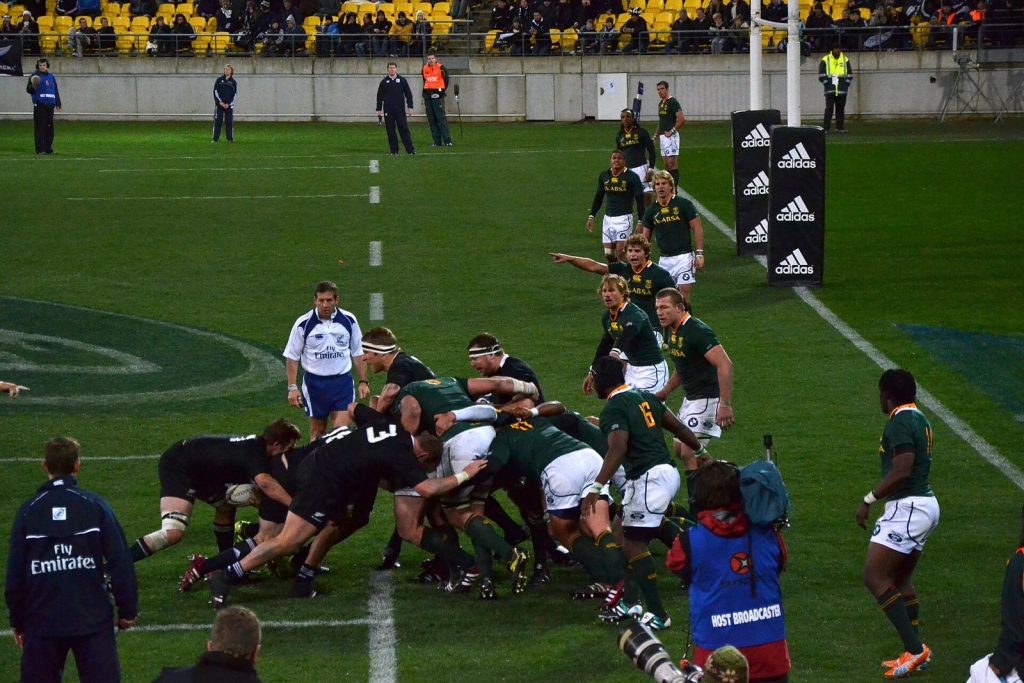
The first Tri Nations was played in 1996. For the next 16 years, the three teams contested it annually. New Zealand dominated, winning ten of the sixteen Tri Nations titles between 1996 and 2011, with South Africa and Australia winning three each.
Format changes in the Tri Nations era
- Initially, each team played the others twice, home and away.
- From 2006, the teams played each other three times, before returning to a shortened schedule in World Cup years such as 2007 and 2011.
Argentina Joins: The Rugby Championship (2012–)
For years Argentina were a strong international side without a regular annual competition against the top nations, relying instead on occasional tours and World Cups. Their entry into the southern competition was confirmed at a meeting in Buenos Aires on 23 November 2011. From 2012 the tournament became a four-team competition and was renamed The Rugby Championship.
Argentina’s inclusion gave the Pumas guaranteed top-level Tests every year, which had previously been impossible to schedule regularly. It has also changed the competition’s character, adding long-haul travel to and from South America for the other three teams.
How the Competition Works
Fixtures
In a standard year, each team plays the other three home and away — a double round-robin of six rounds per team. In Rugby World Cup years (2015, 2019 and 2023), a shortened single round was played to protect the international calendar. Between 2022 and 2025, the competition used “mini-tours,” with each nation hosting one opponent for both of their fixtures, reducing travel.
Points and bonus points
| Outcome | Points |
|---|---|
| Win | 4 |
| Draw | 2 |
| Loss | 0 |
| Try bonus | 1 — for scoring three or more tries more than the opponent (since 2016) |
| Losing bonus | 1 — for losing by seven points or fewer |
The try bonus has changed. Until 2015, a team earned a bonus point for scoring four or more tries, regardless of the opponent’s tally. Since 2016 the competition has used a “net try” bonus: a team gets the extra point only by scoring at least three tries more than its opponent. That means a high-scoring match where both sides score four tries yields no try bonus for either side, rewarding genuine dominance rather than shoot-outs.
A quick illustration with invented scores shows how this works. If Team A beats Team B by five tries to one, Team A has scored four more tries and takes five points (four for the win plus the try bonus). If Team A wins by five tries to three, the margin is only two tries, so it takes four points. If Team B loses that second match by, say, 31–26, it collects a losing bonus point for finishing within seven. Over a six-match campaign, those single points can easily decide the title, which is why teams that are already winning comfortably often keep attacking in the final minutes in search of one more try, and why trailing teams fight hard to stay within seven points even when victory has slipped away.
The team with most points at the end wins the title. Tiebreakers are applied if teams finish level.
The Trophies Within the Championship
Like the Six Nations, the Rugby Championship contains several bilateral trophies, some much older than the tournament itself.
- Bledisloe Cup (New Zealand v Australia): first contested in 1931 and one of the most famous trophies in the sport. New Zealand have held it for long stretches of its history, and matches against Australia within the Rugby Championship usually count towards it.
- Freedom Cup (New Zealand v South Africa): introduced in 2004, it is contested between the two most successful nations in Rugby World Cup history.
- Mandela Challenge Plate (Australia v South Africa): first contested in 2000, named after Nelson Mandela.
- Puma Trophy (Australia v Argentina): contested since 2000.
Because these trophies sit within the wider tournament, a single Test can decide a bilateral trophy and still be only one step in the championship race.
Winners, 1996–2025
Rugby Championship winners (2012–2025)
| Year | Winner |
|---|---|
| 2012 | New Zealand |
| 2013 | New Zealand |
| 2014 | New Zealand |
| 2015 | Australia |
| 2016 | New Zealand |
| 2017 | New Zealand |
| 2018 | New Zealand |
| 2019 | South Africa |
| 2020 | Tri Nations (New Zealand) |
| 2021 | New Zealand |
| 2022 | New Zealand |
| 2023 | New Zealand |
| 2024 | South Africa |
| 2025 | South Africa |
In 2020, during the COVID-19 pandemic, the competition was played as a Tri Nations featuring New Zealand, Australia and Argentina; New Zealand won it.
Titles overall
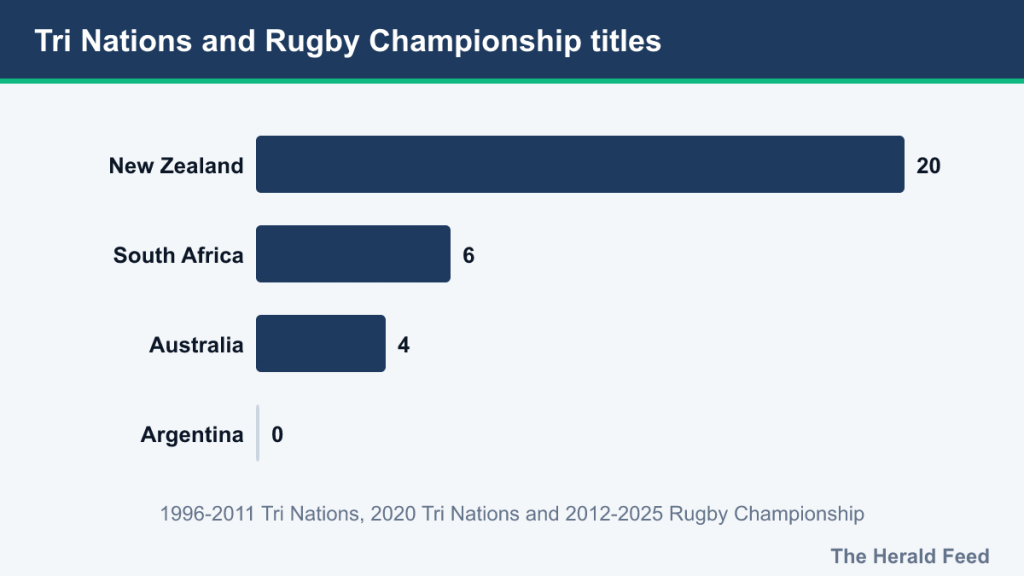
Counting the Tri Nations (1996–2011), the 2020 Tri Nations and the Rugby Championship through 2025:
- New Zealand: 20 titles
- South Africa: 6 titles
- Australia: 4 titles
- Argentina: yet to win the title
South Africa’s back-to-back titles in 2024 and 2025 came on the back of their Rugby World Cup wins in 2019 and 2023, while New Zealand’s long dominance — including three straight titles from 2021 to 2023 — remains the competition’s defining story. Our guide to how the Rugby World Cup works lists those World Cup results.
What Changes in 2026 and Beyond
The competition is not following its usual pattern every year. According to published plans:
- No Rugby Championship in 2026: instead, New Zealand tour South Africa for a series that includes four Tests, and Australia tour Argentina for two Tests.
- 2027–2029: the Rugby Championship is due to return in its usual format, with the mini-tour approach expected to continue in 2027.
- 2030: no tournament is planned.
Calendars in international rugby are subject to change, so check the national unions’ announcements for the latest schedule.
Rugby Championship vs Six Nations
Fans often compare the two great annual international competitions. They share a purpose but differ in several ways.
| Rugby Championship | Six Nations | |
|---|---|---|
| Teams | 4 (NZ, SA, Australia, Argentina) | 6 (England, France, Ireland, Italy, Scotland, Wales) |
| Fixtures in a standard year | Double round-robin: each team plays the others home and away | Single round-robin: each team plays the others once |
| Time of year | Southern Hemisphere winter and spring | February to March |
| Try bonus | Net three tries more than the opponent | Four tries or more |
| Clean-sweep bonus | None | 3 extra points for a Grand Slam |
| Losing bonus | Lose by seven or fewer | Lose by seven or fewer |
| Founded | 1996 (as Tri Nations) | Home Nations Championship first played in 1883; six teams since Italy joined in 2000 |
Because Rugby Championship teams meet each other twice in a normal year, a heavy defeat can be avenged within weeks — and home advantage in the return fixture often matters. The longer travel distances, especially to and from Argentina and South Africa, are another factor that has no real equivalent in the Six Nations.
What to Watch For Each Season
- Bonus points: with the net-try rule, a team that wins comfortably but not overwhelmingly may finish behind a rival that crushed someone. Keep an eye on try differentials.
- Away wins: winning on the road — at altitude in South Africa, in New Zealand or in Argentina — is where titles are usually decided.
- The trophy subplots: a team out of the title race can still be playing for the Bledisloe Cup, Freedom Cup or Mandela Challenge Plate, which keeps late-tournament matches meaningful.
- Selection experiments: in the years before a Rugby World Cup, coaches often give new players their first exposure to elite opposition here.
Why It Matters
- The highest level of regular competition: the four teams include every Southern Hemisphere World Cup winner, so annual meetings are among the toughest Tests in the sport.
- Testing ground before World Cups: coaches use the competition to settle combinations and try tactics against elite opponents.
- Old rivalries in new structures: the Bledisloe Cup and the All Blacks–Springboks rivalry predate the tournament by decades, and the Championship gives them a regular stage.
- Growth for Argentina: regular top-tier fixtures have helped the Pumas compete with the best.
FAQ
When did Argentina join?
Argentina first played in 2012, when the Tri Nations became The Rugby Championship.
Who has won the most titles?
New Zealand, with 20 titles across the Tri Nations and Rugby Championship eras through 2025.
How does the try bonus point work now?
Since 2016, a team earns it by scoring at least three tries more than its opponent in a match.