The Six Nations Championship Explained
How rugby's Six Nations works: its history from 1883, the bonus-point system, Grand Slam, Triple Crown, Wooden Spoon, rivalry trophies and winners through 2026.
For six weekends every late winter, the Six Nations Championship takes over the rugby calendar in Europe. England, France, Ireland, Italy, Scotland and Wales play each other once, and the result is a compact, high-stakes tournament full of old rivalries, packed stadiums and a remarkable number of trophies.
This guide explains how the championship began, how the table works, what the Grand Slam, Triple Crown and Wooden Spoon mean, and the many smaller trophies contested inside it. If you are new to the sport, start with our beginner’s guide to rugby union rules.
From Home Nations to Six Nations
The championship is one of the oldest international competitions in any team sport. It was first played in 1883 as the Home Nations Championship between England, Ireland, Scotland and Wales. England were left out of the 1888 and 1889 tournaments after refusing to join the International Rugby Football Board, a reminder that the early years of international rugby were shaped by arguments over who made the rules.
France joined in 1910, creating the Five Nations. The tournament reverted to a Home Nations format for the 1932–1939 editions without France, and the Five Nations resumed after the Second World War.
Italy joined in 2000, and the competition became the Six Nations. It has kept that line-up ever since. Separate Women’s and Under-20 Six Nations competitions are played alongside the men’s tournament.
How the Format Works
Each team plays the other five once, so every nation has either two or three home matches in a given year. The five rounds run from early February to the second Saturday in March. There are no play-offs: the team at the top of the table after round five is champion.
Points and bonus points
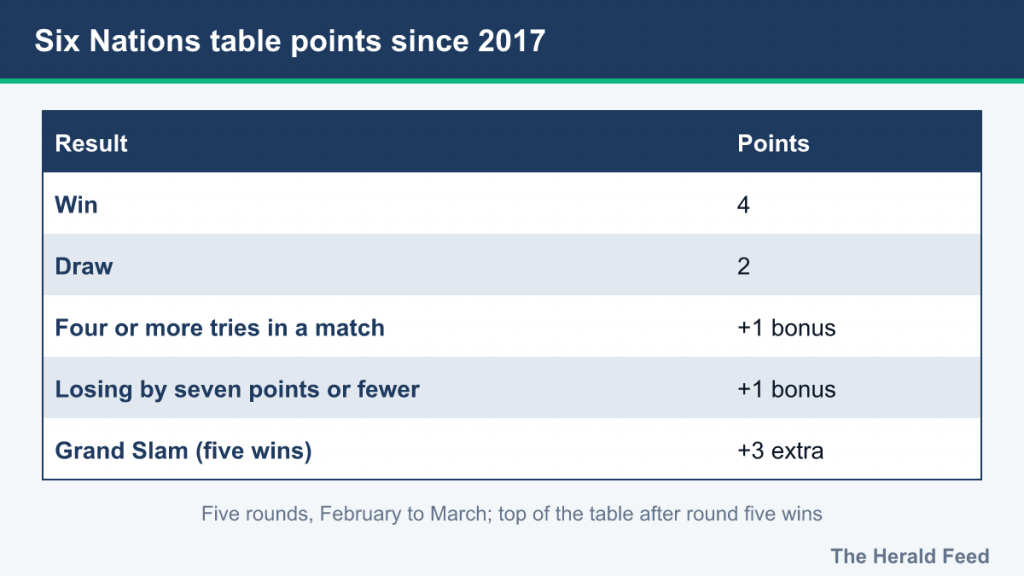
Until 2016, the table used two points for a win and one for a draw. Since 2017, the Six Nations has used a bonus-point system:
- 4 points for a win;
- 2 points for a draw;
- 1 bonus point for scoring four or more tries in a match;
- 1 bonus point for losing by seven points or fewer;
- 3 extra points for a Grand Slam.
The Grand Slam bonus exists for a specific reason. Without it, a team could in theory win all five games and still finish below a side that lost once but collected more bonus points. The three extra points guarantee that a Grand Slam always wins the title.
Tiebreakers
Before 1994, teams level on points shared the championship. Since then, ties are broken by points difference; if that is level too, the team that scored more tries wins. Only if both are equal is the title shared.
The Grand Slam, Triple Crown and Wooden Spoon
Grand Slam
A Grand Slam means winning all five matches. It is the most prestigious achievement in the championship and remains relatively rare: in the Six Nations era (2000–2026), France and Wales have won four each, Ireland three and England two. Scotland and Italy have yet to win one. The Six Nations-era Grand Slams were won by France in 2002, 2004, 2010 and 2022; Wales in 2005, 2008, 2012 and 2019; Ireland in 2009, 2018 and 2023; and England in 2003 and 2016. No team has completed one since Ireland in 2023.
Triple Crown
The Triple Crown is contested only by the four Home Nations. A team that beats the other three — England, Ireland, Scotland or Wales — in the same championship wins it, regardless of results against France and Italy. A dedicated Triple Crown trophy has been presented since 2006. In 2026, Ireland won their 15th Triple Crown.
Wooden Spoon
The Wooden Spoon is an informal, unwanted “award” for the team finishing last. No physical trophy is presented. Italy have finished bottom more often than anyone in the Six Nations era, but the Spoon has moved around: in 2026, Wales finished sixth in the table.
The Trophies Within the Trophy
One of the Six Nations’ charms is the number of individual rivalry trophies contested during the tournament. They are awarded to the winner of a specific fixture:
| Trophy | Contested by | First awarded |
|---|---|---|
| Calcutta Cup | England v Scotland | 1879 |
| Millennium Trophy | England v Ireland | 1988 |
| Centenary Quaich | Ireland v Scotland | 1989 |
| Giuseppe Garibaldi Trophy | France v Italy | 2007 |
| Auld Alliance Trophy | France v Scotland | 2018 |
| Doddie Weir Cup | Scotland v Wales | 2018 |
| Cuttitta Cup | Scotland v Italy | 2022 |
| Solidarity Trophy | Ireland v France | 2026 |
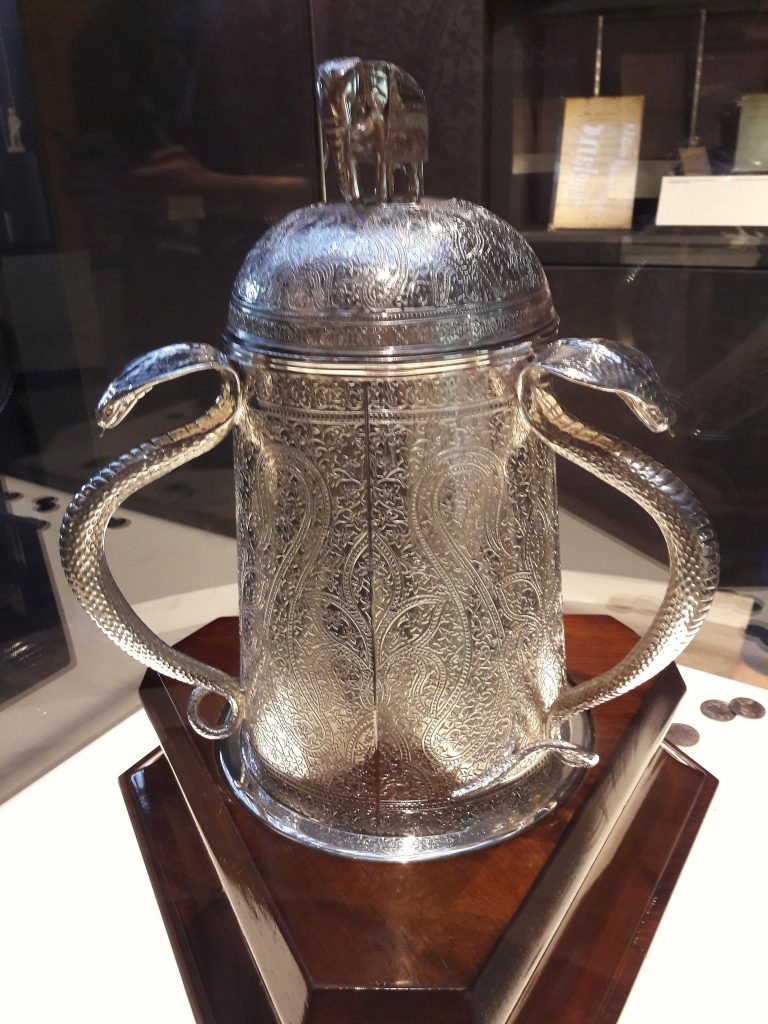
The Calcutta Cup is the oldest, predating the championship itself. The Doddie Weir Cup is named after the former Scotland lock, who was diagnosed with motor neurone disease in 2016 and died in 2022; it was created to raise awareness of the illness and first contested in November 2018, when Wales beat Scotland 21–10 in Cardiff.
The championship trophy itself has a shorter history than the competition. The original was first presented to France in 1993; a new design was introduced in 2015. That trophy was damaged by fire in 2026, so the 2026 champions received a replica, with a new trophy planned for 2027.
Six Nations Champions, 2000–2026
| Year | Champion | Year | Champion |
|---|---|---|---|
| 2000 | England | 2014 | Ireland |
| 2001 | England | 2015 | Ireland |
| 2002 | France | 2016 | England |
| 2003 | England | 2017 | England |
| 2004 | France | 2018 | Ireland |
| 2005 | Wales | 2019 | Wales |
| 2006 | France | 2020 | England |
| 2007 | France | 2021 | Wales |
| 2008 | Wales | 2022 | France |
| 2009 | Ireland | 2023 | Ireland |
| 2010 | France | 2024 | Ireland |
| 2011 | England | 2025 | France |
| 2012 | Wales | 2026 | France |
| 2013 | Wales |
Through 2026, that gives France eight Six Nations titles, England seven, and Ireland and Wales six each. Scotland and Italy have not yet won the Six Nations, although Scotland won titles in the Home and Five Nations eras.
The 2026 championship went down to the last kick. France beat England 48–46 in the final match with a last-kick penalty from Thomas Ramos to retain their title, finishing on 21 points to Ireland’s 19. Across the full history of the championship, including shared titles, England and Wales lead with 39 titles each.
The All-Time Record
Because the championship stretches back to 1883, the all-time table looks quite different from the Six Nations era alone. Before 1994, teams level on points shared the title, so a number of championships ended with joint winners. Counting outright and shared titles together, the totals stand as follows:
| Nation | Titles (incl. shared) | Outright titles | Grand Slams |
|---|---|---|---|
| England | 39 | 29 | 13 |
| Wales | 39 | 28 | 12 |
| France | 28 | 20 | 10 |
| Ireland | 24 | 16 | 4 |
| Scotland | 22 | 14 | 3 |
| Italy | 0 | 0 | 0 |
France’s 2026 success took them to 20 outright titles. Wales sit level with England on total titles thanks largely to their successes in earlier eras, while all of Scotland’s titles date from before Italy’s arrival in 2000. A Grand Slam has always meant beating every other team in the same season: four wins in the Five Nations era, five since Italy joined.
Italy’s record shows how hard it is for a newcomer to break into a long-established competition. They have finished last more often than any other team since joining, and they are still waiting for a first title and a first Grand Slam. Their rivalry trophies with France and Scotland give them annual targets beyond the overall table.
Why the Six Nations Matters
The Six Nations is more than a warm-up for the Rugby World Cup. For the nations involved it is an annual measure of standing, a source of fierce local rivalries and a major part of their unions’ finances. Fixtures such as England against Scotland for the Calcutta Cup or France against Ireland carry their own weight whatever the table says.
The format also makes every match count. With only five games, a single defeat can end a Grand Slam bid, and bonus points and points difference often decide the title on the final weekend. In 2026, France and Ireland both won four matches, and the title was settled by the final kick of the championship.
The arithmetic behind the Grand Slam bonus is neat. A Grand Slam team collects at least 23 points: 20 for five wins plus the three-point bonus. The best any team with a defeat can do is 22 — four wins with try bonuses (20) plus two bonus points from a narrow, four-try loss. So the bonus of three is exactly enough to make a Grand Slam unbeatable.
Common Questions
Can a team win the title after losing a match?
Yes — most champions do. Only a Grand Slam winner goes unbeaten. France won in 2026 despite not winning all five games.
Why is it called a Triple Crown when there are six teams?
The Triple Crown dates from the Home Nations era and only involves England, Ireland, Scotland and Wales. Matches against France and Italy do not count.
Is there a southern hemisphere equivalent?
The closest equivalent is the Rugby Championship, contested by Argentina, Australia, New Zealand and South Africa. Unlike the Six Nations, it is played in the southern hemisphere’s winter and spring, and the teams travel much greater distances between matches.
Does Italy play for any trophies?
Yes. Italy contest the Giuseppe Garibaldi Trophy against France and the Cuttitta Cup against Scotland.