How the Rugby World Cup Works: Format, Qualifying and History
How the men's Rugby World Cup works: qualifying, pools and knockouts, the Webb Ellis Cup, every winner since 1987 and the new 24-team format for 2027.

Every four years, the Rugby World Cup becomes the centre of the union calendar. National teams that play only a handful of Tests a year against each other meet in a single tournament, and the winner lifts the Webb Ellis Cup. The competition has produced some of the sport’s most famous moments, from South Africa’s 1995 victory on home soil to Jonny Wilkinson’s extra-time drop goal in 2003.
This guide explains how the men’s tournament works: how teams qualify, how the pool stage and knockouts are structured, who has won it, and what changes at the 2027 edition in Australia, the first with 24 teams.
A Short History
The first Rugby World Cup was played in 1987, co-hosted by New Zealand and Australia, with 16 teams. It was organised before union turned professional, at a time when international rugby consisted mainly of tours and the Five Nations Championship in Europe. New Zealand won the inaugural final, beating France 29–9 at Eden Park.
The tournament grew quickly in size and importance. It kept 16 teams through 1995, expanded to 20 teams in 1999, and stayed at 20 until 2023. Union itself became openly professional in August 1995, two months after the third tournament ended.
Hosts through the years
- 1987 — New Zealand and Australia
- 1991 — England
- 1995 — South Africa
- 1999 — Wales
- 2003 — Australia
- 2007 — France
- 2011 — New Zealand
- 2015 — England
- 2019 — Japan
- 2023 — France
- 2027 — Australia
- 2031 — United States
Some tournaments have shared matches with neighbouring unions; the list shows the lead host. Japan in 2019 took the tournament to Asia, and the 2031 edition will be the first held in North America.
Every Final and Winner
| Year | Winner | Score | Runner-up |
|---|---|---|---|
| 1987 | New Zealand | 29–9 | France |
| 1991 | Australia | 12–6 | England |
| 1995 | South Africa | 15–12 (aet) | New Zealand |
| 1999 | Australia | 35–12 | France |
| 2003 | England | 20–17 (aet) | Australia |
| 2007 | South Africa | 15–6 | England |
| 2011 | New Zealand | 8–7 | France |
| 2015 | New Zealand | 34–17 | Australia |
| 2019 | South Africa | 32–12 | England |
| 2023 | South Africa | 12–11 | New Zealand |
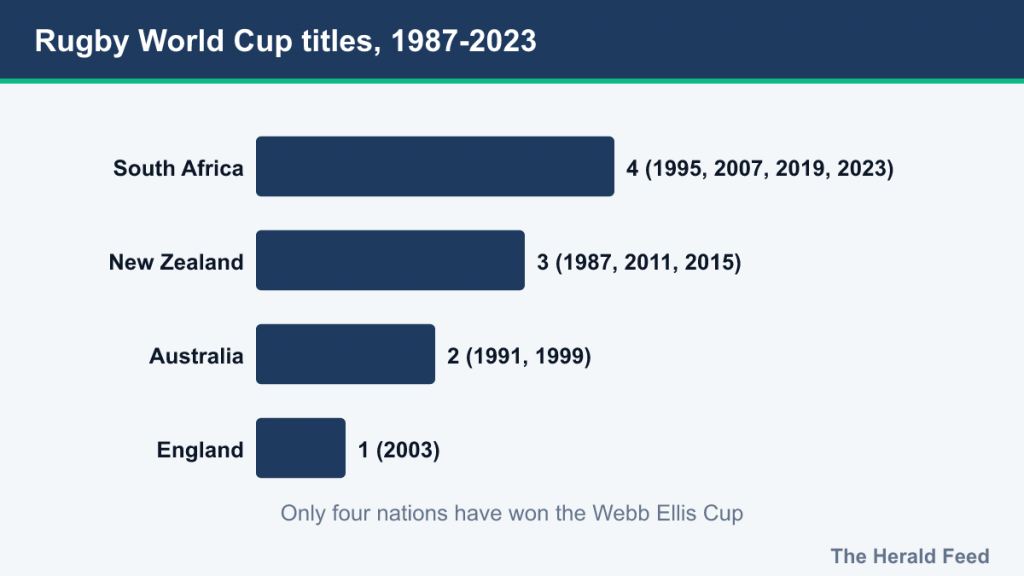
Through 2023, South Africa have the most titles with four (1995, 2007, 2019 and 2023), followed by New Zealand with three (1987, 2011, 2015), Australia with two (1991, 1999) and England with one (2003). Only those four nations have won the tournament. South Africa’s 2023 win, a one-point victory over New Zealand at the Stade de France, made them the second team after New Zealand to retain the trophy.
Two finals have gone to extra time. In 1995, South Africa beat New Zealand 15–12 in Johannesburg; in 2003, England beat Australia 20–17 in Sydney. The closest finals have been decided by single points: 2011 (8–7) and 2023 (12–11).
The Webb Ellis Cup
The trophy is named after William Webb Ellis, the Rugby School pupil credited by legend with first picking up the ball and running with it in the 1820s — a story most historians treat as myth rather than documented fact. The cup itself is older than the tournament. It was made in 1906 by Garrard’s, the crown jewellers, and was chosen as the World Cup trophy in 1987. It is silver, gilded in gold, and stands about 38 cm tall. In Australia it has acquired the affectionate nickname “Bill”.
How Qualifying Works
Qualifying rewards performance at the previous tournament. For 2027, twelve teams qualified automatically by finishing in the top three of their pool at the 2023 World Cup: France, New Zealand, Italy, Ireland, South Africa, Scotland, Wales, Fiji, Australia, England, Argentina and Japan.
The remaining twelve places were filled through regional qualifying competitions in Europe, Africa, Asia, the Americas and Oceania, plus play-offs between regions. The last place went to a four-team final qualification tournament involving Belgium, Namibia, Samoa and Brazil, which Samoa won. The full list of qualifiers through the regional route was Georgia, Spain, Romania, Portugal, Tonga, Canada, the United States, Uruguay, Chile, Samoa, Zimbabwe and Hong Kong China.
This system means that the established nations are almost guaranteed a place, while emerging nations have a long road through regional events. It also gives every tier-two union a meaningful competitive target in the years between tournaments.
The Tournament Format
The pool stage
Teams are drawn into pools, and each team plays every other team in its pool once. Results earn competition points:
- 4 points for a win;
- 2 points for a draw;
- 1 try bonus point for scoring four or more tries, win or lose;
- 1 losing bonus point for losing by seven points or fewer.
Bonus points mean a team can earn up to five points from a win, and a narrow loss with four tries can be worth two. In tight pools, these points often decide who goes through.
From 1999 to 2023, the 20 teams were split into four pools of five, with the top two in each pool reaching the quarter-finals. In 2023, for example, that meant pools A to D with ten matches each.
The knockouts
Knockout matches are single games. If the scores are level at full time, the match goes to extra time, and then to a sudden-death period if needed. Losing semi-finalists play a bronze-medal match the week before the final.
What Changes in 2027
The 2027 tournament in Australia is the first with 24 teams, and World Rugby has redesigned the format around them:
- Six pools of four teams (A to F), so each team plays three pool matches rather than four.
- The top two in each pool plus the four best third-placed teams advance.
- A new round of 16, followed by quarter-finals, semi-finals, the bronze final and the final.
- 52 matches in total, up from 48 in 2023, played over 43 days.
- A guaranteed minimum of five days’ rest between matches for every team.
Third-placed teams are ranked across all six pools, first by competition points. In the round of 16, the winners of Pools A to D face third-placed teams, while the winners of Pools E and F meet runners-up.
Dates, venues and pools
The tournament runs from 1 October to 13 November 2027. Australia open the event at Perth Stadium, and the final is at Stadium Australia in Sydney. Host cities include Adelaide, Brisbane, Melbourne, Newcastle, Perth, Sydney and Townsville. The pool draw was held in Sydney in December 2025. Teams were divided into four bands of six according to the men’s world rankings, with one team from each band going into each pool, so that the strongest sides were kept apart. As hosts, Australia were placed in Pool A in advance. The result:
| Pool | Teams |
|---|---|
| A | New Zealand, Australia, Chile, Hong Kong China |
| B | South Africa, Italy, Georgia, Romania |
| C | Argentina, Fiji, Spain, Canada |
| D | Ireland, Scotland, Uruguay, Portugal |
| E | France, Japan, United States, Samoa |
| F | England, Wales, Tonga, Zimbabwe |
The expansion is designed to give more nations a place on the biggest stage, while the smaller pools mean fewer heavily one-sided pool matches per team. The round of 16 adds an extra knockout weekend, so the eventual champion will need to win four knockout games instead of three.
Why the World Cup Matters So Much
Union has no global league for national teams, so the World Cup is the one moment when nearly every major nation is measured against the others in the same competition. It shapes coaching cycles — many national coaches are appointed and judged on four-year World Cup terms — and it drives the sport’s finances and growth in new markets.
It also creates moments that reach well beyond rugby. South Africa’s 1995 win at Ellis Park in Johannesburg, decided by Joel Stransky’s extra-time drop goal, ended with President Nelson Mandela, wearing a number 6 Springbok shirt, presenting the trophy to captain François Pienaar — an image remembered as a landmark of the country’s post-apartheid era. Eight years later, Jonny Wilkinson’s drop goal in the final minute of extra time at Stadium Australia gave England their only title so far.
Common Questions
Can a team lose in the pool stage and still win the tournament?
Yes, and 2023 proved it. Both finalists lost a pool match: New Zealand were beaten 27–13 by France in the opening game, and South Africa lost 13–8 to Ireland. Both still reached the knockouts and met in the final. Bonus points and points difference often matter more than an unbeaten record.
Why is it held every four years?
The four-year cycle gives national teams time to build squads through annual competitions such as the Six Nations and the Rugby Championship, and summer and autumn Test windows. It also follows the same rhythm as many other global sporting events, so each edition feels like a genuine occasion rather than a routine fixture.
What happens if a knockout match is drawn?
The match goes to extra time. If it is still level, a sudden-death period follows, in which the next score wins. Two finals, 1995 and 2003, were settled in extra time by drop goals.
Does the host nation qualify automatically?
For 2027, Australia were already through by finishing in the top three of their 2023 pool, but they were placed in Pool A as hosts and play the opening match in Perth. Hosting brings home crowds and a favourable schedule, though home advantage has produced only a handful of champions.
The women’s Rugby World Cup is a separate tournament with its own history and champions. For differences between rugby’s codes — the Rugby League World Cup is an entirely separate competition too — see our guide to rugby union vs rugby league.