The Origins of Rugby: William Webb Ellis, the RFU and the 1895 Split
From the Webb Ellis legend at Rugby School to the RFU in 1871, the 1895 Northern Union breakaway and union turning professional in 1995.
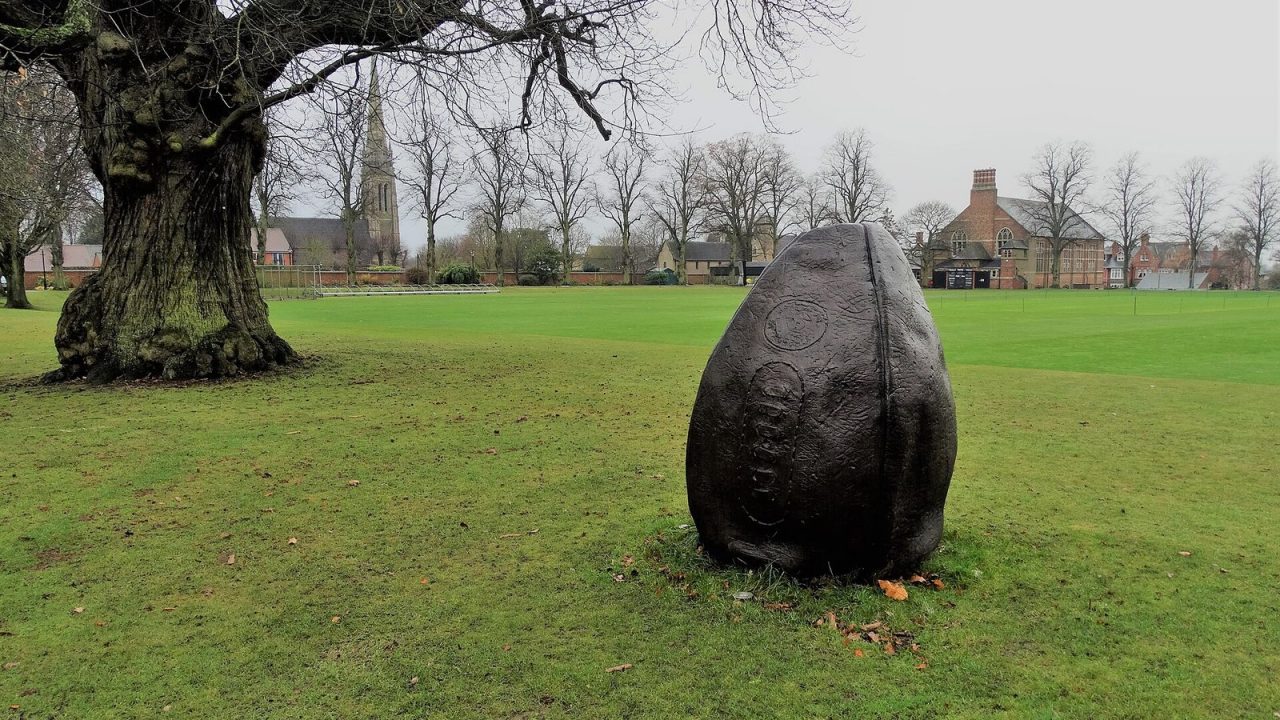
Every Rugby World Cup winner lifts a trophy named after a schoolboy who, according to legend, picked up a football and ran with it in 1823. It is a wonderful story. It is also one that most historians treat with deep suspicion. The real origins of rugby are less tidy: a school game that evolved over decades, a governing body formed in a London restaurant, a bitter dispute over money that split the sport in two, and, a century later, the end of amateurism. This article walks through each chapter, sticking to dates that can be verified and flagging where legend takes over from evidence.
Football at Rugby School
Rugby takes its name from Rugby School in Warwickshire, England. Like many English public schools in the late 18th and early 19th centuries, Rugby had its own version of “football,” and it was well established there by the early 1800s. Each school’s game had its own customs: some favoured kicking and dribbling, others allowed the ball to be handled.
These games were not codified in any modern sense. Rules were passed down by tradition and argued over by the boys themselves. The decisive step came in 1845, when three Rugby pupils produced the first written set of rules for the school’s game. Written rules mattered because they could be carried elsewhere: as Rugby old boys went on to universities, the army, the church and the professions, they took the game with them.
The Webb Ellis Legend
William Webb Ellis was born on 24 November 1806 in Salford, Lancashire, attended Rugby School, and later became an Anglican clergyman. He died on 24 February 1872 in Menton in the south of France.
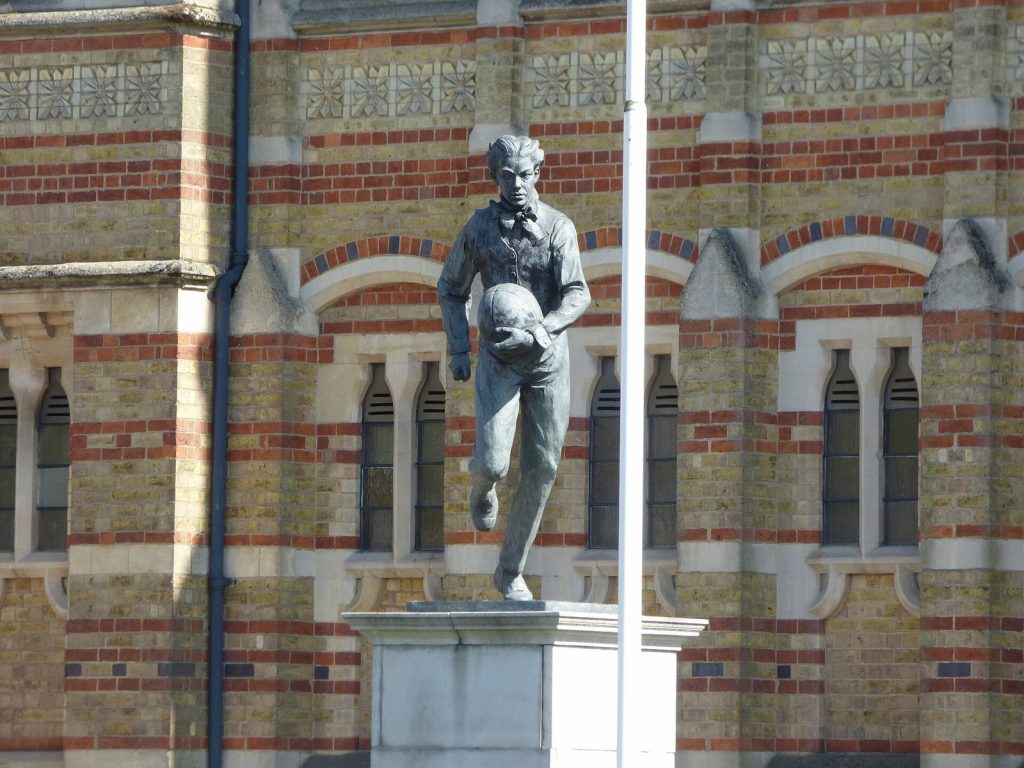
The story that made him famous did not appear until long after he had left the school — and after he had died. In 1876, a former Rugby pupil named Matthew Bloxam wrote to The Meteor, the school magazine, claiming that the change to a running game had come from a boy named Ellis. In a further letter in December 1880, Bloxam gave the fuller version: that in the latter half of 1823 Webb Ellis caught the ball in his arms and ran forward with it, at a time when the rules allowed a catch but expected the catcher to move backwards, not forwards.
The 1895 investigation
In 1895 the Old Rugbeian Society set up a sub-committee to look into the origins of the game. Its report, published in 1897, supported Bloxam’s account. In 1900 a plaque was installed at Rugby School crediting Webb Ellis with originating the distinctive feature of the rugby game in 1823.
Why historians doubt it
The Webb Ellis story is now widely regarded as an origin myth, for several reasons:
- Late evidence: Bloxam’s accounts were written more than 50 years after the supposed event, and no account from 1823 itself has been produced.
- No support from later pupils: Thomas Hughes, the Rugby old boy best known as the author of Tom Brown’s School Days, said that the Webb Ellis story had not survived into his own time at the school.
- Gradual change: running with the ball appears to have developed gradually; other boys, such as Jem Mackie, have been suggested as early exponents.
- Timing of the inquiry: the sociologists Dunning and Sheard argued that the 1895 investigation was bound up with the split that year between what became rugby union and rugby league — a moment when the school and its old boys had reason to assert ownership of the game’s identity.
None of this means Webb Ellis never ran with a ball; it means the evidence is too thin to treat his run as the moment rugby was invented. The legend has nonetheless been embraced. His grave in Menton was rediscovered in 1958 by Ross McWhirter and is now maintained by the French Rugby Federation, and the men’s Rugby World Cup trophy, first contested in 1987, is the Webb Ellis Cup. You can read more about that tournament in our guide to how the Rugby World Cup works.
The Rugby Football Union, 1871
By the 1860s, “football” clubs were springing up across England, playing a confusing variety of rules. In 1863 the Football Association was formed and adopted rules that excluded carrying the ball and hacking, which made the split between the dribbling and handling codes more explicit.
The handling clubs responded eight years later. On 26 January 1871, representatives of 21 clubs met at the Pall Mall Restaurant on Regent Street in London and founded the Rugby Football Union (RFU). The meeting had been prompted by a letter to The Times co-written by Edwin Ash, who became the first treasurer; Algernon Rutter was elected the first president. Three lawyers who were former Rugby School pupils — Rutter, Holmes and Maton — drafted the first laws, which were approved in June 1871.
The first international
The same year saw the first rugby international. On 27 March 1871, Scotland played England at Raeburn Place in Edinburgh, and Scotland won by a goal and a try to a try. It was the start of the oldest international fixture in the sport, and England and Scotland still meet every year in what is now the Six Nations.
An international board
As more nations played each other, disputes over the laws needed an arbiter. In 1886, Scotland, Ireland and Wales formed the International Rugby Football Board, the body known today as World Rugby. England, which had considered the RFU the sport’s natural authority, refused to join until 1890.
The 1895 Split: Broken Time and the Northern Union
Rugby’s great schism was about class and money. By the 1880s and 1890s, the game had become enormously popular in the industrial north of England, especially in Yorkshire and Lancashire. Many northern players were working men who lost wages when they took time off work to play or travel. Clubs wanted to compensate them for this “broken time.”
The RFU, dominated by southern, middle-class administrators, was committed to strict amateurism and refused. It moved to stamp out any form of payment, and tensions grew through the early 1890s.
The Huddersfield meeting
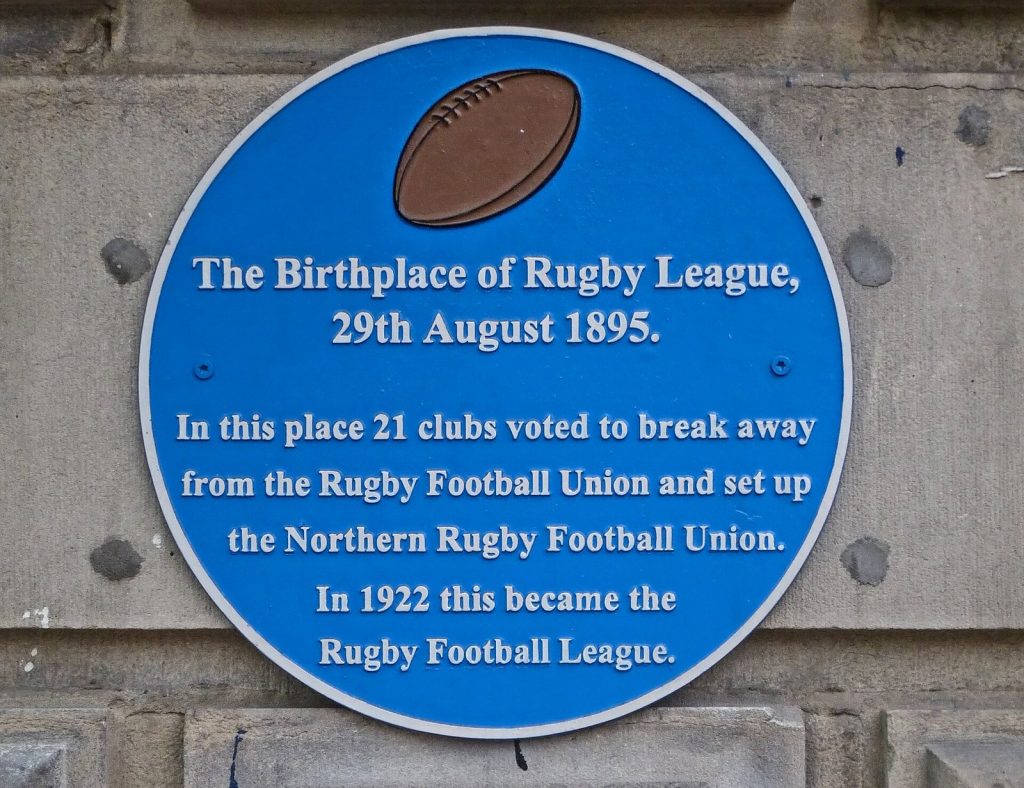
On 29 August 1895, representatives of northern clubs met at the George Hotel in Huddersfield and resigned from the RFU to form the Northern Rugby Football Union. Accounts differ slightly on the exact number of clubs at the meeting — sources give 20 or 22 — but the scale of the breakaway is clear. Within fifteen years, more than 200 clubs had left the RFU to join the new organisation.
From Northern Union to rugby league
At first the Northern Union played under essentially the same laws as the RFU. Over the following years it changed the game to make it faster and more attractive to paying spectators:
- 1897: the line-out was abolished.
- 1906: teams were reduced from 15 to 13 players, and the ruck after a tackle was replaced by the play-the-ball.
- 1922: the Northern Union was renamed the Rugby Football League.
The new code spread quickly. Breakaway movements in Australia and New Zealand adopted Northern Union rules in 1907 and 1908; the New South Wales Rugby Football League was founded in Sydney on 8 August 1907. Our guides to the differences between union and league and to rugby league rules explain how far the two codes have drifted apart since.
Amateurism, “Shamateurism” and 1995
For a century after the split, rugby union remained officially amateur. In practice, as the game grew into a global television sport, players at the top level increasingly received indirect benefits, a situation critics called “shamateurism.” The pressure came to a head in 1995:
- In Australia, the new Super League rugby league competition threatened to lure union players with large salaries.
- The national unions of South Africa, New Zealand and Australia formed SANZAR and agreed a deal with Rupert Murdoch’s News Corporation worth US$550 million over ten years for television rights, to fund a new provincial competition (which became Super 12) and an annual Tri Nations series.
- A rival venture, the World Rugby Corporation, tried to sign leading players for a professional global competition, and at one point had many All Blacks and Wallabies under contract before the plan collapsed.
On 26 August 1995, the International Rugby Board declared rugby union an “open” game, removing restrictions on payments to people connected with the sport. The board saw it as the only way to end shamateurism and keep control of the game. Exactly a hundred years after the Huddersfield meeting, the issue that had split rugby had been resolved in the direction the northern clubs had wanted.
Timeline at a Glance
| Year | Event |
|---|---|
| 1823 | Supposed date of Webb Ellis’s run (according to Bloxam, writing decades later) |
| 1845 | First written rules of football at Rugby School |
| 1871 | RFU founded (26 January); first international, Scotland v England (27 March) |
| 1886 | International Rugby Football Board formed |
| 1895 | Northern Rugby Football Union formed in Huddersfield (29 August) |
| 1897 | Old Rugbeian Society report backs Webb Ellis story |
| 1906 | Northern Union adopts 13-a-side and the play-the-ball |
| 1922 | Northern Union renamed Rugby Football League |
| 1987 | First Rugby World Cup; winners receive the Webb Ellis Cup |
| 1995 | Rugby union declared an open, professional game (26 August) |
Frequently Asked Questions
Did William Webb Ellis invent rugby?
Almost certainly not in any simple sense. The only evidence for his famous run comes from Bloxam’s letters written decades later, and the game at Rugby School evolved gradually. The legend is best understood as a story the game tells about itself.
Why did rugby split into union and league?
The immediate cause was “broken time” — compensation for working players who lost wages to play. The RFU insisted on strict amateurism; the northern clubs left in 1895 to form the Northern Union, which later developed its own laws and became rugby league.
When did rugby union become professional?
The International Rugby Board declared union an open game on 26 August 1995, ending a century of official amateurism.