A History of Test Cricket: From 1877 to the Modern Era
From the first Test in Melbourne in 1877 to twelve Test nations, the 2000th Test and day-night cricket: how the longest format grew and survived.
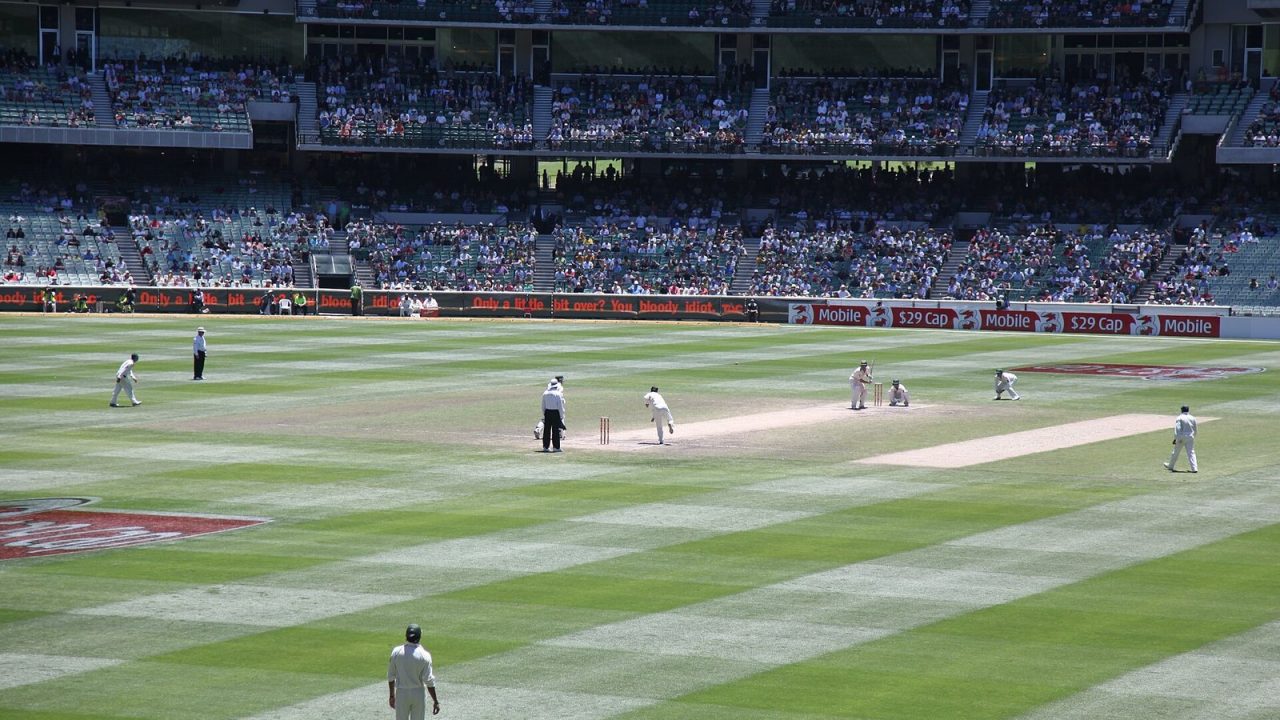
Test cricket is the oldest form of international cricket and, to many players, still the truest examination of skill, patience and temperament. A Test is played over as many as five days, each side bats twice, and a match can end in a win, a loss, a draw or, very rarely, a tie. The format has survived wars, political boycotts, the rise of one-day cricket and the explosion of T20 leagues. To understand why it still matters, it helps to see where it came from and how it grew.
This article traces the story of Test cricket from a single match in Melbourne in 1877 through the expansion to twelve Test-playing nations and into the modern era of day-night Tests and a world championship.
1877: the first Test in Melbourne
The first match now recognised as a Test began on 15 March 1877 at the Melbourne Cricket Ground, between Australia and England. Australia won by 45 runs. Neither side would have described the game as “Test match number one” at the time; the label was applied later, as cricket historians and administrators looked back and decided which matches between representative national sides deserved official status.
It is worth remembering how different that cricket was. There was no international governing body, no agreed calendar of fixtures and no neutral officials. Yet the match set the pattern that still defines the format: two national teams, two innings each, and no limit on overs.
England and Australia played regularly in the years that followed, and in 1882 Australia’s first win on English soil, at The Oval, prompted a mock obituary for English cricket in The Sporting Times. That story gave birth to the Ashes, the most famous rivalry in the game, which we cover in detail in our guide to the history of the Ashes.
How the family of Test nations grew
For its first twelve years, Test cricket was a two-team affair. Since then, the club has expanded slowly, with long gaps between new members. The dates below are the first Test played by each nation, as listed on Wikipedia’s Test cricket page.
| Nation | First Test |
|---|---|
| Australia | 15 March 1877 |
| England | 15 March 1877 |
| South Africa | 12 March 1889 |
| West Indies | 23 June 1928 |
| New Zealand | 10 January 1930 |
| India | 25 June 1932 |
| Pakistan | 16 October 1952 |
| Sri Lanka | 17 February 1982 |
| Zimbabwe | 18 October 1992 |
| Bangladesh | November 2000 |
| Ireland | 11 May 2018 |
| Afghanistan | 14 June 2018 |
Several patterns stand out. The first wave, England, Australia and South Africa, were also the three founding members of the Imperial Cricket Conference, created on 15 July 1909. That body was renamed the International Cricket Conference in 1965 and became the International Cricket Council (ICC) in 1989.
The second wave came between the two world wars. The West Indies, a combined team representing several Caribbean nations and territories, played their first Test in 1928. New Zealand followed in 1930 and India in 1932. Pakistan, formed after the partition of British India in 1947, played its first Test in 1952.
After that came a gap of three decades. Sri Lanka joined the Test ranks in 1982, Zimbabwe a decade later, and Bangladesh in 2000. The most recent additions arrived together: Ireland and Afghanistan were confirmed as Full Members of the ICC, with Test status, on 22 June 2017. Ireland played its first Test in May 2018, and Afghanistan made its Test debut a month later.
Timeless Tests and the five-day standard
Today we take the five-day Test for granted, but for decades the length of a match varied. Many early Tests were “timeless”, meaning they were played to a finish regardless of how many days that took. According to Wikipedia, 99 timeless Tests were played between 1877 and 1939: 91 in Australia, five in England, two in South Africa and one in the West Indies.
The most famous illustration of why that model was abandoned is the timeless Test at Durban in 1938–39, between South Africa and England. Despite being designed to be played to a finish, it was eventually abandoned without a result, which rather undermined the whole point of a match with no time limit. It was the last timeless Test.
The move to the modern standard was gradual. England first scheduled five-day Tests in 1948, and from 1950 nearly all Tests were scheduled for five days. In 1955 the ICC decided that members touring England would play five-day Tests. That five-day framework remains the norm, and it is the reason a draw is still a common and legitimate result. If you want a side-by-side look at how this compares with the shorter formats, see our explanation of Test, ODI and T20 cricket.
Isolation, suspension and politics
Test cricket has never been separate from the wider world, and two episodes show this clearly.
South Africa’s exclusion, 1970–1991
South Africa was suspended from international cricket in 1970 because of the country’s apartheid policies. The ban lasted for more than two decades. As apartheid was dismantled, the ICC readmitted South Africa in 1991, ending 22 years of isolation; Wikipedia notes that the readmission came at Nelson Mandela’s personal request. An entire generation of South African cricketers spent their careers without playing Test cricket, which is one reason statistical comparisons involving South African players from that era are so difficult.
Zimbabwe’s voluntary suspension
Zimbabwe, which entered Test cricket in 1992, voluntarily suspended its Test status in 2006 following a period of poor results and off-field turmoil. It returned to Test cricket after its status was reinstated in August 2011. The episode showed that Test status is not simply a badge; a nation also needs the depth of players and the domestic structure to compete over five days.
Landmarks along the way
Because Tests are numbered in sequence, cricket has a tidy way of marking milestones.
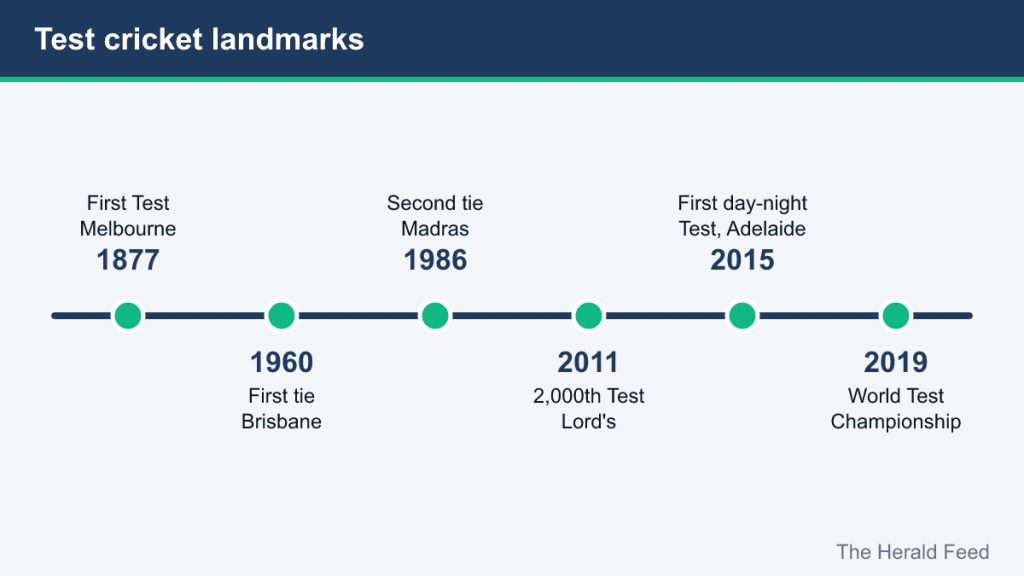
- The two ties. In well over 2,000 Tests, only two have ended in a tie, where the scores finished level with the side batting last all out. The first was West Indies v Australia at the Gabba in Brisbane in December 1960. The second was India v Australia at Chepauk in Madras (now Chennai) in September 1986. Two other Tests have finished with the scores level but are recorded as draws, because the side batting last was not bowled out.
- The 2000th Test. The 2,000th Test was played at Lord’s from 21 to 25 July 2011, between England and India. It was also the 100th Test between the two countries, and England won by 196 runs on the way to a 4–0 series victory.
- The first day-night Test. The ICC permitted day-night Test cricket in 2012, and the first was played between Australia and New Zealand at the Adelaide Oval in November 2015, using a pink ball that is easier to see under floodlights.
- The first world championship. The ICC World Test Championship began in 2019, giving bilateral series a shared points table for the first time. New Zealand won the first final, beating India by eight wickets.
What changed in the modern era
The last few decades have seen Test cricket transformed in style even though its basic structure is the same. Several shifts are worth understanding.
Scoring rates
Batters raised on one-day and T20 cricket bring attacking skills into the longer format. Shots once regarded as risky, such as reverse sweeps and ramps, now appear in Tests, and teams are more willing to chase targets aggressively in the fourth innings. Fewer matches drift into tame draws than in some earlier eras, though the draw has not disappeared.
Technology and officiating
Television replays, ball-tracking and edge-detection technology have changed how decisions are made. Players can now challenge certain umpiring decisions through a review system, which has reduced obvious errors and also changed tactics, especially around lbw appeals.
Competition for the calendar
The rise of franchise T20 leagues has created pressure on the international schedule. Some nations play relatively few Tests, and players sometimes have to choose between formats. Debates about how to protect Test cricket have included proposals for a two-division structure; in 2016 the ICC considered such a plan, but it was shelved after opposition from several member boards. The World Test Championship was, in part, an attempt to give every Test series wider context. Our guide to the World Test Championship explains how its points system works.
Why Test cricket endures
It is fair to ask why a format that can take five days and still end without a winner has lasted for nearly 150 years. Several qualities explain its staying power.
- Depth of contest. A Test tests everything: a batter’s ability to survive long spells, a bowler’s stamina and variety, a captain’s ability to read conditions as a pitch changes over five days.
- The draw as a weapon. In Tests, a team that cannot win can still save the match. Rearguard batting performances to secure a draw are among the most celebrated moments in the game’s history.
- Prestige. For most international players, Test caps remain the most valued, and a Test century or five-wicket haul at a famous ground carries special weight.
- Continuity. Because records go back to 1877, modern performances can be compared with those of earlier generations, which gives Test statistics a unique historical richness.
Common misconceptions about Test history
“The 1877 match was called a Test at the time”
Not in the modern, official sense. The status of early matches was recognised retrospectively, which is why there is occasionally debate about whether certain early fixtures should count.
“Every Test has always lasted five days”
As shown above, early Tests varied in length, and many were timeless. The five-day standard was only settled in the years after the Second World War.
“A tie and a draw with level scores are the same”
They are not. A tie requires the scores to be level when the side batting last has been bowled out (or the match has otherwise ended with all its innings complete). If time runs out with the scores level and wickets still in hand, the result is a draw. That distinction is why only two Tests in history are recorded as ties.
“Test status is permanent”
Zimbabwe’s voluntary suspension between 2006 and 2011 shows that a nation’s participation in Test cricket can change, and South Africa’s exclusion between 1970 and 1991 shows how politics can intervene.