The ICC World Test Championship Explained
How the ICC World Test Championship works: nine teams, two-year cycles, 12 points per win, percentage of points, the final, and every winner since 2021.
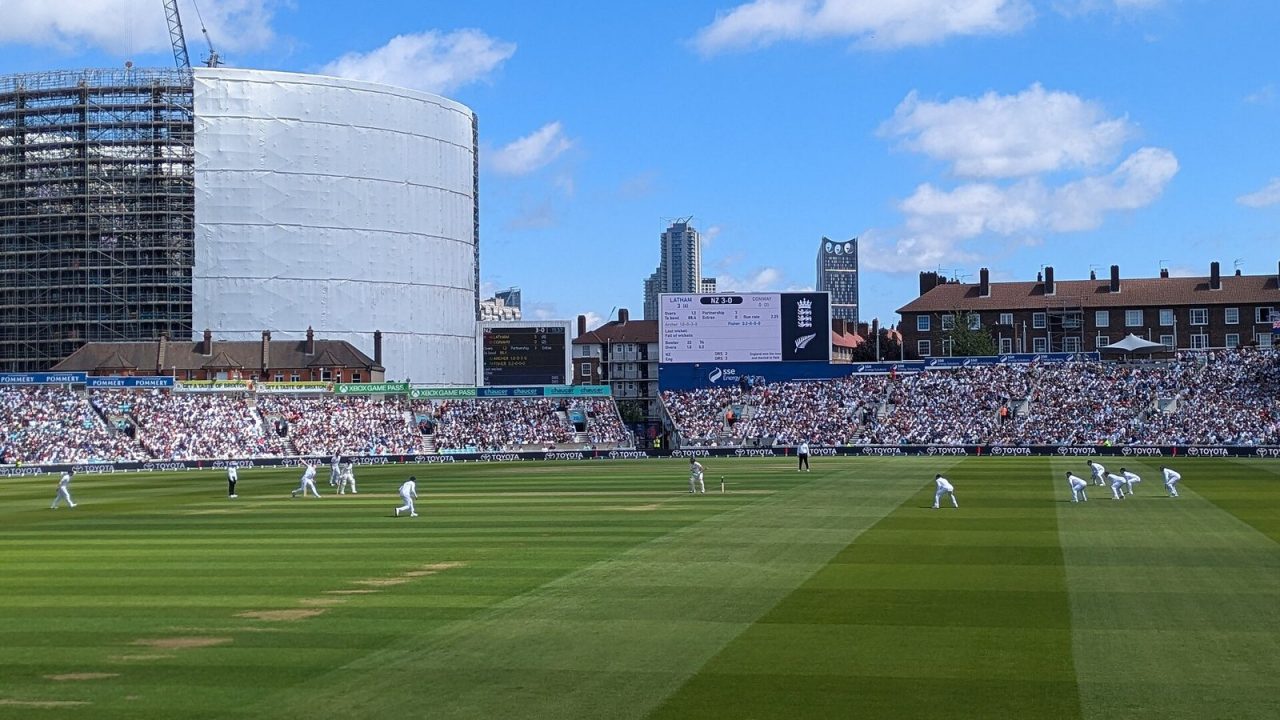
For most of its history, Test cricket had no overall champion. Teams played bilateral series — some famous, like the Ashes, others barely noticed outside the countries involved — and fans argued about who was really the best side in the world. The ICC World Test Championship (WTC) was created to give those series a shared context: every match in a two-year cycle earns points towards a league table, and the top two teams meet in a one-off final.
This guide explains how the WTC cycle works, how points and percentages are calculated, how finalists are decided, and who has won so far. For background on the longest format itself, see our guide to Test, ODI and T20 cricket.
The Basic Idea
The WTC is not a tournament played in one place. It is a league built on top of the normal international calendar.
- Nine teams take part in the current cycle: Australia, Bangladesh, England, India, New Zealand, Pakistan, South Africa, Sri Lanka and West Indies.
- Each cycle lasts roughly two years.
- Each team plays six series — three at home and three away — against six of the other eight teams. Teams do not play every opponent.
- Series range from two to five Tests.
- Results earn points, and teams are ranked by the percentage of available points they have won.
- The top two teams play a one-off final, held in England so far.
Because the fixtures are the existing bilateral series, the WTC does not decide who plays whom; those schedules are agreed between national boards under the ICC’s Future Tours Programme. That is why some teams play many more Tests in a cycle than others.
How Points Work
In the 2025–27 cycle, as in the previous two, every Test is worth the same number of points regardless of series length:
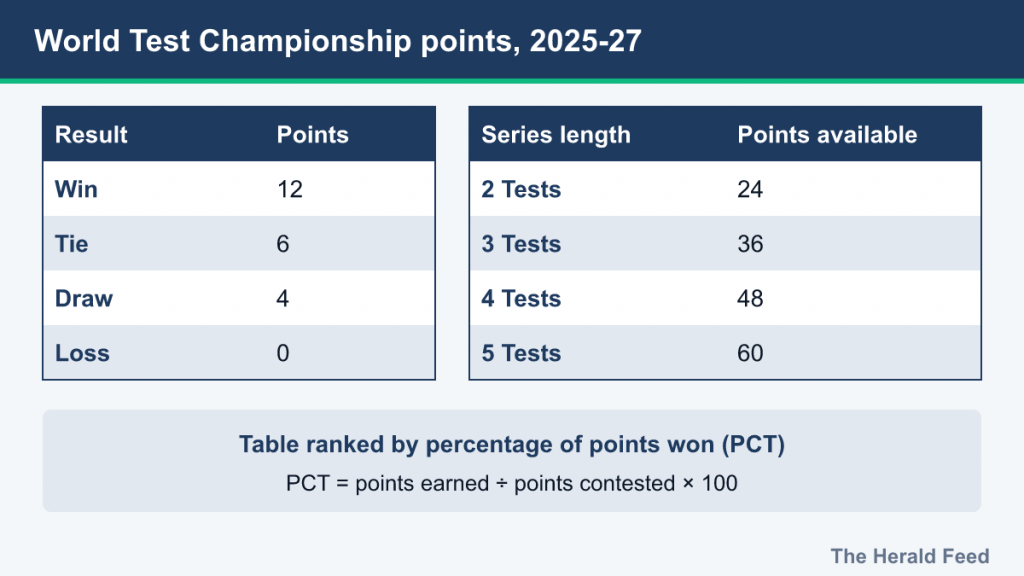
| Result | Points |
|---|---|
| Win | 12 |
| Tie | 6 |
| Draw | 4 |
| Loss | 0 |
So a two-Test series puts 24 points on the table for each team, a three-Test series 36, a four-Test series 48 and a five-Test series 60.
Why percentages?
Because teams play different numbers of Tests, raw points would favour the busiest teams. Instead, the table ranks teams by percentage of points won (often shown as PCT): points earned divided by points contested, multiplied by 100.
Here is a simple illustrative example (not real data). Suppose a team has played 10 Tests, so 120 points have been contested. If it has won six (72 points), drawn two (8 points) and lost two, it has 80 points, which is 80 ÷ 120 = 66.67%. A team that has played only six Tests and won four, drawn one and lost one has 52 of 72 points — 72.22% — and would sit above the first team despite fewer total points.
Over-rate deductions
Slow over rates are punished in the table. In the 2025–27 cycle, a team that is behind the required over rate at the end of a match loses one point for each over it is short — unless it bowled the opposition out within 80 overs. In a close race for the final, even a few lost points can matter, so captains pay close attention to the clock.
Tiebreakers
If two teams finish level on percentage, the 2025–27 regulations separate them by number of series wins, then by percentage of points in away matches, and finally by the ICC Test rankings at a fixed date before the final.
How to Read the WTC Table
The WTC standings look busier than a normal league table. The columns you will usually see are:
- Matches (M), Won (W), Lost (L), Drawn (D): Tests played in the current cycle and their results. Ties are listed separately when they occur.
- Deductions (Ded): points removed for slow over rates.
- Points (Pts): total points earned after deductions.
- PCT: the percentage of points won — the column that actually decides positions.
Two habits help when following the race. First, ignore the points column for ranking purposes; a team with fewer points can sit higher because it has played fewer matches. Second, look at the fixtures each team has left. A side with a high PCT but a difficult away series to come is more vulnerable than its position suggests, while a team with home series still to play may climb late. Fans and broadcasters often publish “what each team needs” scenarios in the final months of a cycle, recalculating the maximum PCT each side can still reach.
How the Championship Shapes Tactics
Because a win is worth three times as much as a draw, the WTC rewards captains who chase results. That can influence decisions you see on the field:
- Earlier declarations: setting a gettable target to give the bowlers time to win, rather than batting the opposition out of the game.
- Pushing on in the final session: a team that might once have settled for a draw may keep attacking, accepting some risk of defeat.
- Home advantage: boards know that winning home series is the most reliable path to a high PCT, so pitches and scheduling are often tailored to the home team’s strengths.
- Squad rotation: with Tests spread over two years, workloads for fast bowlers become part of championship planning.
None of this is required by the regulations, but the points system makes a drawn series noticeably less valuable than it used to be.
How the System Has Changed
The first cycle, 2019–21, used a different method. Each series was worth a maximum of 120 points, divided equally among its matches. A win in a two-Test series was worth 60 points, while a win in a five-Test series was worth just 24 — so a single win in a short series counted for far more than one in a long series.
The COVID-19 pandemic then forced postponements and cancellations. In November 2020 the ICC announced that finalists would be decided by percentage of points earned, accepting that some series would never be played. The per-match system with percentages was then adopted from the 2021–23 cycle onwards and remains in use.
The Finals So Far
| Cycle | Final venue | Winner | Runner-up | Result |
|---|---|---|---|---|
| 2019–21 | Rose Bowl, Southampton | New Zealand | India | Won by 8 wickets |
| 2021–23 | The Oval, London | Australia | India | Won by 209 runs |
| 2023–25 | Lord’s, London | South Africa | Australia | Won by 5 wickets |
2021: New Zealand’s breakthrough
The inaugural final at Southampton gave New Zealand their first title in the format. They beat India by eight wickets, a landmark moment for a country with a much smaller player base than most of its rivals.
2023: Australia complete the set
Australia beat India by 209 runs at The Oval. India became the first team to lose two WTC finals.
2025: South Africa at Lord’s
The third final, at Lord’s, saw South Africa beat Australia by five wickets to take the title for the first time, with Australia beaten finalists as defending champions.
The 2025–27 Cycle
The current cycle began on 17 June 2025, when Sri Lanka hosted Bangladesh at Galle. It includes 27 series and 71 matches in its league stage. Notable series include a five-Test England–India series in 2025, the 2025–26 Ashes in Australia (see our history of the Ashes), and, for England, a three-Test tour of South Africa in late 2026. The final is scheduled for The Oval in London, with the championship due to conclude in June 2027.
Because standings change after almost every Test, we do not list a table here — the ICC website carries the live standings.
What comes next
Reports on the competition’s future indicate that the 2027–29 edition is expected to include all 12 Test-playing nations — adding Afghanistan, Ireland and Zimbabwe — and that a proposed two-division system with promotion and relegation was not adopted. The same reports suggest that four-day Tests are expected for some smaller nations, so that they can play a number of matches comparable to the bigger teams within the same two-year window. Details may still change, so treat future formats as provisional until the ICC publishes final regulations.
Why the WTC Matters
- Context for every Test: a dead rubber in a bilateral series can still matter for WTC qualification.
- Incentive to win: with a win worth three times a draw, teams have reason to push for results.
- A global champion: Test cricket finally has a title holder, giving smaller Test nations a clear target.
- Away performance: because the tiebreakers reward away success, winning abroad carries extra weight.
Criticisms and Debates
The WTC has also attracted criticism, much of it fair:
- Uneven schedules: teams do not play the same opponents or the same number of Tests, so the table compares different workloads.
- A single final: a one-off match in English conditions decides two years of work. Some argue for a best-of-three final, though the calendar makes that hard.
- Neutral venue questions: all finals so far have been in England, which suits some teams more than others.
- Over-rate penalties: point deductions for slow over rates have occasionally influenced qualification, which some see as disproportionate.
FAQ
How many points is a Test win worth?
Twelve points in the current system, with six for a tie and four for a draw.
Do all Test teams take part?
Not in the 2025–27 cycle. Nine teams compete; Afghanistan, Ireland and Zimbabwe play Tests outside the championship.
Who has won the World Test Championship?
New Zealand (2021), Australia (2023) and South Africa (2025).