The British & Irish Lions Explained
Who the British & Irish Lions are, how players are picked, how a tour works, and the series that built rugby's most unusual touring tradition.

Most international rugby teams represent a single country. The British & Irish Lions represent four. Every four years, the best players from England, Ireland, Scotland and Wales stop being rivals, pull on the same red jersey and travel to the southern hemisphere to take on Australia, New Zealand or South Africa. A Lions tour is short, intense and rare, and that rarity is a big part of why it means so much to players and supporters alike.
This guide explains who the Lions are, how the squad is selected, how a modern tour is structured, and the series that shaped the team’s reputation, up to and including the 2025 tour of Australia.
Who the British & Irish Lions are
The Lions are a composite rugby union team drawn from the four “home unions”: England, Ireland (which plays as a single team for the whole island), Scotland and Wales. Unlike a national side, the Lions do not play a regular calendar of fixtures. They exist almost entirely for tours, and they tour only once every four years.
That makes selection a career milestone. Many players win dozens of caps for their country but are never chosen for the Lions; others are picked for a single tour and remember it as the high point of their careers. Because each touring cycle comes around so rarely, a player typically has only a handful of realistic chances in his career, and timing, form and fitness all have to line up.
The team’s identity has changed over the years. Early touring teams were often described simply as British teams, and later as the British Isles. On the 1950 tour the side officially adopted the name British Lions, a nickname journalists had already been using since the tour of South Africa in 1924. Since the 2001 tour of Australia the full official name has been the British & Irish Lions, reflecting the fact that Irish players have always been part of the team.
The four-year touring cycle
Since 1989, the Lions have toured every four years, rotating between the three great southern-hemisphere rugby nations: Australia, New Zealand and South Africa. In practice this means each opponent hosts the Lions roughly once every twelve years. A young fan in Auckland, Brisbane or Cape Town may only see the Lions in their own country two or three times in a lifetime.
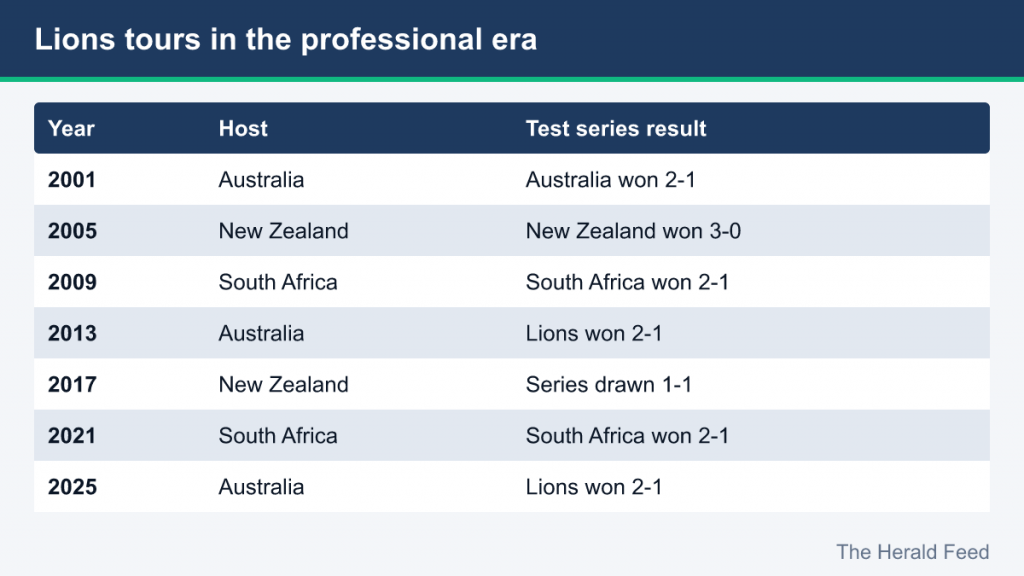
The rotation in the professional era has looked like this:
| Year | Host | Test series result |
|---|---|---|
| 2001 | Australia | Australia won 2–1 |
| 2005 | New Zealand | New Zealand won 3–0 |
| 2009 | South Africa | South Africa won 2–1 |
| 2013 | Australia | Lions won 2–1 |
| 2017 | New Zealand | Series drawn 1–1 (one test drawn) |
| 2021 | South Africa | South Africa won 2–1 |
| 2025 | Australia | Lions won 2–1 |
The next men’s tour is scheduled for New Zealand in 2029. A women’s Lions team was established in 2024 and is due to make its first tour, also to New Zealand, in 2027.
How Lions players are selected
Selection is led by the head coach, who is appointed well in advance of the tour, together with his assistant coaches. The squad is drawn from players eligible for any of the four home unions. Most have already played test rugby for their country, but uncapped players can be selected if they are eligible for one of the four nations, and occasionally a player in form for his club earns a surprise call.
Selection debates tend to follow the same themes every cycle:
- Form versus reputation. Should the coaches pick the player who has been outstanding in the Six Nations that spring, or the proven veteran who has performed in big matches before?
- National balance. Fans in each country count how many of “their” players made the squad. Coaches insist they pick on merit, but the national split is always a talking point, especially when one country has just won the Six Nations Championship.
- The captain. The Lions captain has to unite players who were rivals a few months earlier. In recent tours that role has gone to players such as Sam Warburton (2013 and 2017), Alun Wyn Jones (2021) and Maro Itoje (2025).
Squads are usually announced in the spring, after the Six Nations, giving players and coaches only a few weeks of preparation before departure. That compressed timetable is one of the biggest challenges a Lions coach faces: he has to build combinations, a playbook and a team culture almost from scratch.
How a Lions tour is structured
A modern Lions tour combines non-test matches with a three-match test series. The tour matches serve several purposes at once: they give the squad time to adapt to local conditions, let coaches test combinations, and give every player a chance to stake a claim for the test team.
The 2025 tour of Australia is a good example of the modern template. It ran from late June to early August and featured ten matches in total:
- A warm-up match against Argentina in Dublin before departure, which the Lions lost 28–24. It was the first time the Lions had played a match in Ireland.
- Six tour matches in Australia: against the Western Force in Perth, the Queensland Reds in Brisbane, the NSW Waratahs in Sydney, the ACT Brumbies in Canberra, an AUNZ Invitational XV in Adelaide, and a First Nations & Pasifika XV in Melbourne.
- Three tests against the Wallabies in Brisbane, Melbourne and Sydney.
The First Nations & Pasifika XV fixture replaced a planned game against the Melbourne Rebels, who were disbanded after the 2024 Super Rugby Pacific season. Amateur-era tours were far longer: the 1974 Lions, for example, played 22 matches in South Africa.
The test series itself is simple: three matches, and the side that wins more of them wins the series. If the tests are split with a draw, the series can be shared, as happened in New Zealand in 2017.
A history that began in 1888
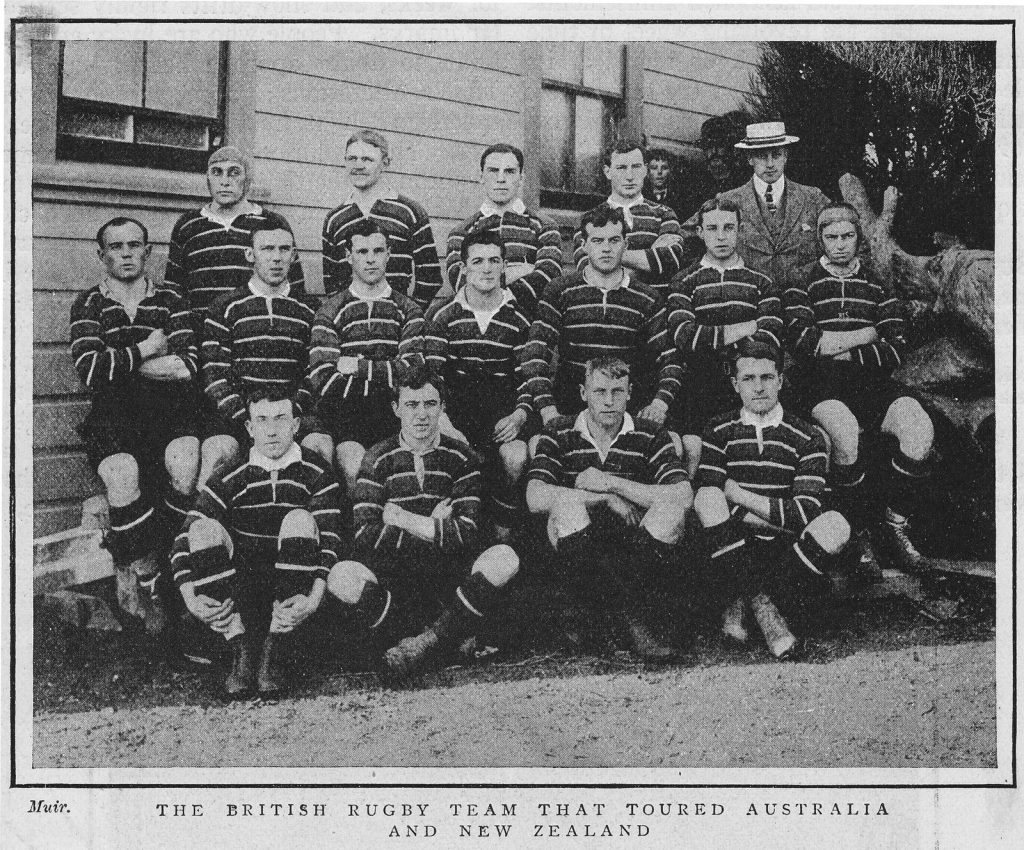
The Lions trace their history back to 1888, when a team organised by the English cricketers Alfred Shaw and Arthur Shrewsbury toured Australia and New Zealand. That trip was a commercial venture rather than an official tour, and it predated any formal agreement between the home unions, but it is regarded as the starting point of the Lions story.
Across all test matches, the Lions’ record shows how hard touring is. According to the Wikipedia summary of results through the 2025 tour, the Lions had played 146 tests, winning 72, losing 63 and drawing 11. The record varies sharply by opponent:
| Opponent | Tests played | Lions wins | Lions losses | Draws |
|---|---|---|---|---|
| Australia | 26 | 19 | 7 | 0 |
| New Zealand | 41 | 7 | 30 | 4 |
| South Africa | 49 | 18 | 25 | 6 |
The figures make one thing obvious: beating the All Blacks in New Zealand is the hardest task in Lions rugby. Only one Lions team has ever won a series there.
The series that made the legend
1971: New Zealand
The 1971 Lions remain the only side to win a test series in New Zealand, taking it 2–1. Built around a brilliant Welsh core including scrum-half Gareth Edwards and fly-half Barry John, the team combined attacking flair with the organisation to compete up front. For many supporters, it is still the benchmark Lions tour.
1974: South Africa
Three years later, the Lions went to South Africa and went through the entire tour of 22 matches unbeaten, winning the test series 3–0 with one test drawn. The 1974 side was famous for its forward power and its refusal to be intimidated, and it is often mentioned alongside 1971 as the greatest Lions team.
1997: South Africa
The first tour of the professional era came just two years after South Africa had won the 1995 Rugby World Cup on home soil. The Springboks were favourites, but the Lions won the series 2–1, a result that helped convince doubters that the concept still had a place in the professional game.
2013, 2017 and 2021: the Gatland era
Warren Gatland coached three consecutive tours. In Australia in 2013, with Sam Warburton as captain, the Lions won the series 2–1, sealing it with a 41–16 win in the deciding test. In 2017 in New Zealand, again under Gatland and Warburton, the series finished level: New Zealand won the first test 30–15, the Lions won the second 24–21, and the third was drawn. In 2021, the tour of South Africa was played behind closed doors because of the COVID-19 pandemic, and the Springboks won the series 2–1.
2025: Australia
Under head coach Andy Farrell and captain Maro Itoje, the 2025 Lions won the series against Australia 2–1. They won the first test 27–19 in Brisbane and clinched the series in Melbourne with a 29–26 victory, recovering from a 23–5 deficit at the Melbourne Cricket Ground. Australia won the final test 22–12 in Sydney. Tom Curry and Dan Sheehan each scored two tries in the series, and Finn Russell finished as the top points scorer both in the tests and across the whole tour.
Why the Lions still matter in the professional era
Every so often, someone questions whether a team that meets only once every four years still has a place in a crowded calendar. Club owners worry about player workload, and international coaches lose their best players for the summer. Yet the Lions have survived, and several reasons explain why.
- Scarcity. Because tours happen so rarely, every series feels like an event. There is no “next year” to make amends.
- Travelling support. Lions tours are famous for the thousands of supporters who travel from Britain and Ireland, turning host cities red for several weeks.
- Value to hosts. For the host union, a Lions tour is a major commercial and sporting event. Wikipedia’s account of the 2025 tour notes press reports describing it as the most profitable Lions tour in history.
- A unique test of coaching. Bringing together players who use different systems for their countries, and turning them into a coherent test side in a matter of weeks, is a challenge no other team faces.
The Lions also sit outside the normal structure of international competitions. They are not part of the Rugby World Cup cycle or the Rugby Championship,. They play no regular fixture list of their own, and that independence is part of the appeal: a Lions series is judged on its own terms.
Common questions about the Lions
Do Lions tests count as caps?
Yes. Lions players earn Lions caps for appearing in test matches, which are recorded separately from their caps for England, Ireland, Scotland or Wales. Tour matches against provincial sides or invitational teams do not count as tests. Because there are only three tests every four years, Lions caps are scarce: the record holder, Ireland’s Willie John McBride, won 17 Lions caps between 1962 and 1974.
Why only Australia, New Zealand and South Africa?
These three nations have historically been the strongest rugby countries outside Europe and can host a full tour with competitive provincial opposition. Earlier touring teams also visited Argentina three times before the Second World War (1910, 1927 and 1936), but the modern rotation has been settled on the three big southern-hemisphere unions since 1989.
If you are new to the sport and want to follow a Lions series properly, it helps to understand the basics of scoring, the breakdown and set pieces first. Our beginner’s guide to rugby union rules covers everything you need to enjoy the tests.