The Indian Premier League (IPL) Explained
How the IPL works: ten franchises, the player auction and retentions, overseas limits, the Impact Player rule, playoffs and every champion through 2026.
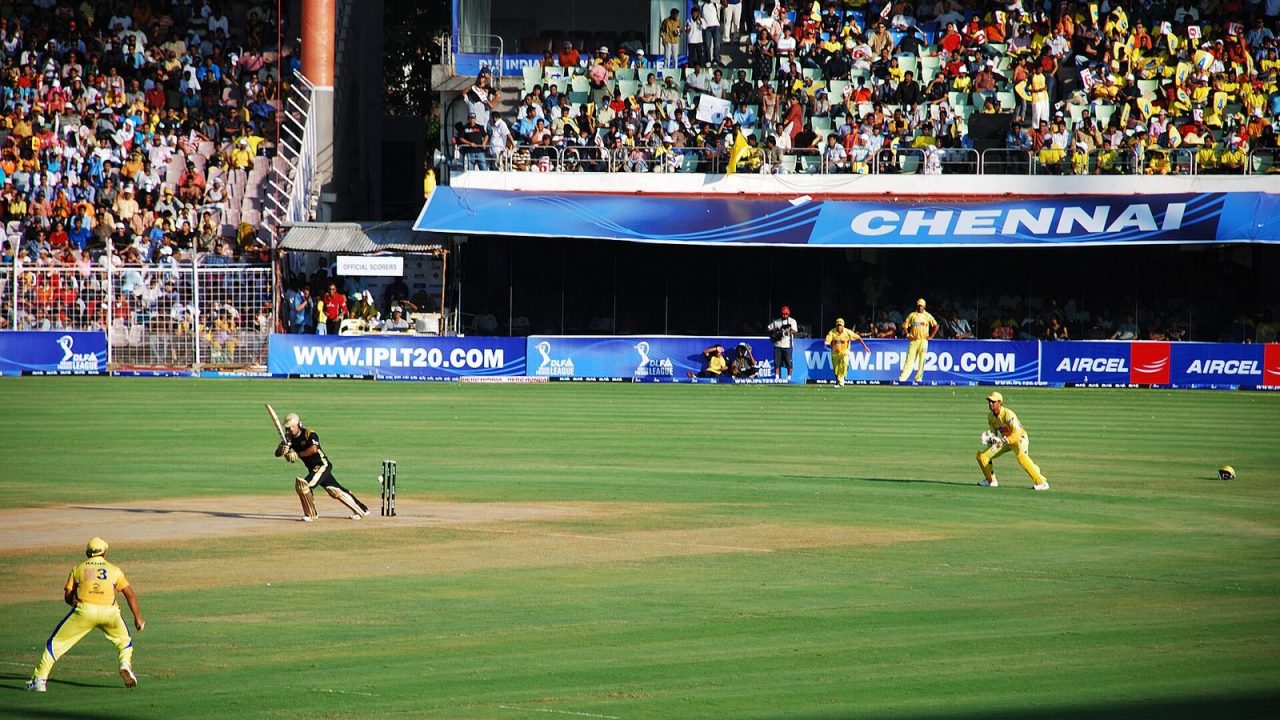
The Indian Premier League changed cricket. Before it launched, Twenty20 was seen by many as a novelty; within a few years, the IPL had become one of the most valuable sports competitions in the world, a magnet for the best players on the planet, and the template for franchise T20 leagues everywhere. This guide explains how it works — the teams, the auction, the squad rules, the playoff system and the rule innovations — and lists every champion through the 2026 season.
If you are new to the shortest format, our guide to Test, ODI and T20 cricket explains the basics of a 20-over match.
Origins: 2007–2008
The IPL was launched by the Board of Control for Cricket in India (BCCI) on 13 September 2007, and the first season was played in 2008 with eight franchises. The idea was a city-based league, owned by private investors who bought the right to operate a team, with players recruited through an open auction rather than by geography. That combination — franchise ownership, auctions and a short, television-friendly format — was new to cricket.
The 2008 season was won by Rajasthan Royals, one of the less fancied teams, which helped establish the idea that the auction could make any side competitive.
The Ten Teams
The league expanded to ten teams in 2022, when Gujarat Titans and Lucknow Super Giants joined. As of the 2026 season, the ten franchises are:
| Team | Abbreviation |
|---|---|
| Chennai Super Kings | CSK |
| Delhi Capitals | DC |
| Gujarat Titans | GT |
| Kolkata Knight Riders | KKR |
| Lucknow Super Giants | LSG |
| Mumbai Indians | MI |
| Punjab Kings | PBKS |
| Rajasthan Royals | RR |
| Royal Challengers Bengaluru | RCB |
| Sunrisers Hyderabad | SRH |
Some teams have changed their names over the years — Delhi, Punjab and Bengaluru among them — so older records may use different titles.
How a Season Works
The league stage
The 2026 season ran from 28 March to 31 May and included 74 matches. The ten teams were split into two groups of five. Each team played every side in its own group once and every side in the other group twice, giving 14 league matches per team. Teams earn points for wins, and net run rate is used to separate teams level on points. The top four after the league stage go through to the playoffs.
The playoffs
The IPL uses a four-team playoff that rewards finishing in the top two:
- Qualifier 1: 1st v 2nd. The winner goes straight to the final.
- Eliminator: 3rd v 4th. The loser is out.
- Qualifier 2: the loser of Qualifier 1 plays the winner of the Eliminator for the second place in the final.
- Final: winner of Qualifier 1 v winner of Qualifier 2.
The structure gives the top two teams a “second chance,” while the third- and fourth-placed teams must win three knockout games in a row to lift the trophy. The 2026 final was played at the Narendra Modi Stadium in Ahmedabad.
The Auction, Retentions and Salary Cap
The auction is the IPL’s most distinctive feature. Instead of teams developing players through academies or signing them through transfers, most players are sold to franchises in a televised bidding process. Players register in advance with a base price, an auctioneer calls each name in turn, and franchises bid against each other until only one remains; players who attract no bids go unsold. Because every team’s budget is finite, auction strategy is as much about when not to bid as when to chase a target.
Mega auctions and mini-auctions
An auction is held every year, usually in the off-season. Every three years there is a mega auction, when squads are largely rebuilt and most players re-enter the pool. In between, smaller mini-auctions let teams fill gaps.
Retentions
Before a mega auction, each franchise may retain a limited number of players from its existing squad. At the most recent mega auction (for the 2025 season, held in Jeddah in November 2024), the cap was six retained players. Retained players’ salaries count against the team’s budget, so keeping stars means less money to spend at the auction itself.
The salary cap
Each franchise works with a fixed total purse. For 2025, the cap was ₹120 crore per team, and teams had to spend at least 75% of it. The cap forces trade-offs: a franchise that pays heavily for one superstar must find value elsewhere.
Squad Rules: Overseas Players and the Impact Player
Overseas limits
The IPL attracts the best players from around the world, but limits ensure Indian players remain the core of every team:
- A squad can have a maximum of 25 players.
- No more than eight of them can be overseas players.
- No more than four overseas players can be in the playing XI.
Choosing which four overseas players to field is one of a captain’s biggest decisions, and it changes with conditions and opponents.
The Impact Player rule
Introduced for the 2023 season, the Impact Player rule allows each team to make one tactical substitution during a match. Teams name a list of substitutes alongside their XI — five under the current rules — and can bring one of them in to replace a player from the starting line-up.
In practice, the rule often works like this: a team batting first fields an extra batter, then swaps in an extra bowler for the second innings, or vice versa. The rule interacts with the overseas limit: if an overseas player is used as the Impact Player, the starting XI must have contained no more than three overseas players.
The Impact Player rule is controversial. Supporters say it adds tactical depth and lets teams play specialists. Critics argue it reduces the value of genuine all-rounders and makes batting line-ups so deep that scores have risen sharply.
Every IPL Champion, 2008–2026
| Season | Champion |
|---|---|
| 2008 | Rajasthan Royals |
| 2009 | Deccan Chargers |
| 2010 | Chennai Super Kings |
| 2011 | Chennai Super Kings |
| 2012 | Kolkata Knight Riders |
| 2013 | Mumbai Indians |
| 2014 | Kolkata Knight Riders |
| 2015 | Mumbai Indians |
| 2016 | Sunrisers Hyderabad |
| 2017 | Mumbai Indians |
| 2018 | Chennai Super Kings |
| 2019 | Mumbai Indians |
| 2020 | Mumbai Indians |
| 2021 | Chennai Super Kings |
| 2022 | Gujarat Titans |
| 2023 | Chennai Super Kings |
| 2024 | Kolkata Knight Riders |
| 2025 | Royal Challengers Bengaluru |
| 2026 | Royal Challengers Bengaluru |
The most successful teams
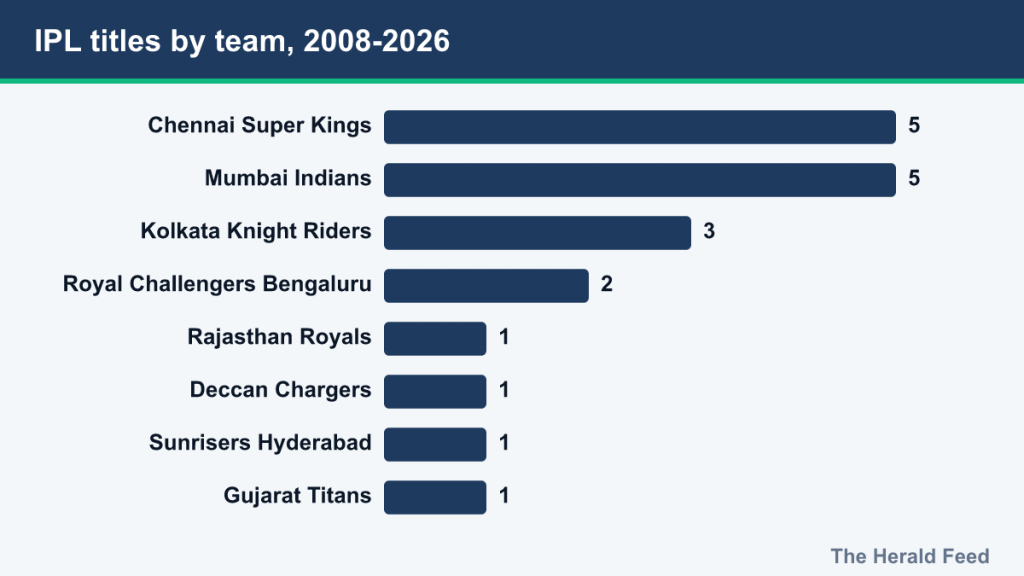
Through the 2026 season, Chennai Super Kings and Mumbai Indians share the record with five titles each. Kolkata Knight Riders have three. Royal Challengers Bengaluru, long known as one of the league’s most famous teams without a title, finally won in 2025 by beating Punjab Kings in the final and then retained the trophy in 2026, beating Gujarat Titans by five wickets in the final. Gujarat Titans won the title in their debut season, 2022.
How IPL Teams Approach a Match
An IPL innings is short, but teams split it into distinct phases, and you will hear commentators refer to them constantly.
The powerplay
The first six overs come with fielding restrictions, so only a limited number of fielders may stand outside the inner circle. Batting sides try to score quickly while the field is up; bowling sides want early wickets with the new ball, often using swing or extra pace.
The middle overs
Between the powerplay and the final few overs, spinners and change bowlers try to slow the scoring and take wickets as batters look to accelerate. Match-ups — a left-arm spinner against a set of right-handers, for example — drive many captaincy decisions here.
The death overs
The last overs of an innings belong to big hitters and to specialist bowlers who can land yorkers and disguise slower balls. Teams often plan their whole bowling order backwards from who will bowl the final two or three overs.
Chasing versus setting
Many captains prefer to chase when they win the toss, because knowing the target allows a side to pace its innings, and because evening dew can make the ball harder for bowlers to grip later in the match. Conditions vary by venue, though, and the Impact Player rule has given teams extra flexibility either way.
Common Questions About the IPL
How many teams are in the IPL?
Ten, as of the 2026 season. The league started with eight in 2008 and expanded to ten in 2022.
Who has won the most IPL titles?
Chennai Super Kings and Mumbai Indians, with five each through 2026.
Is the IPL an international competition?
No. It is a domestic franchise league run by the BCCI, although it features many international players within the overseas limits.
Why the IPL Matters Beyond India
- Player earnings and careers: the auction has transformed what cricketers can earn, and many international players plan their year around the IPL window.
- Skills and tactics: innovations in power-hitting, death bowling and data-driven team selection have spread from the IPL to international cricket.
- Talent pathway: uncapped Indian players can make their name in front of a vast audience, and many later earn international selection.
- A global model: franchise leagues in other countries borrowed the IPL’s model of city teams, auctions or drafts, and short seasons.
Following the IPL: A Viewer’s Guide
- Watch the toss and the Impact Player sheet: they tell you how a team intends to play the match.
- Track net run rate late in the season: with ten teams chasing four playoff places, NRR often decides who qualifies.
- Read the scorecard: strike rates and economy rates matter more than raw totals in T20; our guide on how to read a cricket scorecard explains the columns.
- Remember DRS: the IPL uses player reviews, as explained in our DRS guide.