Types of Bowling in Cricket: Pace, Swing, Seam and Spin
An overview of cricket's bowling styles — fast, swing, seam, off-spin, leg-spin and left-arm spin — plus the yorker, bouncer, slower ball and googly.
Every delivery in cricket is a small contest of intentions. The batter wants to score or survive; the bowler wants to take a wicket or, failing that, stop the runs. How a bowler goes about it depends on the type of bowling they specialise in. Broadly, bowlers fall into two families — pace (also called fast or seam bowling) and spin — but within each family there are several distinct crafts, each with its own tools and variations.
This overview explains the main styles, what the bowler is trying to achieve with each, and the variations you will hear commentators talk about. If you need a refresher on overs, wickets and the basic ways of getting out first, start with our beginner’s guide to cricket rules.
The One Rule Every Bowler Shares: Don’t Throw
Before looking at styles, it is worth knowing the constraint that defines bowling. The ball must be bowled, not thrown. Originally the rule meant the elbow could not straighten during delivery at all. After biomechanical research found that almost every bowler extends the elbow slightly, a tolerance was introduced: under current regulations, elbow extension of up to 15 degrees is permitted before a delivery is considered illegal. That tolerance applies to fast bowlers and spinners alike.
Bowlers also deliver from either side of the wicket (“over” or “round” the wicket) and with either arm, and they must tell the umpire if they change. Line (where the ball travels relative to the stumps) and length (where it pitches) are the basic vocabulary of all bowling. A “good length” ball lands in the area that leaves the batter unsure whether to play forward or back.
Pace Bowling: Speed as a Weapon
Pace bowlers run in and deliver the ball quickly, using speed to hurry the batter. Wikipedia’s summary of bowling speeds puts fast bowling in the professional game at roughly 80 mph and above, with many top fast bowlers exceeding 85 mph and a few exceeding 95 mph. Medium pace sits roughly in the 60–80 mph range. Commentators also use in-between labels such as “fast-medium” and “medium-fast.”
Pure pace does several things for a bowler:
- It reduces reaction time. A batter has a fraction of a second to judge line, length and bounce.
- It produces bounce. Quick bowlers, especially tall ones, can make the ball rise sharply from a short length, threatening the gloves, the shoulder of the bat and the body.
- It magnifies small errors. A slightly late shot against a fast bowler becomes an edge to the slips or wicketkeeper.
Few bowlers rely on speed alone, however. Most pace bowlers also move the ball, either in the air (swing) or off the pitch (seam). That is why the umbrella term “seamers” is often used for all faster bowlers.
Swing Bowling: Movement Through the Air
Swing is sideways movement of the ball while it is travelling through the air, before it bounces. It comes from the way air flows differently over the two halves of the ball.
Conventional swing
Fielding teams keep one side of the ball shiny by polishing it, while the other side naturally roughens with wear. When the ball is relatively new, the bowler angles the seam, and air flows differently over the two sides, so the ball moves in the air towards the rough side. For a right-handed batter:
- An outswinger is bowled with the seam angled towards the slips and moves away from the batter, towards the off side. It is the classic wicket-taking ball, drawing edges to the wicketkeeper and slips.
- An inswinger is bowled with the seam angled towards the leg side and moves into the batter, threatening the stumps and pads — and bringing LBW into play (see our LBW rule explainer).
The best swing bowlers can move the ball both ways with little change in action, so the batter cannot read which way it will go.
Reverse swing
As the ball gets older and more worn, something counterintuitive can happen: the ball begins to swing towards the shiny side instead — the opposite of conventional swing. This is reverse swing. It tends to appear once the ball is well worn, which is why it is especially relevant in Test cricket, and it often occurs late in the ball’s flight, making it very hard to defend against at speed.
Reverse swing is closely associated with Pakistani fast bowlers. Sarfraz Nawaz is credited with introducing it to international cricket in the late 1970s, passing the skill to Imran Khan, who in turn taught Wasim Akram and Waqar Younis — two of the most feared practitioners in the game’s history.
What the swing bowler wants
The swing bowler’s typical aim is to pitch the ball up — fuller than a seam bowler might — to give it time to move in the air and to tempt the batter into a drive. A drive at a ball that swings late is how many edges are produced.
Seam Bowling: Movement Off the Pitch
Seam movement is sideways deviation after the ball bounces. The bowler aims to land the ball on its raised stitching — the seam — so that it grips or skids unpredictably off the surface. Even a small deviation of a few centimetres can find the outside edge or beat the bat entirely.
Seam bowling is typically associated with:
- Hitting a “good length” consistently, often described as “hitting the deck” in the right area.
- Bowling a disciplined line around off stump, sometimes called the “corridor of uncertainty,” where batters are unsure whether to play or leave.
- Exploiting helpful pitches, such as surfaces with grass or moisture, where the ball moves more off the seam.
Many of the most successful new-ball bowlers are not the fastest in their team; they are the most accurate, landing the seam upright ball after ball.
Spin Bowling: Turn, Drift and Deception
Spin bowlers deliver the ball more slowly and impart rapid rotation. That rotation makes the ball drift in the air and then deviate sideways after pitching. Spin is categorised by the arm used and whether the spin comes mainly from the fingers or the wrist.
| Type | Arm | Method | Stock ball turns (to a right-handed batter) |
|---|---|---|---|
| Off-spin | Right | Finger spin | From off side to leg side (into the batter) |
| Leg-spin | Right | Wrist spin | From leg side to off side (away from the batter) |
| Left-arm orthodox | Left | Finger spin | From leg side to off side (away from the batter) |
| Left-arm unorthodox (wrist spin) | Left | Wrist spin | From off side to leg side (into the batter) |
What spinners are trying to do
Commentators describe spin bowling with a handful of terms:
- Turn — how far the ball deviates after pitching.
- Drift — sideways movement in the air caused by the spin.
- Dip — the ball dropping sooner than the batter expects, so it lands shorter.
- Flight — tossing the ball higher so it spends longer in the air, tempting the batter forward.
- Bounce — extra bounce that surprises the batter.
A spinner’s plan is often a slow build: settle into a rhythm, deny easy runs, and lure the batter into a mistake — a stumping, a catch at short leg or slip, or a misjudged drive. Spinners usually become more dangerous as a pitch wears and offers more grip.
Three of the four leading wicket-takers in Test history — Muttiah Muralitharan, Shane Warne and Anil Kumble — are spinners, a reminder that spin is not a secondary skill.
The Main Variations Explained
Variations are deliveries a bowler uses to surprise a batter who has settled against their stock ball.
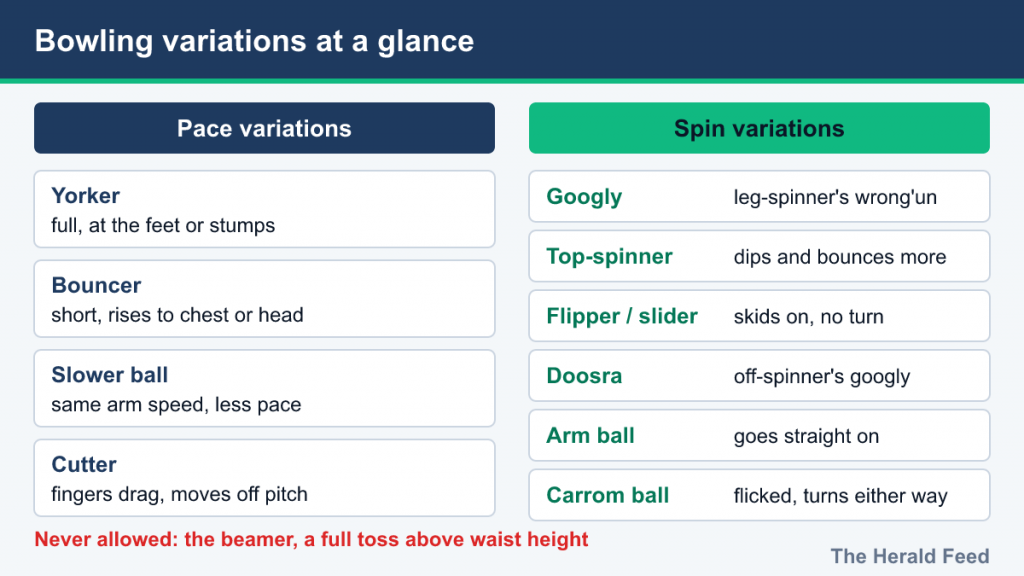
For pace bowlers
- Yorker: a full delivery aimed at the batter’s feet or the base of the stumps. It is hard to hit, which makes it a key weapon at the end of limited-overs innings, and it can bowl the batter outright.
- Bouncer: a short ball that rises towards the batter’s chest or head. It can force a hurried hook or pull, induce a catch, or simply push the batter back to set up a full ball. Playing conditions limit how many bouncers can be bowled per over in international cricket — for example, one per over in T20 internationals and, since 2012, two per over in ODIs.
- Slower ball: a delivery bowled with the same arm speed but significantly less pace, using a changed grip (off-cutters, knuckle balls, back-of-the-hand deliveries). The batter plays too early and mistimes the shot.
- Cutters: the bowler drags fingers across the ball to produce sideways movement off the pitch, similar to spin but at medium or higher pace.
One delivery is never acceptable: a full toss that reaches the batter above waist height, known as a beamer. It is dangerous and is called a no-ball.
For spinners
- Googly: the leg-spinner’s “wrong’un,” which spins the opposite way to the stock ball while looking similar out of the hand.
- Top-spinner: spins forward rather than sideways, dipping and bouncing more than expected.
- Flipper and slider: leg-spin variations that skid on rather than turn, often trapping batters on the back foot.
- Doosra: the off-spinner’s equivalent of the googly, turning away from the right-hander.
- Arm ball: a finger spinner’s delivery that goes straight on with the arm instead of turning.
- Carrom ball: flicked out with the fingers, as a carrom player flicks a disc; it can turn either way.
How Captains Use Different Bowlers
A balanced attack combines styles so the batter never faces the same challenge for long.
- The new ball: usually given to swing and seam bowlers, because a hard, shiny ball swings and bounces most.
- The middle period: spinners often take over in Test cricket, controlling the scoring rate and probing patiently. In limited-overs matches they bowl through the middle overs to slow the run rate.
- The old ball: reverse-swing bowlers come into play in long innings.
- The death overs: in limited-overs cricket, specialists in yorkers and slower balls are used at the end of the innings.
Fields are set to match the plan. An outswing bowler will want slips and a gully; a leg-spinner might want a slip, a short leg and boundary riders for the mistimed sweep. Our guide to cricket fielding positions shows where those fielders stand.
Common Misunderstandings
“Swing and seam are the same thing”
They are related but different. Swing happens in the air before the ball bounces; seam movement happens off the pitch after it bounces. A bowler can produce one, the other, or both.
“Faster is always better”
Raw pace helps, but accuracy and movement take more wickets over time. Many successful seamers operate below the very top speeds.
“Spinners only matter on dusty pitches”
Turning pitches help, but good spinners take wickets through flight, drift and deception even on true surfaces, and in white-ball cricket they are vital for slowing the scoring.