Cricket Batting Shots: A Guide to the Drive, Cut, Pull and Sweep
A guide to cricket's main batting shots — defence, drives, cut, pull, hook, sweep, reverse sweep and scoop — and which deliveries each one suits.
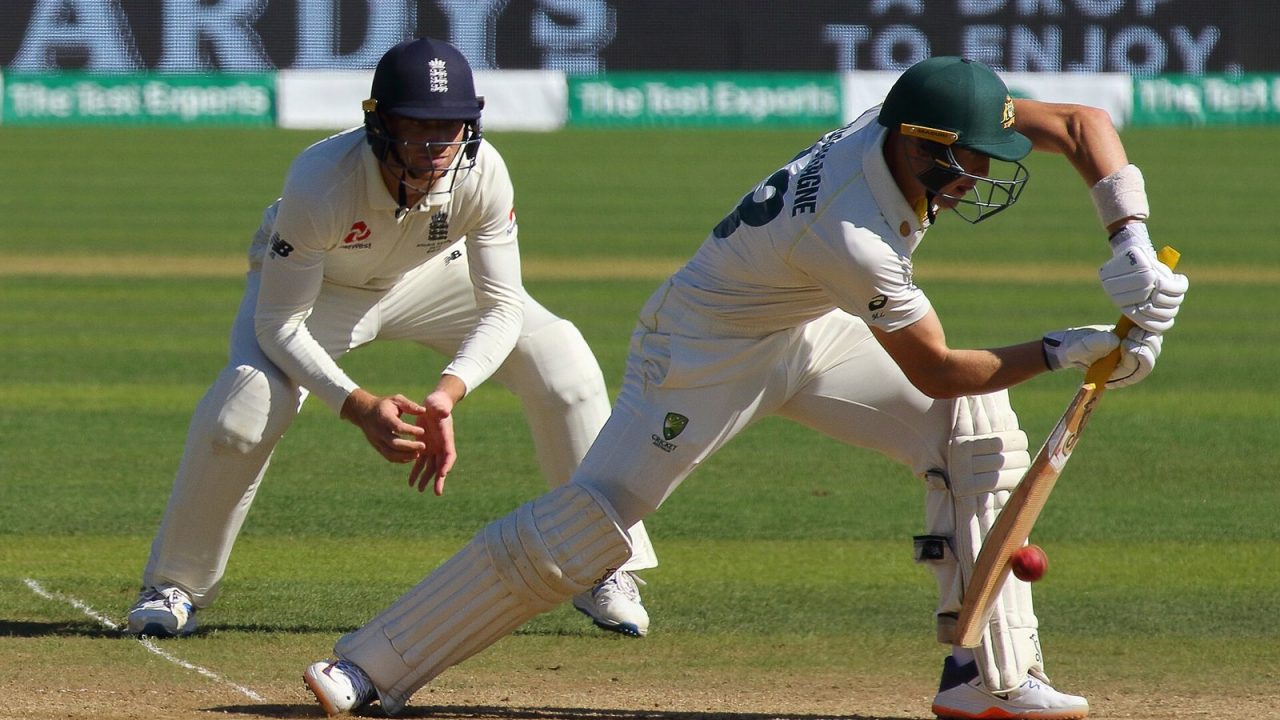
Watch a good batter for an over or two and you will notice something: they are not choosing shots at random. Each stroke in cricket is matched to a particular kind of delivery — its length (how far down the pitch it bounces), its line (how far from the stumps it travels) and its height when it arrives. Choosing the right shot for the ball is the essence of batting, and choosing the wrong one is how most batters get out.
This guide is a spectator’s and beginner’s tour of the main shots: what each one is, which ball it suits, where it sends the ball, and the risks involved. It describes technique in general terms; for proper coaching, work with a qualified coach. If you are unsure of field names such as cover, point or fine leg, our fielding positions guide will help.
The Foundations: Stance, Front Foot and Back Foot
Most batters use a side-on stance: feet roughly shoulder-width apart either side of the crease, front shoulder pointing down the pitch, head still and eyes level, bat resting near the back foot. Some successful batters use more open stances, but the principles are the same — be balanced, watch the ball, move decisively.
Almost every shot begins with one key decision:
- Front foot: for a fuller ball, the batter steps forward towards the pitch of the ball, getting close to it to smother movement and drive or defend.
- Back foot: for a shorter ball, the batter moves back and across towards the stumps to give more time to play it after it bounces.
Getting this decision wrong — going forward to a short ball, or back to a full one — is the root of many dismissals.
Defensive Shots
Forward defence
Played to a good-length or full ball on or around the stumps, at roughly ankle-to-thigh height. The batter steps forward, bat and pad close together, and lets the ball meet a straight bat angled down so it drops into the pitch. The aim is simple: protect the stumps and give no catch.
Backward defence
Played to a shorter ball rising to between the thigh and the chest. The batter moves back and across, gets the body in line, and plays the ball down with soft hands. It is the stock response to a good short-of-length ball from a fast bowler.
Defence is not glamorous, but in Test cricket especially, a batter who cannot defend cannot survive long enough to score.
The Drives
Drives are front-foot shots played with a straight (vertical) bat to fuller deliveries that are “pitched up.” They are the classic attacking shots of cricket. All drives share the same idea: step towards the ball, keep the head over it, and swing through the line.
| Drive | Ball it suits | Where it goes |
|---|---|---|
| Cover drive | Full, just outside off stump | Through the covers on the off side |
| Off drive | Full, around off stump | Towards mid-off |
| Straight drive | Full, on the stumps | Straight past the bowler |
| On drive | Full, on middle or leg stump | Between the stumps and mid-on |
| Square drive | Full and wide outside off | Towards point |
The risk: drives at balls that are not quite full enough, or that move late, produce edges to the slips and wicketkeeper. Driving away from the body at a swinging ball is the batter’s most common mistake against seamers — exactly what the swing bowlers described in our guide to bowling types are hoping for.
Back-Foot Attacking Shots: Cut, Pull and Hook
The cut
The cut is played to a short ball that is wide of off stump. The batter moves back and across and slices the ball with a horizontal bat towards point. The square cut goes roughly at right angles to the pitch; the late cut is played later, as the ball passes the body, and steered fine towards third man. The cut is a great run-scoring shot but needs width — cutting a ball that is too close to the stumps or too full brings the risk of being bowled or edging behind.
The pull
The pull is the answer to a short ball at around waist height, on or outside leg stump or straight at the batter. The batter goes back, swivels, and uses a horizontal bat to hit the ball through mid-wicket or square leg. It is one of the most productive shots against bowlers who drop short, but if the ball is higher or quicker than expected, it can be top-edged to fielders on the leg side.
The hook
The hook is the pull’s riskier relative, played to a bouncer at chest height or above. The ball is helped on behind square on the leg side. Hooking is spectacular and can bring sixes, but it is the shot most likely to produce a catch at fine leg or deep square leg, and because it is played to the highest balls, batters must wear a helmet and be in good position. Many batters simply choose not to hook, ducking or swaying instead.
Shots Off the Pads: Glance and Flick
When a bowler strays onto the batter’s legs, two simple, low-risk shots are available:
- Leg glance: the bat face is angled late to deflect the ball fine towards fine leg or square leg, using the bowler’s pace.
- Flick (or clip): a wristy shot off the toes or hips, sending a full ball on leg stump between mid-on and square leg.
These shots punish bad bowling with minimal risk. The main danger is missing the ball and being hit on the pad in front of the stumps — see our LBW explainer for when that is out.
Sweeps and Reverse Sweeps
The sweep
The sweep is a cross-batted shot usually played against spinners. The batter goes down on one knee on the front foot and sweeps a low-bouncing ball, typically on or outside leg stump, towards square leg or fine leg. It disrupts a spinner’s length and is a key weapon on turning pitches. Variations include the paddle sweep, with the bat held almost still and the ball deflected fine, and the slog sweep, a full-blooded swing aiming to clear the leg-side boundary.
The reverse sweep
The reverse sweep sends the ball the opposite way — to the off side, towards backward point or third man. Batters may swap their hands on the handle to make the shot easier. Its appeal is that it effectively reverses the field: if the captain has packed the leg side, the off side may be wide open.
The risks are real. Power is hard to generate, and a mistimed reverse sweep can lead to LBW or a top edge. The most famous cautionary tale came in the 1987 World Cup final, when England’s Mike Gatting attempted a reverse sweep from the first ball bowled by Australia’s Allan Border, top-edged it and was caught by the wicketkeeper. The shot was played regularly by Pakistan’s Mushtaq Mohammad in the 1970s and is now standard in limited-overs cricket.
The switch hit
The switch hit goes further: as the bowler runs in, the batter changes their stance and grip completely, turning a right-hander into a left-hander for that delivery. Kevin Pietersen made it famous; the ICC ruled the shot legal.
Modern Innovations: Scoop, Ramp and Upper Cut
T20 cricket has encouraged shots that send the ball into the areas behind the batter, where fielders are scarce.
- Scoop: played to a good-length or slightly short ball from a faster bowler, the batter gets low and lifts the ball over the wicketkeeper’s head. Sri Lanka’s Tillakaratne Dilshan developed a famous version, the “Dilscoop,” at the 2009 World T20.
- Ramp: a similar shot that uses the bowler’s pace to deflect the ball upwards over the slips or fine leg.
- Upper cut: played to a short, rising ball outside off stump, the batter guides it over the slips and gully towards third man.
- Helicopter shot: a wristy, bottom-handed flick at a full or yorker-length ball, finishing with the bat circling overhead.
These shots carry obvious risks: they require precise timing, and mistakes can mean a top edge or, for scoops, a ball to the face — another reason helmets are essential.
Matching Shot to Ball: A Quick Reference
| Delivery | Typical shot options |
|---|---|
| Full, on the stumps | Straight drive, on drive, forward defence |
| Full, outside off | Cover drive, off drive, leave |
| Good length, on the stumps | Forward or backward defence |
| Short and wide outside off | Cut, upper cut |
| Short, at the body or leg side | Pull, hook, duck or sway |
| On the pads | Flick, leg glance |
| Spinner, low on leg side | Sweep, paddle sweep |
| Yorker | Block it out; in T20, scoop or flick |
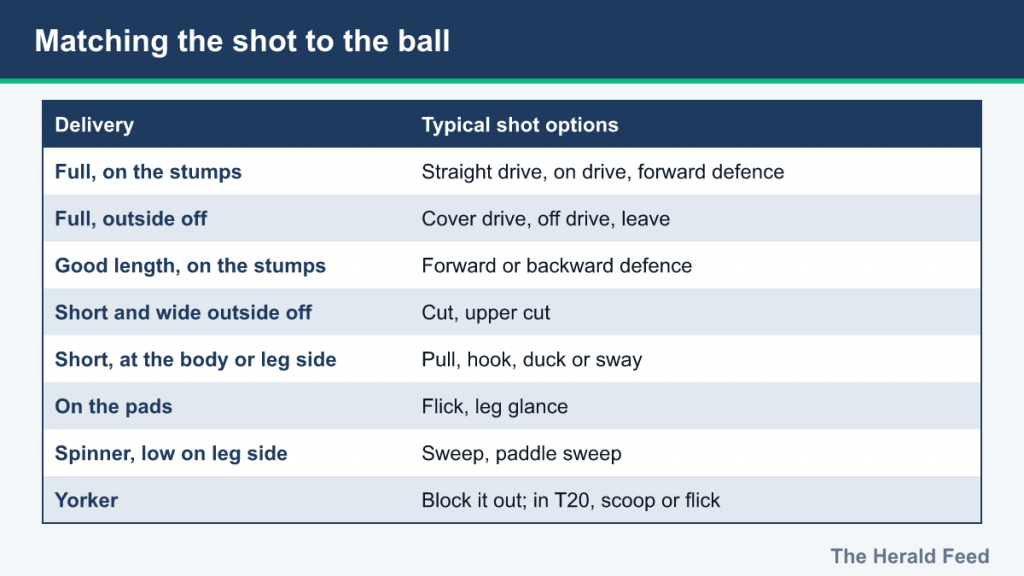
And never forget the most underrated option of all: the leave. Lifting the bat out of the way of a ball outside off stump, judging it will miss the stumps, is a vital skill in Test cricket.
Common Mistakes Beginners Make
- Playing across the line too early: cross-batted shots such as the pull and sweep are best saved for the right ball; using them against straight, full deliveries is a common route to being bowled or LBW.
- Feet stuck in the crease: without a clear forward or back movement, the batter reaches for the ball and edges it.
- Head falling over: if the head is not still and over the ball, timing suffers and balls are hit in the air.
- Trying to hit too hard: good timing does more than brute force; many of the best drives are played with surprisingly little effort.
- Ignoring the field: hitting the ball straight to a fielder wastes a good shot. Look at where the gaps are before each ball.