Rugby Sevens Explained: Rules, Tactics and the Olympic Game
How rugby sevens differs from 15-a-side: seven players, seven-minute halves, drop-kicked conversions, tournament formats and Olympic medallists.
Rugby sevens is the same sport as fifteen-a-side rugby union, played on the same size of field, with the same ball and almost the same laws. Yet it looks and feels like a different game. With only seven players a side, the pitch suddenly seems enormous, a single missed tackle can mean a try from 80 metres, and a match is over in roughly the time it takes to watch the first quarter of a Test. This guide explains exactly what changes in sevens, why those changes produce such a distinctive style, how tournaments are organised, and how the format became an Olympic sport.
If you are new to rugby altogether, it helps to know the basics of the fifteen-a-side game first — our beginner’s guide to rugby union rules covers scoring, the forward pass, the tackle and set pieces. Everything below assumes that foundation and focuses on the differences.
Where Sevens Came From
Sevens was born in the Scottish Borders. In 1883, Ned Haig and David Sanderson, butchers in the town of Melrose, came up with a shortened tournament as a fundraiser for Melrose RFC. A full fifteen-a-side tournament would have been impossible to fit into a single afternoon, so they cut team numbers and match length. The first event was played at The Greenyards in Melrose, and the Melrose Sevens is still staged every year, making it one of the oldest continuously running tournaments in the sport.
From the Borders, the game spread around the world. A major turning point was the Hong Kong Sevens, first held in 1976 — one of the first rugby union events to attract major commercial sponsorship, and the model for the festival-style weekend that is still central to sevens culture.
The sport gained its own Rugby World Cup Sevens in 1993, first played at Murrayfield in Edinburgh, where England won the inaugural men’s title. The men’s trophy is the Melrose Cup, a nod to the town where it all started. A women’s World Cup Sevens followed in 2009. Since 2018 the tournament has been scheduled two years after each Olympic Games.
The Key Law Differences From Fifteens
World Rugby publishes a standard set of law variations for sevens. The core laws of the game still apply — the try is worth five points, a conversion two, a penalty goal or drop goal three, and the ball still cannot be passed forward — but the following changes reshape everything.
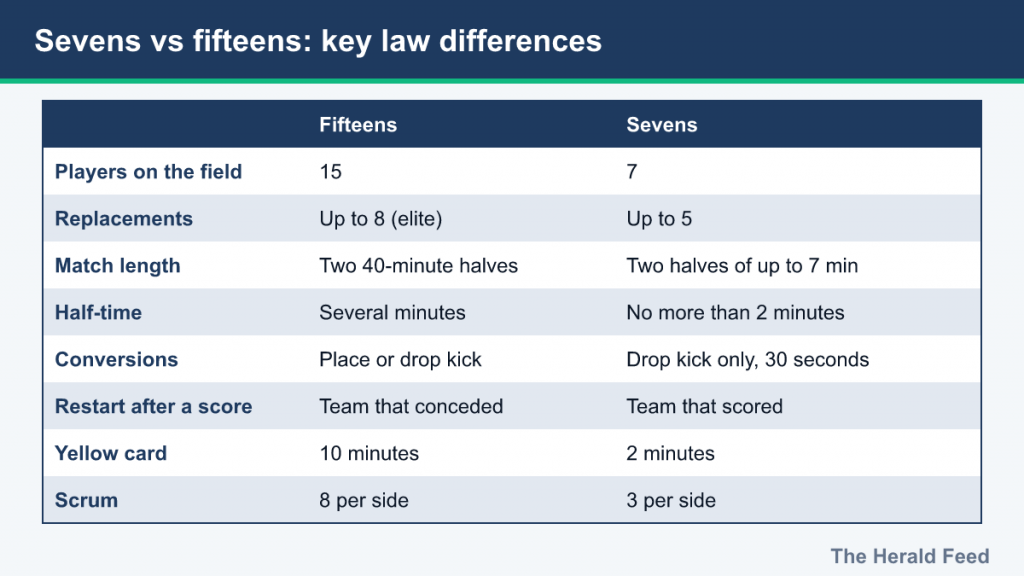
| Area | Fifteens | Sevens |
|---|---|---|
| Players on the field | 15 | 7 |
| Replacements | Up to 8 in elite matches | Up to 5 |
| Match length | Two 40-minute halves | Two halves of no more than 7 minutes |
| Half-time | A full interval of several minutes | No more than 2 minutes |
| Drawn knockout matches | Competition-specific | Extra-time periods of up to 5 minutes, next score wins |
| Conversions | Place kick or drop kick | Drop kick only, within 30 seconds of the try being awarded |
| Penalty goals | Place kick or drop kick | Drop kick only |
| Restart after a score | Team that conceded kicks off | Team that scored kicks off |
| Yellow card | 10 minutes | 2 minutes |
| Scrum | 8 players per side | 3 players per side |
Seven-minute halves
Under World Rugby’s sevens variations, a match lasts 14 minutes — two halves of no more than seven minutes each — plus time lost, with a half-time interval of no more than two minutes. That brevity is what allows a tournament to squeeze dozens of matches into a weekend. Finals used to be played over two ten-minute halves, but since 2017 final-round matches have used the standard seven-minute halves. If a match that needs a winner is level at full time, play restarts after a one-minute break with periods of no more than five minutes, and the first score wins.
The scoring team kicks off
This is the law that most shapes the flow of a sevens match. In fifteens, the team that concedes kicks off to the team that scored. In sevens, the team that has just scored restarts with a drop kick from the centre of the halfway line, and it must do so within 30 seconds. A team that wins its own restart can score again without the opposition touching the ball. Many coaches regard restarts as the single most important set piece in sevens.
Drop-kicked conversions
Conversions must be drop kicks and must be taken within 30 seconds of the try being awarded. There is no time for a kicking tee and a long routine. Penalty goals, when teams choose to kick them, are also drop kicks. In practice, penalty goals are relatively rare in sevens: with so much space on the field, a quick tap penalty is usually a more profitable option than three points.
Two-minute yellow cards
A yellow card in sevens means a two-minute suspension rather than ten. Two minutes may sound short, but it is around a seventh of the match, and playing with six defenders across a 70-metre-wide pitch is extremely difficult. Teams frequently concede during a sin-binning.
Why Sevens Looks So Different on the Field
The pitch is the same size as in fifteens, but there are fewer than half as many players on it. That simple ratio creates the defining characteristics of the format.
Space and speed
With seven defenders trying to cover the full width of the field, gaps appear constantly. Sevens rewards raw pace, agility and the ability to beat a defender one-on-one. Wingers and backs from fifteens often adapt well, but so do players with backgrounds in athletics or other sports. Unlike in fifteens, where a forward pack may grind out metres, a sevens attack often depends on one player creating a half-gap and another finishing from distance.
Possession is precious
Because a turnover can lead directly to a try at the other end, teams are generally patient, passing across the field to probe for a mismatch. Kicking in open play is less common than in fifteens, since it often hands possession to an opponent with lots of room to run.
Tackling and the breakdown
Defence in sevens is about line speed, shape and, above all, completing one-on-one tackles. There is rarely cover behind a missed tackle. At the breakdown, teams usually commit very few players — often only the tackler and one more — because every extra player who joins a ruck is one fewer defender in the line. Turnovers won at the breakdown can be decisive, but over-committing is punished quickly.
Scrums and lineouts
Set pieces still exist but are simplified. A sevens scrum has three players from each side, typically two props and a hooker, which makes it far quicker to set and restart than the eight-man contest described in our guide to the rugby scrum. Lineouts usually involve two or three players and are mainly about securing clean possession quickly rather than mounting a driving maul.
How Sevens Tournaments Are Structured
Sevens is almost always played as a tournament rather than as individual fixtures. A typical event runs over one, two or three days, with teams grouped into pools before knockout rounds.
- Pool stage: teams are divided into pools (often of four) and play each other once in round-robin format.
- Knockout stage: the top teams from each pool advance to quarter-finals, semi-finals and a final.
- Placings: many tournaments also run play-off brackets for lower positions. Historically, events awarded a Cup, Plate, Bowl and Shield so that teams of different standards all had something to play for.
At the elite level, the World Rugby Sevens Series began in the 1999–2000 season, with a women’s series added from 2012–13. In 2023 it was rebranded as SVNS, with the men’s and women’s tournaments held at the same venues on the same weekends, and the season culminating in a Grand Final. New Zealand has been the most successful men’s team in the history of the series. The detailed SVNS structure has changed several times, so check the official schedule each season.
Sevens at the Olympic Games
Rugby had an early Olympic history in its fifteen-a-side form: rugby union was played at the Games of 1900, 1908, 1920 and 1924, then dropped. The sport returned in the sevens format. The International Olympic Committee voted at its session in Copenhagen in October 2009 to include rugby sevens from the 2016 Games, and both men’s and women’s tournaments have been held at every Olympics since.
The Olympic format
Twelve teams compete in each of the men’s and women’s tournaments. They are split into three pools of four, and each team plays the others in its pool once. The top two in each pool plus the two best third-placed teams reach the quarter-finals. Winners go on to the medal semi-finals, the final decides gold and silver, and the two losing semi-finalists play for bronze. Classification matches decide the remaining places.
Olympic medallists, 2016–2024
| Games | Event | Gold | Silver | Bronze |
|---|---|---|---|---|
| Rio 2016 | Men | Fiji | Great Britain | South Africa |
| Rio 2016 | Women | Australia | New Zealand | Canada |
| Tokyo 2020 (held 2021) | Men | Fiji | New Zealand | Argentina |
| Tokyo 2020 (held 2021) | Women | New Zealand | France | Fiji |
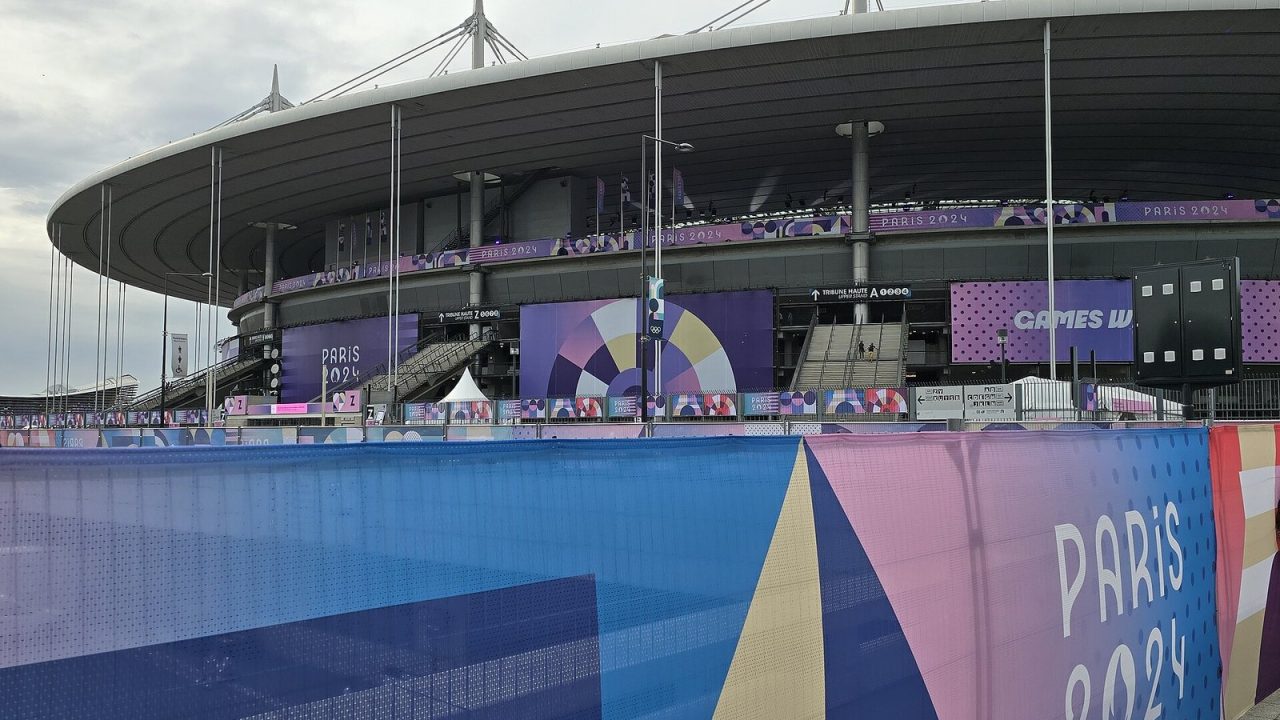
| Paris 2024 | Men | France | Fiji | South Africa |
| Paris 2024 | Women | New Zealand | Canada | United States |
A few results stand out. Fiji’s men won the first Olympic rugby sevens final in Rio, beating Great Britain 43–7, and then defended the title in Tokyo with a 27–12 win over New Zealand. In Paris, the host nation France beat Fiji 28–7 in the men’s final. On the women’s side, Australia won the inaugural gold in Rio, and New Zealand then took back-to-back titles, beating France 26–12 in Tokyo and Canada 19–12 in Paris.
Why Sevens Matters, and How to Watch It
Sevens plays a role far beyond its own tournaments. Olympic status brings access to national sports funding in many countries where rugby is not a traditional major sport, and the women’s game in particular has benefited. Sevens is also a development pathway: many fifteen-a-side internationals played it early in their careers to sharpen handling, decision-making and tackling in space, while some of the best sevens players are specialists who stay in the format, because the skill set is genuinely distinct.
If you are watching for the first time, a few habits help:
- Watch the restarts. After every score, see whether the scoring team regathers its own kick-off. Long winning streaks are usually built on restart dominance.
- Count defenders in the line. If a team has committed two players to a ruck, it is defending with five across the pitch — that is when breaks happen.
- Notice the clock. In a 14-minute match, a two-minute yellow card or a long stoppage has a big effect on the outcome.
One common misconception is worth clearing up: sevens is not “touch rugby with tackles.” It uses the full contact laws of rugby union, and the pitch is not smaller — the field is exactly the same size as in fifteens, which is precisely why the game is so open.
Frequently Asked Questions
How long is a sevens match?
Two halves of no more than seven minutes each, plus stoppage time, with a half-time interval of no more than two minutes.
Is there a Sevens World Cup?
Yes. The Rugby World Cup Sevens was first held in 1993, and the men’s winners receive the Melrose Cup. It is a separate competition from the fifteen-a-side tournament described in our Rugby World Cup guide.