The Rugby Scrum Explained: Binding, Engagement and Penalties
How the rugby union scrum works: when it is awarded, the crouch-bind-set sequence, each forward's job, the feed, common penalties and uncontested scrums.
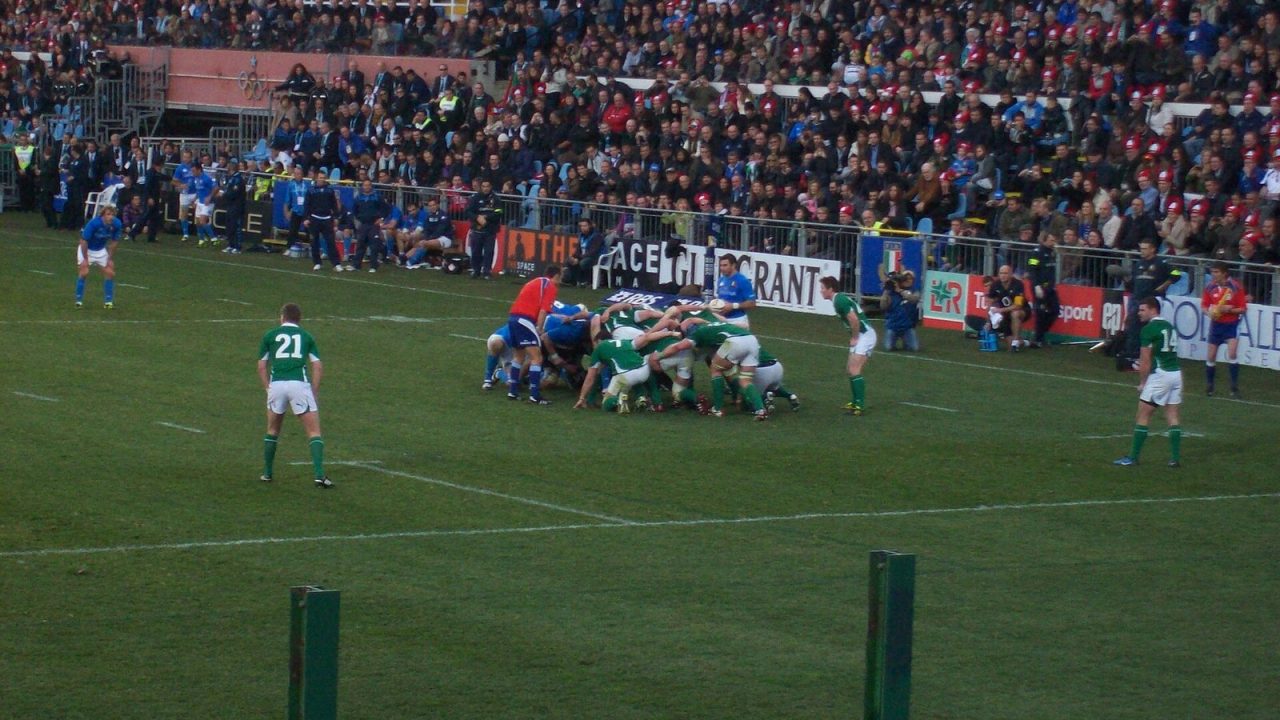
The scrum is the most distinctive sight in rugby union: sixteen forwards locked together, heads down, pushing against each other while the ball is fed into a narrow tunnel between them. To a newcomer it can look like a messy shoving contest that ends with the referee blowing the whistle. In fact it is one of the most tightly regulated parts of the game, and a dominant scrum can decide a match.
This guide explains when scrums are awarded, how they are formed, what each forward does, how the feed works, and the most common offences. The detail comes from Law 19 of World Rugby’s Laws of the Game. For the wider basics, see our beginner’s guide to rugby union rules.
Why and When a Scrum Is Awarded
A scrum is a way of restarting play quickly and safely after a minor offence or stoppage. It concentrates the forwards in one place, which creates space for the backs to attack from the resulting possession.
Law 19 lists the situations in which a scrum is awarded, and which team throws the ball in. The most common are:
- Knock-on or forward pass — the non-offending team throws in.
- Unplayable ball at a tackle or ruck — the team that was last moving forward throws in.
- Unsuccessful maul — the team not in possession at the start of the maul throws in.
- Failure to “use it” when the referee calls for the ball to be played — the team not in possession throws in.
- Option after a penalty or free kick — a team awarded a penalty may choose a scrum instead.
Choosing a scrum from a penalty has become a common tactic for teams with a strong pack. A scrum near the opposition line can earn another penalty, a penalty try or a pushover try, and it keeps the opposition’s forwards tied in while the backs attack.
Who Is in the Scrum
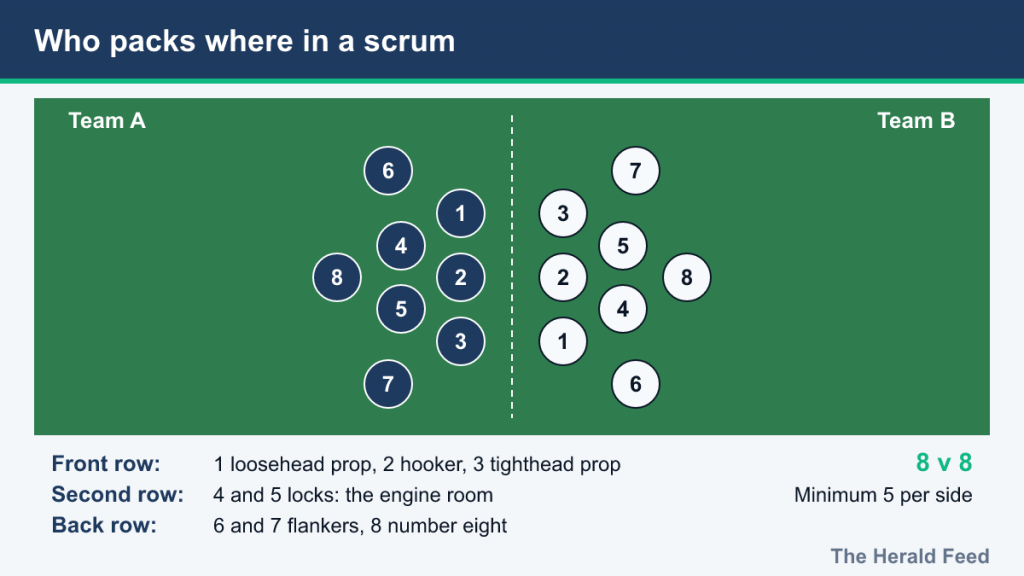
With 15 players per team, each scrum has eight players from each side: two props, a hooker, two locks and three back-row forwards. A team cannot have fewer than five players in a scrum, even if it has lost players to cards or injury.
Front row (1, 2, 3)
The loosehead prop (1) packs on the left, the hooker (2) in the middle, and the tighthead prop (3) on the right. The front rows meet head to head. The laws require each front-row player to place their head to the left of their opponent’s, without touching the opponent’s neck or shoulders. The hooker binds with both arms over or under the props’ arms and is responsible for striking the ball back with the foot.
Second row (4, 5)
The two locks bind together and onto the props in front of them, with their heads between the props and the hooker. They provide much of the pushing power, which is why the second row is called the engine room.
Back row (6, 7, 8)
The flankers bind on the outside of the scrum, and the number eight binds at the back between the locks. Back-rowers add weight and stability but also have to break away quickly to defend once the ball emerges. The number eight controls the ball at their feet and can pick it up to attack. For more on each forward’s role across the game, see our guide to rugby union positions.
Crouch, Bind, Set: How a Scrum Is Formed
The referee marks the place of the scrum, which creates a middle line parallel to the try lines. Teams must be ready to form the scrum within 30 seconds of the mark being made, or they concede a free kick. The engagement then follows three calls.
“Crouch”
The front rows crouch, with heads and shoulders no lower than their hips. Hookers must keep one foot forward as a “brake foot” to stop the scrum from lurching forward. Failing to crouch correctly is a free kick offence.
“Bind”
Each prop binds on their opponent. The loosehead places their left arm inside the tighthead’s right arm and grips the back or side of the opponent’s jersey; the tighthead places their right arm outside the loosehead’s left upper arm and does the same. These binds must be maintained throughout the scrum, and failing to bind properly is a penalty offence. Locks and back-rowers must also bind correctly, using at least one arm.
“Set”
On “set”, the two packs come together. Only then can hookers remove the brake foot. All front-row players must have both feet on the ground, and every player must be ready to push. Even so, pushing is not allowed until the ball has left the scrum-half’s hands. Shoving before the feed is a free kick offence, and this pre-engagement control is what modern scrum laws were designed to achieve: a stable, square engagement rather than a high-speed collision.
The Feed and Winning the Ball
The scrum-half of the team awarded the scrum throws the ball in — commonly called the “feed”. Law 19 requires the feed to be made from outside the tunnel, without delay, in a single forward movement, at quick speed and straight, so that it first touches the ground inside the tunnel. Breaking any of those requirements is a free kick offence. The scrum-half may stand with their shoulder on the middle line, slightly towards their own side.
The scrum begins when the ball leaves the scrum-half’s hands. Front-row players may strike for the ball only once it touches the ground in the tunnel, and the hooker of the throwing team must strike for it. Once the ball has passed the front rows, it is usually controlled at the feet of the number eight.
Once the scrum is stationary and the ball has been available at the back for a few seconds, the referee calls “use it”, and the team must play the ball immediately or concede a scrum to the opposition.
How a scrum ends
A scrum ends when the ball comes out anywhere other than the tunnel, when the number eight picks it up from the feet of a lock, when the scrum-half plays the ball that has reached the hindmost player’s feet, or when the ball reaches or crosses the try line. Offside lines also end at that moment.
Common Scrum Offences
Scrum offences fall into two groups. Technical infringements usually earn a free kick; offences involving binding, pushing or safety earn a penalty.
| Offence | Typical sanction |
|---|---|
| Not ready within 30 seconds of the mark | Free kick |
| Incorrect crouch or not using the brake foot | Free kick |
| Pushing before the ball is fed | Free kick |
| Feed not straight, delayed or not quick | Free kick |
| Throwing team’s hooker not striking for the ball | Free kick |
| Incorrect or released binding | Penalty |
| Not pushing straight and parallel to the ground | Penalty |
| Intentionally collapsing the scrum, kneeling or falling | Penalty |
| Lifting or forcing an opponent upwards | Penalty |
| Charging the opposition front row | Penalty |
| Scrum-half or back-rower offside | Penalty |
Collapses, wheels and resets
If a scrum collapses or a player is lifted, the referee must blow the whistle immediately. If the referee judges that someone collapsed it deliberately — for example, a prop dropping a bind and pulling down — a penalty follows. If no one is clearly at fault, the scrum is reset.
Scrums are also reset without a penalty if the ball comes straight out of either end of the tunnel, if the scrum wheels more than 90 degrees, or if neither team wins possession. Repeated resets are one of the most frustrating sights in rugby for spectators, and they are often what referees have in mind when they speak to front-row players between scrums.
Offside at the scrum
The scrum-half of the team not in possession must stay close to the ball on their own side, or retreat well behind the scrum. Players not involved in the scrum must stay at least five metres behind the hindmost foot of their team’s scrum until it ends.
Uncontested Scrums and Safety
Because the front row is the most specialised and physically demanding position, the laws include safeguards. Under Law 3, teams must name enough suitably trained front-row players: a 23-player matchday squad must include six who can play loosehead prop, tighthead prop and hooker.
If a team cannot field a suitably trained front row — through injury, for instance — the referee orders uncontested scrums, in which the packs still form up but do not compete with a push, turning the scrum into a simple restart. When a front-row player leaves the field, the referee asks at the next scrum whether the team can still contest; if a trained front-rower returns or comes on, contested scrums resume.
The laws close the obvious loophole. Uncontested scrums that result from a sending-off, a yellow card or an injury must still be played with eight players per side, so a team cannot gain an extra back by not scrummaging. In elite rugby, a player whose departure caused uncontested scrums cannot be replaced, and the guidelines allow a further player to be removed in some circumstances as a sanction. If a front-rower is yellow-carded and the team cannot contest, it must take another player off so a replacement front-rower can come on.
Safety also explains the strict rules on head position, binding and engagement. A collapsing scrum puts the necks and spines of front-row players at risk, which is why referees are told to stop play immediately when a scrum goes down.
How to Watch a Scrum
Watching the scrum closely is rewarding once you know where to look. Focus on the two tightheads: the side whose tighthead stays square and moves forward is usually winning. Look at the backs of the props and locks — flat backs mean they are pushing efficiently; heads popping up suggest trouble. And watch the referee’s position and body language: referees often speak to the front rows before a scrum, and repeated warnings to the same prop tend to come before a penalty.
The scrum may take only seconds, but what happens in it often decides whether a team kicks for goal, attacks from a platform, or spends the next minutes defending.