How the ICC Cricket World Cup Works
How the men's 50-over Cricket World Cup works: qualification, the formats used since 1975, every winner through 2023 and the new format for 2027.

The ICC Men’s Cricket World Cup is the oldest global tournament in the sport and, for many players, still the biggest prize in white-ball cricket. It is played in the one-day international format, 50 overs per side, and it has been held roughly every four years since 1975. Along the way it has produced legendary finals, regular changes of format and one of the most dramatic finishes in any sport.
This guide explains how the tournament has been organised over the years, how teams qualify, who has won it, and how the 2027 edition in South Africa, Zimbabwe and Namibia will work. If you need a refresher on how a 50-over match differs from Tests and T20s, read our guide to cricket’s three formats.
The Origins: 1975 and the 60-Over Era
The first men’s World Cup was held in England in 1975 with eight teams. The format was simple: two groups of four, with the top two in each group reaching the semi-finals. Matches were 60 overs per side, played in white clothing with a red ball, and the West Indies beat Australia by 17 runs in the final at Lord’s.
England hosted the next two tournaments as well. The West Indies retained the trophy in 1979, and in 1983 India produced one of the great upsets by beating them by 43 runs in the Lord’s final, ending the West Indies’ run of titles and giving India their first.
The 1987 tournament, co-hosted by India and Pakistan, was the first held outside England and the first with 50 overs per side, which has remained the standard length ever since.
Every Final, 1975–2023
| Year | Host(s) | Winner | Runner-up | Margin | Final venue |
|---|---|---|---|---|---|
| 1975 | England | West Indies | Australia | 17 runs | Lord’s, London |
| 1979 | England | West Indies | England | 92 runs | Lord’s, London |
| 1983 | England | India | West Indies | 43 runs | Lord’s, London |
| 1987 | India, Pakistan | Australia | England | 7 runs | Eden Gardens, Kolkata |
| 1992 | Australia, New Zealand | Pakistan | England | 22 runs | MCG, Melbourne |
| 1996 | India, Pakistan, Sri Lanka | Sri Lanka | Australia | 7 wickets | Gaddafi Stadium, Lahore |
| 1999 | England (with matches elsewhere) | Australia | Pakistan | 8 wickets | Lord’s, London |
| 2003 | South Africa, Zimbabwe, Kenya | Australia | India | 125 runs | Wanderers, Johannesburg |
| 2007 | West Indies | Australia | Sri Lanka | 53 runs (D/L) | Kensington Oval, Bridgetown |
| 2011 | India, Sri Lanka, Bangladesh | India | Sri Lanka | 6 wickets | Wankhede Stadium, Mumbai |
| 2015 | Australia, New Zealand | Australia | New Zealand | 7 wickets | MCG, Melbourne |
| 2019 | England, Wales | England | New Zealand | Tie; Super Over tied; won on boundary count | Lord’s, London |
| 2023 | India | Australia | India | 6 wickets | Narendra Modi Stadium, Ahmedabad |
Through 2023, Australia have won the tournament a record six times (1987, 1999, 2003, 2007, 2015 and 2023), including three in a row from 1999 to 2007. India and the West Indies have two titles each, and Pakistan, Sri Lanka and England one each.
How the Format Has Changed
Few tournaments have tinkered with their structure as often. Each change tried to balance two aims: giving smaller nations a chance to play, and making sure the strongest teams meet in meaningful matches.
- 1975–1983: eight teams in two groups of four; top two in each group to the semi-finals.
- 1987: the same eight-team structure, but now with 50 overs per side.
- 1992: nine teams in a single round-robin, with the top four reaching the semi-finals. It was also the first World Cup with coloured clothing, white balls and black sightscreens, and several matches were played under floodlights.
- 1996: twelve teams in two groups of six, with the top four from each going into quarter-finals.
- 1999 and 2003: two pools, with the top three from each advancing to a Super Six round, then semi-finals.
- 2007: sixteen teams in four groups of four, followed by a Super Eight.
- 2011 and 2015: fourteen teams in two groups of seven, with the top four from each reaching the quarter-finals.
- 2019 and 2023: ten teams in a single round-robin, with the top four reaching the semi-finals.
The 2007 edition is often cited as a cautionary tale: pre-tournament favourites India and Pakistan both went out in the group stage, removing two of the biggest draws from the rest of the event. The ten-team round-robin of 2019 and 2023 reversed that by guaranteeing every team nine matches, but it was criticised for leaving out associate nations.
How the League Tables Work
Round-robin stages are ranked on competition points, with two points for a win. In 2023, for example, India won all nine of their league matches to top the table with 18 points, while South Africa and Australia both finished on 14 and New Zealand on 10. Those four went through to the semi-finals — and Australia, third in the table, went on to beat India by six wickets in the final in Ahmedabad on 19 November.
When teams finish level on points, the main tiebreaker is net run rate (NRR). In simple terms, it compares how quickly a team scores its runs with how quickly it concedes them, across all its matches in that stage:
- Work out the team’s run rate: total runs scored divided by total overs faced.
- Work out the opposition run rate: total runs conceded divided by total overs bowled.
- Subtract the second figure from the first.
A team with a positive NRR scores faster than its opponents; a negative NRR means the reverse. As a purely illustrative example, a side that has scored at 6.0 runs an over while conceding 5.5 would have an NRR of +0.5. Special rules apply when a team is bowled out before its overs are used up — the calculation counts it as having faced the full quota of overs — which is why captains chasing a target late in a group stage sometimes push hard to win quickly, improving their NRR.
Because NRR rewards margins, the final round of group matches often becomes a calculation exercise for fans, with teams needing not just a win but a win by a particular margin to overtake a rival.
The Most Famous Final: Lord’s, 2019
No World Cup final has been closer than 2019. England and New Zealand both finished on 241 after 50 overs, and the Super Over that followed was tied as well. Under the playing conditions at the time, England won because they had hit more boundaries in the match — 26 to New Zealand’s 17.
The outcome prompted widespread debate. In October 2019, the ICC scrapped the boundary-count tiebreaker for its global events: in semi-finals and finals, a tied Super Over is now repeated until there is a winner. In group matches, a tied Super Over means the match is tied.
How Qualification Works
Qualification has changed along with the format. Early tournaments simply invited the Test nations plus a small number of associates. Later, associate nations qualified through the ICC Trophy, which became the Cricket World Cup Qualifier.
For 2027, the route is:
- Hosts: South Africa and Zimbabwe qualify directly as hosts.
- Rankings: the best eight other teams in the ICC men’s ODI rankings at the 30 September 2026 cut-off qualify directly.
- Qualifier: the remaining four places are decided at the Cricket World Cup Qualifier. The winner goes straight into the group stage; the other three enter a preliminary round.
The 2027 World Cup Format
The 2027 tournament expands the field from 10 teams to 14. In July 2026, the ICC confirmed a revised structure with several rounds:
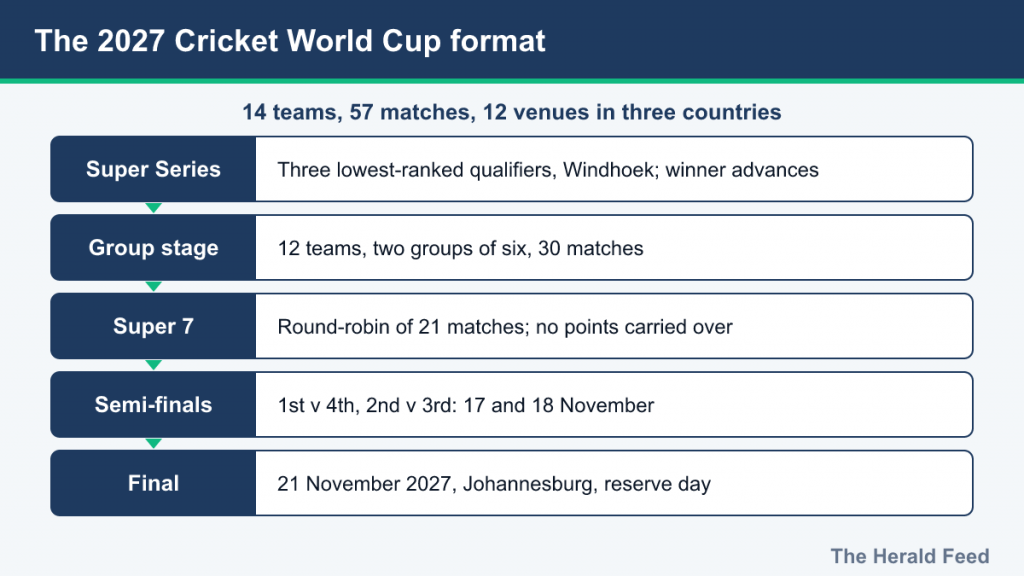
- Super Series: the three lowest-ranked qualifiers play a three-team round-robin in Windhoek, Namibia, on 2, 4 and 6 October 2027. The winner advances.
- Group stage: twelve teams in two groups of six, playing 30 matches in total. The top three in each group, plus the better of the two fourth-placed teams, advance.
- Super 7: the seven remaining teams play a round-robin of 21 matches, starting on 25 October. Points do not carry over from the group stage.
- Semi-finals: first plays fourth and second plays third, on 17 November in Cape Town and 18 November in Tshwane.
- Final: 21 November 2027 in Johannesburg, with a reserve day.
That makes 57 matches across 12 venues in three countries: Windhoek in Namibia; Harare, Bulawayo and Victoria Falls in Zimbabwe; and eight South African venues including Cape Town, Johannesburg, Durban and Gqeberha. The ICC said the revamp was designed to create “greater context, competitiveness and consequence” throughout the event.
The Trophy
The current trophy was introduced in 1999 and was the tournament’s first permanent prize. It is made of silver and gilt, with a golden globe held up by three silver columns shaped like stumps and bails. It stands about 60 cm tall and weighs around 11 kg. The ICC keeps the original, and winners receive a replica.
Common Questions
Is the T20 World Cup the same competition?
No. The ICC Men’s T20 World Cup, first played in 2007, is a separate tournament in the 20-over format. The Women’s Cricket World Cup is also separate, and in fact began two years before the men’s, in 1973.
What happens if rain affects a match?
Rain-affected ODIs use the Duckworth-Lewis-Stern method to set revised targets, as in the 2007 final. Knockout matches typically have reserve days, as the 2027 semi-finals and final do.
Why do some editions have more teams than others?
The ICC balances commercial interest in big fixtures — such as India against Pakistan — against the goal of growing the game. More teams mean more chances for associates, but also more one-sided matches. Each format change has been a different answer to that trade-off.