The ICC Men’s T20 World Cup Explained
How the ICC Men's T20 World Cup works: its history since 2007, the 20-team format with a Super 8 stage, qualification and every winner through 2026.
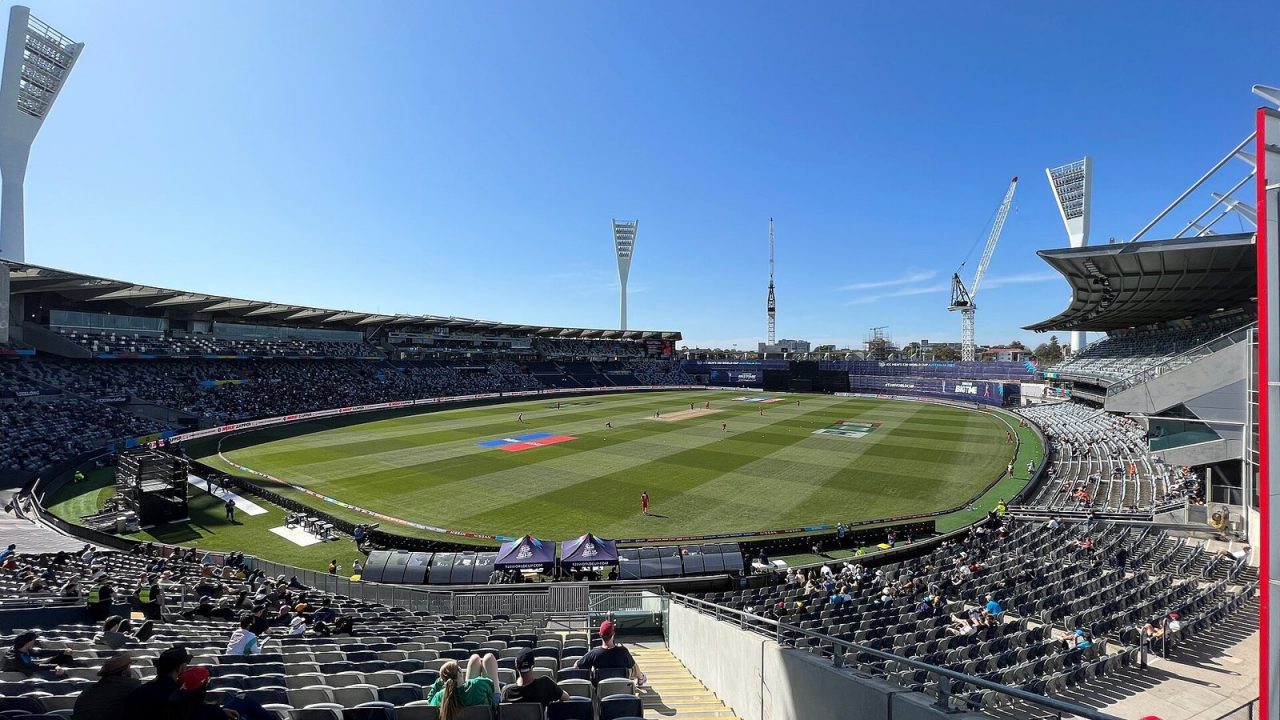
The ICC Men’s T20 World Cup is the youngest of cricket’s global tournaments, and in many ways the loudest. Matches last around three hours, results swing on a single over, and teams that would rarely trouble the giants in a five-day Test can win a game with one inspired spell or a burst of big hitting. Since its first edition in 2007, the tournament has grown from twelve teams to twenty and become one of the most watched events in the sport.
This guide explains how the tournament is organised, how teams qualify, how the current format works, and who has won it, through the 2026 edition in India and Sri Lanka.
A quick primer on T20 cricket
Twenty20 cricket gives each side a single innings of up to 20 overs. Fielding restrictions apply in the opening powerplay, bowlers are limited to a maximum share of the overs, and the result is usually decided in an evening. A tied match goes to a Super Over, a one-over-per-side eliminator. If you want the full comparison with Tests and one-day internationals, our guide to cricket’s three formats sets them side by side.
The short format suits a global tournament. A team can play several matches in a week, schedules are easier to fit into broadcast windows, and the gap between strong and emerging cricket nations is narrower than in longer formats. That combination explains why the ICC has repeatedly expanded the event.
A short history: from 2007 to 2026
The first edition was held in South Africa in 2007 with twelve teams. India beat Pakistan in a tense final, scoring 157 for 5 and bowling Pakistan out for 152. A few months later, the Indian Premier League launched in 2008, and franchise T20 cricket has grown alongside the World Cup ever since.
Early editions were held roughly every two years. After the 2016 tournament in India there was a five-year gap before the next edition, held in the United Arab Emirates and Oman in 2021, followed quickly by Australia in 2022. The 2024 edition, co-hosted by the West Indies and the United States, was the first with 20 teams. The 2026 edition, co-hosted by India and Sri Lanka, kept that 20-team format.
Every winner through 2026
| Year | Host(s) | Winner | Runner-up |
|---|---|---|---|
| 2007 | South Africa | India | Pakistan |
| 2009 | England | Pakistan | Sri Lanka |
| 2010 | West Indies | England | Australia |
| 2012 | Sri Lanka | West Indies | Sri Lanka |
| 2014 | Bangladesh | Sri Lanka | India |
| 2016 | India | West Indies | England |
| 2021 | UAE and Oman | Australia | New Zealand |
| 2022 | Australia | England | Pakistan |
| 2024 | West Indies and USA | India | South Africa |
| 2026 | India and Sri Lanka | India | New Zealand |
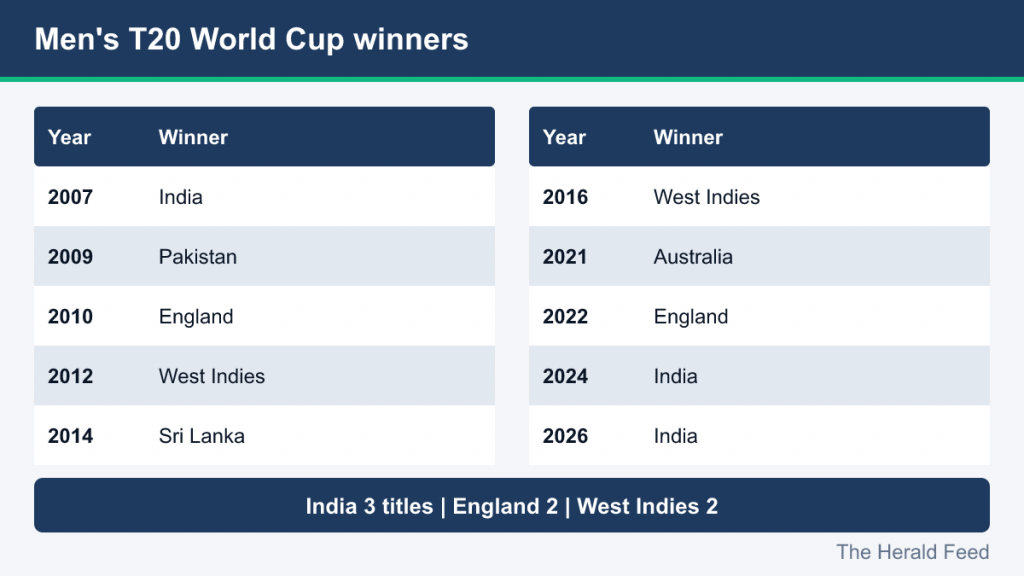
Through 2026, India lead the list with three titles (2007, 2024 and 2026). England (2010 and 2022) and the West Indies (2012 and 2016) have won it twice each, and Australia, Pakistan and Sri Lanka have one title apiece. New Zealand and South Africa have reached finals without winning.
How the 20-team format works
Since 2024, the men’s T20 World Cup has used a three-stage structure. The 2026 tournament, played from 7 February to 8 March 2026, is the clearest current example.
Stage 1: the group stage
The 20 teams are split into four groups of five. Each team plays every other team in its group once, so each side has four group matches. The top two from each group advance. In 2024 this stage alone accounted for 40 of the tournament’s 55 matches.
Stage 2: the Super 8
The eight qualifiers are divided into two groups of four, and again each team plays the others in its group once. Points do not carry over from the first stage, so every Super 8 team starts level. The top two in each Super 8 group advance.
Stage 3: the knockouts
The final four play two semi-finals, and the winners meet in the final. In 2026 the final was held at the Narendra Modi Stadium in Ahmedabad.
Why this structure?
The format tries to balance two goals that pull in opposite directions. The ICC wants to include as many nations as possible, which is good for the global growth of the game. But it also wants the later stages to feature competitive matches between strong teams. A large first stage, followed by a smaller second group stage, gives emerging nations meaningful fixtures while ensuring the knockouts are usually contested by the strongest sides.
One consequence is that every match in the opening round matters. With only four group games and two qualifying places, a single defeat to a lower-ranked team can put a favourite under real pressure.
How teams qualify
Qualification has changed several times as the tournament has grown.
- Early editions. In 2007, the ten Full Members of the ICC qualified automatically, and two further places went to Associate nations through a qualifying competition. Later editions added global and then regional qualifying events for Associates.
- Rankings-based entry. From the 2019–2021 cycle, the top teams in the T20I rankings qualified directly, with others going through regional qualifiers followed by a global qualifier.
- The current model. For 2022–2024, direct places went to the top teams from the previous tournament and from the T20I rankings, along with the hosts. From 2024, the global qualifier was dropped and the leading teams from the regional qualifiers advanced directly to the World Cup.
This system means that the tournament now regularly includes nations that do not play Test cricket. The 2024 edition brought the co-hosts the United States into the main event, and in 2026 Italy qualified for the men’s T20 World Cup for the first time. Late changes can also happen: before the 2026 tournament, Bangladesh withdrew and were replaced by Scotland.
The 2026 edition in focus
India entered their home tournament as defending champions, having won in the Caribbean in 2024, and they retained the title. In the final in Ahmedabad they made 255 for 5 and bowled New Zealand out for 159 in 19 overs, winning by 96 runs. The victory made India:
- the first team to win the men’s T20 World Cup three times;
- the first team to win two consecutive T20 World Cups;
- the first host nation to win the title on home soil.
India’s Sanju Samson was named player of the series. Pakistan opener Sahibzada Farhan scored the most runs in the tournament, 383, while India’s Jasprit Bumrah and Varun Chakravarthy shared the lead in wickets with 14 each.
What makes T20 World Cup cricket different
Tournament T20 cricket rewards some specific skills and strategies.
Powerplay intent
With fielding restrictions in the opening powerplay limiting how many fielders can patrol the boundary, teams try to score quickly while the gaps are there. A fast start can set up a match; losing early wickets can wreck it.
Death bowling
The final overs of an innings are where matches are often won and lost. Bowlers who can land yorkers and disguise slower balls under pressure are especially valuable in knockout cricket.
Conditions and venues
Because the tournament moves between continents, conditions vary hugely. Slower, spin-friendly surfaces in South Asia favour different team compositions than the faster pitches of Australia. Selectors pick squads with the host conditions firmly in mind.
Small margins
Group formats with few matches leave little room for error. A washed-out game, a poor net run rate or one bad over can decide whether a team progresses.
Reading the group tables: points and net run rate
Group tables at the T20 World Cup look simple, but the tie-breaker can be confusing for new followers. Teams earn points for wins (and a share of points for no-results), and when two or more sides finish level on points, net run rate (NRR) is the usual way to separate them.
NRR is calculated over the whole stage, not as an average of individual matches. You take a team’s total runs scored divided by the total overs it faced, and subtract its total runs conceded divided by the total overs it bowled. A positive number means a team has, on average, scored faster than its opponents.
A few details trip people up:
- Being bowled out counts as the full 20 overs. If a team is dismissed in 15 overs, its NRR calculation still uses its full quota of 20 overs, so collapsing early is punished heavily.
- Abandoned matches are ignored. Runs and overs from a no-result do not count towards NRR at all.
- Chasing quickly helps. A team that knocks off a target in 12 overs rather than 19 improves its NRR substantially, which is why sides sometimes accelerate late in a chase they are already winning.
In tight groups, teams in their final match often know exactly what margin of victory they need. Following those calculations is part of the drama of the last round of group games.
What comes next: 2028 and beyond
The 2028 Men’s T20 World Cup is scheduled to be co-hosted by Australia and New Zealand. Wikipedia’s summary of the tournament format lists a revised structure for that edition: five groups of four, followed by a “Super 10” stage of two groups of five, and then a six-team knockout stage. Qualification is also due to change, with an expanded global qualifier in which teams coming through regional events compete against the lowest-placed sides from the previous World Cup.
Formats can be adjusted between editions, so it is worth checking the ICC’s official announcements as each tournament approaches.
Frequently asked questions
How is the T20 World Cup different from the 50-over World Cup?
The 50-over Cricket World Cup is older, dating back to 1975, and uses one-day international matches. We explain its history and format in our guide to how the ICC Cricket World Cup works. The T20 World Cup uses the shorter Twenty20 format and has a larger field of 20 teams.
What happens if a T20 World Cup match is tied?
It goes to a Super Over, in which each side bats for one over. Under the rules adopted by the ICC in October 2019, if the Super Over is also tied in a knockout match, further Super Overs are played until there is a winner. In the group stage of a tournament, a tied Super Over means the match is recorded as a tie.
Is there a women’s T20 World Cup?
Yes. The ICC runs a separate Women’s T20 World Cup, which this article does not cover in detail.