Rugby Kicking Tactics: Box Kicks, Grubbers and Territory
Why rugby teams kick so much, how box kicks, grubbers, chips and touch-finders work, and how the 50:22 and kick-chase laws shape the tactics.
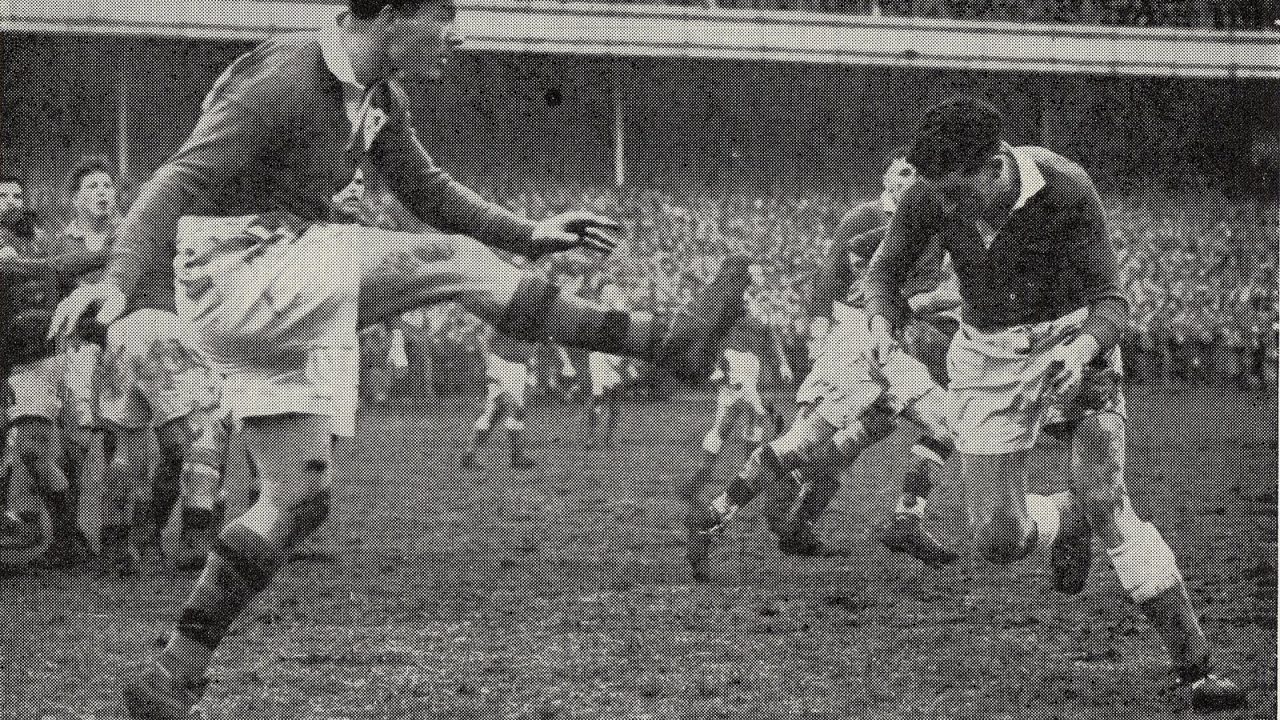
New rugby fans are often puzzled by how often teams give the ball away. A side wins possession, recycles it a couple of times, and then the scrum-half or fly-half boots it high into the air or long down the field. Why would anyone surrender possession in a game where you need the ball to score?
The answer is that rugby is a game of territory as well as possession. Where on the pitch you have the ball matters enormously, and a well-judged kick can be worth more than several phases of carrying. This guide explains the main types of kick, what each is trying to achieve, and the laws that make some kicks so valuable. It focuses on rugby union, with brief comparisons to rugby league along the way.
Why teams kick: territory, pressure and the scoreboard
Every kick in open play is a trade. The kicking team gives up the ball in exchange for something else: ground, a chance to win the ball back, or a set piece in a better part of the field. Coaches broadly think about kicking in four ways.
- Territory. Playing in the opposition half means mistakes by the opponents are more likely to lead to points for you, and mistakes by you are less likely to be punished. A team pinned in its own 22 is under constant pressure.
- Contest. High kicks that the chasing team can compete for give a real chance of regaining possession further up the field.
- Exit. When a team is trapped near its own try line, kicking is the safest way to relieve pressure.
- Attack. Grubbers, chips and cross-field kicks can create try-scoring chances against a defence that has pushed up fast or left space behind it.
Kicking to touch: the laws that decide where the lineout is
A huge share of kicking strategy depends on what happens when the ball goes into touch, so it is worth understanding World Rugby’s Law 18 before looking at specific kicks. The key question is whether the kicking team “gains ground”, meaning the lineout is taken where the ball crossed the touchline rather than level with where it was kicked.
Kicking directly into touch from outside your own 22
If a player kicks the ball directly into touch (on the full) from outside his own 22, there is no gain in ground. The lineout is taken level with where the ball was kicked, or where it went out, whichever is nearer the kicker’s own try line, and the opposition throws in. That is why players outside their 22 usually aim for the ball to bounce in the field of play before going out.
Kicking from inside your own 22
Inside your own 22 you can kick directly into touch and gain the ground, but with an important condition. If the defending team took the ball back into its own 22 and no tackle, ruck or maul has taken place since, there is no gain in ground. A player who picks up a ball lying outside the 22 while standing inside it, or who catches it before it reaches the 22-metre plane, has “taken it back”. In both cases the opposition throws in to the lineout.
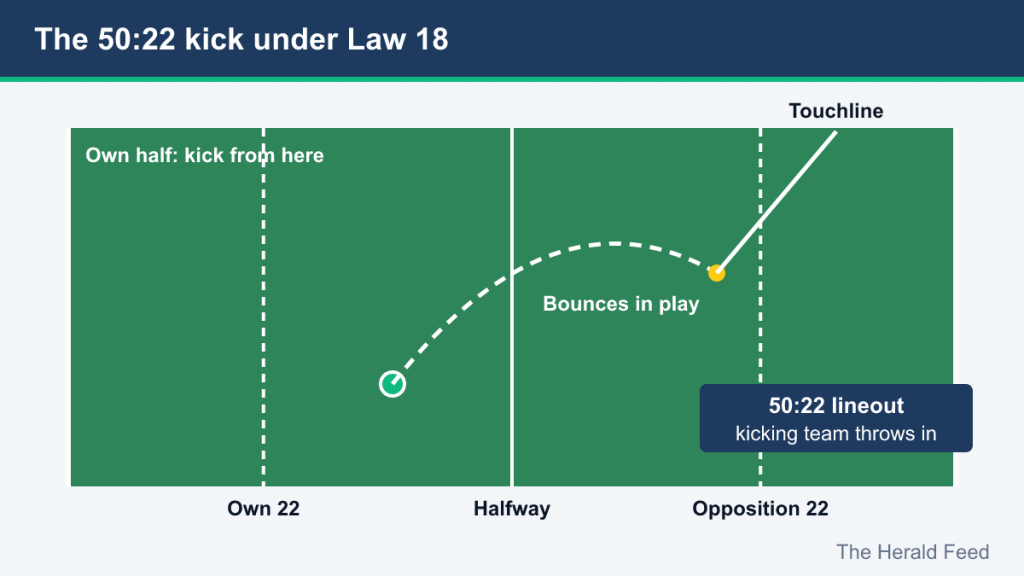
The 50:22
The 50:22 rewards long, accurate kicking in open play. Under Law 18, if a player in his own half kicks the ball indirectly into touch in the opposition’s 22, meaning it bounces in the field of play first, his own team throws in to the resulting lineout, at the point where the ball reached touch. It does not apply to kick-offs or any type of restart kick. Normally the non-kicking team throws in, so the 50:22 turns a territorial kick into an attacking platform close to the opponents’ line. We explain what happens next at that set piece in our guide to the rugby lineout.
The 50:22 has a defensive side effect, too. Because a kick can be rewarded so handsomely, defending teams have to keep wingers or the full-back deeper to cover the space, which in turn can open room for attacking teams in the front line.
Penalties to touch
When a team kicks a penalty into touch, directly or after a bounce, it throws in to the lineout where the ball went out. Combined with a strong driving maul, that is one of the most reliable ways to score in the modern game.
The box kick
The box kick is the scrum-half’s signature kick. Standing at the base of a ruck, scrum or lineout, usually facing his own try line or side-on, the scrum-half kicks the ball high over the forwards, typically towards the touchline area. The aim is to put the ball in the air long enough for a chaser, usually a winger, to arrive at the same time as the catcher.
Why is it so common? It is safe, because the ball is kicked from behind a protective wall of forwards. It is contestable, because hang time lets chasers compete. And it is hard to counter-attack, because the catcher is often under immediate pressure near the touchline.
The box kick has risks. If it is too long, the receiving full-back or winger can catch it under no pressure and run it back. If it is too short, it goes nowhere. And because the scrum-half needs time and space, a quick-rushing defender can charge it down.
Up-and-unders, chips and grubbers
Up-and-under (bomb)
The up-and-under, sometimes called a “Garryowen” in union or a “bomb” in league, is a very high kick, usually from the fly-half or centre, designed to give chasers time to compete in the air. It is particularly effective in wet or windy conditions, against an inexperienced back three, or when the receiving team is defending near its own try line.
Chip kick
A chip is a short, lofted kick over the top of a defensive line that has rushed up. Ideally the kicker or a supporting team-mate regathers the ball behind the defenders. It is a high-skill, high-risk option: done well it breaks a line instantly; done badly it hands the ball to the defence.
Grubber kick
A grubber is kicked along the ground so that it rolls or bounces unpredictably. It is used to get the ball behind a defensive line that has pushed up, especially near the try line, where an attacker can chase it into the in-goal area and ground it. Grubbers are also used to find touch on difficult angles or to force defenders to turn and run back towards their own line.
Cross-field kick
A cross-field kick goes from one side of the pitch to the other, usually towards a winger in space on the far touchline. It works when the defence has been drawn to one side by phase play or when the attacking winger has a height advantage over his opponent. A well-placed cross-field kick can produce a try directly.
The kick chase: where good kicking becomes good tactics
A kick is only as good as the chase that follows it. Coaches talk about the kick chase as a unit skill: the kicker, the chasers and the players behind them all have jobs.
Staying onside
Under Law 10, players in front of a team-mate who kicks are offside. They cannot simply run forward to chase; they must be put onside, for example when the kicker or another onside team-mate runs past them. Players who are in front of the kicker also need to be aware of the 10-metre law: if they are within 10 metres of where the ball lands or is caught, they must retire immediately behind an imaginary line 10 metres from that spot, or behind an onside team-mate. If more than one player is caught in that zone, the player nearest to where the ball lands is penalised. The 10-metre law does not apply when the kick is charged down. Our guide to offside in rugby union covers these lines in more detail.
The chase line
Chasers aim to arrive together and in a line, so the catcher has no easy gap to counter-attack through. A ragged chase, with one player far ahead and others lagging, gives a good runner space to exploit.
Competing in the air
On contestable kicks, the chaser attempts to catch the ball or tap it back, while the receiver tries to secure it. Both players have a right to compete for the ball. Referees look closely at aerial contests, and a player who takes out an opponent in the air without a genuine attempt to play the ball can be penalised and sanctioned under the foul play laws.
Backfield coverage and receiving kicks
Every kicking team is also a receiving team. A side needs a plan for where its back three stand when the opposition has the ball.
- Full-back. Usually stands deepest, covering long kicks and the middle of the field.
- Wingers. Often drop back from the defensive line to cover the corners and the threat of a 50:22 or a long touch-finder.
- The scrum-half or a back-row forward. Sometimes drops back to cover the short box kick space behind the ruck.
When a receiver catches a kick, he has options: kick back (often called “kick tennis” when both teams exchange long kicks), counter-attack, or set up a ruck. The mark is another tool. Under Law 17, a player with at least one foot on or behind his own 22-metre line who catches an opponent’s kick cleanly before it touches the ground or another player, and calls “mark” at the same time, is awarded a free-kick. A mark cannot be claimed from a kick-off or from a restart kick after a score.
How kicking differs in rugby league
Rugby league has its own kicking culture shaped by the tackle count. Teams typically kick on the last tackle of a set, either to gain territory or to attack the try line.
- 40/20 and 20/40. League’s equivalent of the 50:22. A 40/20 is a kick from behind the kicking team’s own 40-metre line that bounces in the field of play and then goes into touch beyond the opponents’ 20-metre line. The 20/40 mirrors it for kicks from behind the kicking team’s 20-metre line that go out beyond the opponents’ 40-metre line. The NRL introduced the 20/40 in 2020 and Super League followed in 2021.
- Bombs and grubbers near the line. League attackers often grubber into the in-goal area hoping to force a goal-line drop-out, which gives them another set of possession.
For a fuller picture of how a set of six works, see our beginner’s guide to rugby league rules.
Common kicking mistakes
- Kicking without a chase. A long kick with no organised chase hands a dangerous counter-attacker the ball and space.
- Finding the full-back. Long kicks that land straight on the opposing full-back’s chest allow him to choose his next move at leisure.
- Kicking out on the full from outside the 22. This gives away all the ground the kick was meant to gain.
- Taking the ball back into the 22. Players who carry or catch the ball back into their own 22 and then kick directly out lose the gain in ground.
- Overusing the box kick. A predictable kicking pattern lets defences set up for it and counter-attack.