Offside in Rugby Union: The Different Offside Lines Explained
Rugby union has several offside lines. Learn open-play offside, the 10-metre law, and the ruck, maul, scrum and lineout offside lines under World Rugby law.
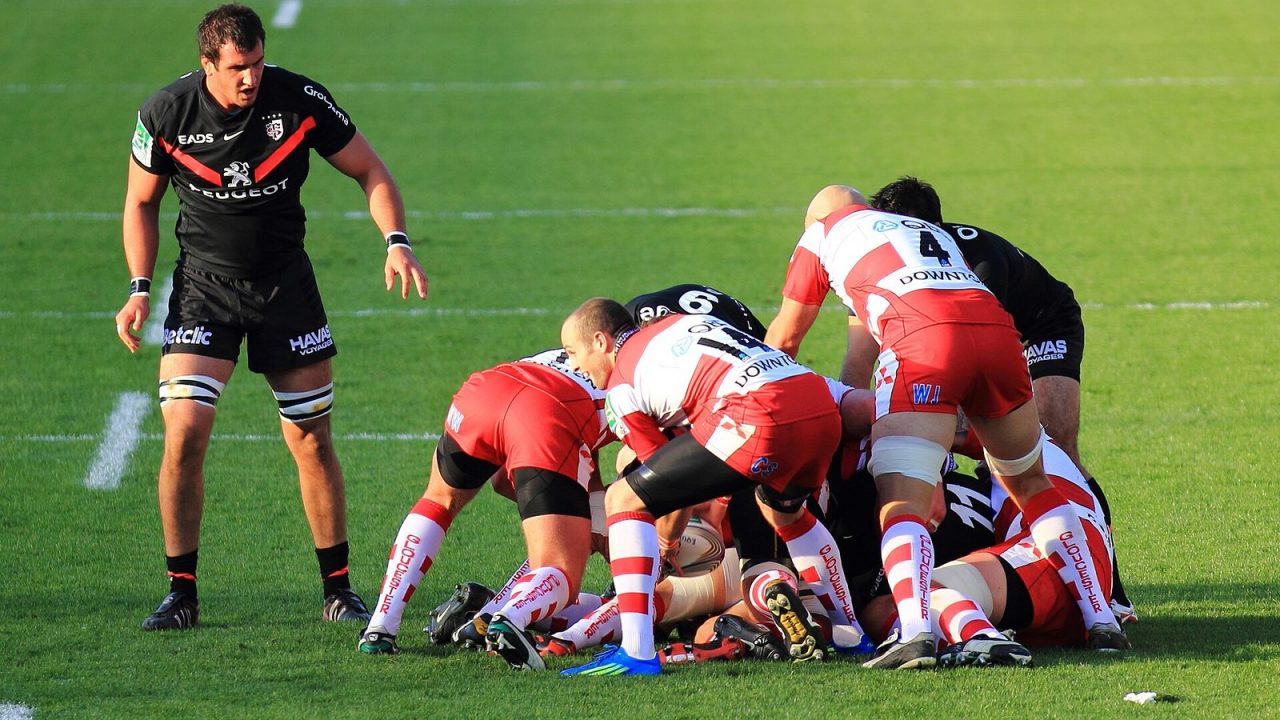
“Offside!” is probably the most frequent shout from rugby crowds, and also one of the least understood. Unlike football, where offside is one law about one line, rugby union has a whole family of offside situations. Which line applies depends on what is happening: open play, a kick, a ruck or maul, a scrum or a lineout. Once you know which phase you are watching, the logic becomes clear — and you will start spotting offside defenders before the referee’s arm goes up.
This guide follows World Rugby’s Laws of the Game, mainly Law 10 (offside and onside in open play) and the offside clauses in Laws 15, 16, 18 and 19. For the basics of the game, see our beginner’s guide to rugby union rules.
The Principle: Only Onside Players Can Play
Law 10 begins with a simple principle: the game is played only by players who are onside. Because the ball cannot be passed forward, a team’s attacking line naturally forms behind the ball. Offside laws stop players from gaining an unfair advantage by standing in front of that line — whether to receive a kick, block defenders, or rush into a tackle from an illegal position.
Being offside is not, in itself, an offence. An offside player is only penalised when they take part in play or fail to do what the law requires of them. That distinction explains many of the decisions that puzzle spectators.
Offside in Open Play
In open play (general play, outside rucks, mauls, scrums and lineouts), a player is offside if they are in front of a team-mate who is carrying the ball or who last played it. When the last action was a kick, the kicker’s foot sets the line.
An offside player must not:
- play the ball;
- tackle the ball-carrier;
- prevent the opposition from playing as they wish;
- loiter in an offside position.
Under Law 10.4, an offside player may be penalised if they do not try to retreat and then interfere with play, if they move towards the ball, or if they were in front of a team-mate who kicked and fail to retire as required. The non-offending team then chooses between a penalty at the place of the infringement or a scrum where the offending team last played the ball.
Accidental offside
Sometimes an offside player simply cannot avoid being hit by the ball or by a team-mate carrying it. The law calls this accidental offside. Play continues unless the offending team gains an advantage, in which case the sanction is a scrum — not a penalty.
The 10-Metre Law: Offside at Kicks
Kicks create the most common open-play offside situation. When a team-mate kicks the ball ahead, every player in front of the kicker is offside. Those players must not just stand still. Under Law 10.4(c), they must immediately retire behind an onside team-mate or behind an imaginary line 10 metres from where the opponent is waiting to catch the ball, or where the ball lands.
That 10-metre “circle” is why you often see chasers stop and back-pedal while the receiving player catches the ball. If more than one player is caught inside the 10 metres, the one closest to where the ball lands or is caught is penalised. The law does not apply when the kick is charged down or touched in an attempted charge-down.
Being put onside after a kick
Players in front of the kicker can be put onside in several ways:
- By their own action: retiring behind the team-mate who kicked the ball, or behind another onside team-mate.
- By a team-mate: the kicker, or another onside team-mate, runs past them.
- By an opponent: an opponent kicks the ball, or intentionally touches the ball without gaining possession.
There is an important exception. Law 10.8 states that a player who is offside under the 10-metre law can only be put onside by a charge-down — opponents running or passing with the ball do not release them, so they must retire as the law requires. The laws on being put onside by opponents in kicking duels have been a recurring subject of World Rugby law reviews, so it is worth checking the current Law 10 wording each season.
Offside at the Ruck and Maul
When a ruck or maul forms, open-play offside gives way to a fixed line for each team. Our full guide to the ruck and maul covers how those phases work; here is the offside part.
- Ruck: each team’s offside line runs parallel to the try line through the hindmost point of its hindmost player in the ruck.
- Maul: each team’s offside line runs through the hindmost foot of its hindmost player in the maul.
- If that point is on or behind a team’s own try line, the try line becomes the offside line.
Players not involved in the ruck or maul must either join it legally — from behind that line — or retire behind it. Common penalties include defenders standing in front of the line (“creeping up”), players hovering at the side of the ruck, and players who leave a ruck and then step forward without first getting back onside.
Law 10 adds an important detail: a player who was offside at a ruck, maul, scrum or lineout stays offside after it ends. They are only put onside by retiring behind the applicable line, by an opponent carrying the ball five metres, or by an opponent kicking it.
Offside at the Scrum
The scrum has three different groups of players, and the law treats each one separately.
Players in the scrum
The eight forwards bound in the scrum are governed by the scrum law itself and must stay bound until it ends.
Scrum-halves
The scrum-half of the team throwing in must keep at least one foot level with or behind the ball once play starts. The opposing scrum-half may follow the ball with both feet no further forward than the middle line of the tunnel, or may retreat to their team’s offside line at the hindmost foot, or at least five metres behind it.
Everyone else
All other players must stay at least five metres behind the hindmost foot of their team in the scrum. If that hindmost foot is in in-goal or within five metres of the team’s own try line, their offside line is the try line instead. The five-metre gap is what gives backs space to attack from scrums. As soon as the scrum ends, these offside lines stop applying. Our scrum explainer describes the set piece in more detail.
Offside at the Lineout
The lineout, governed by Law 18, also has separate lines for different groups.
- Players in the lineout: until the ball has been thrown in and touched a player or the ground, their offside line is the mark of touch — the line of the throw. After that, it is a line through the ball. A jumper who crosses the mark of touch without catching the ball must return immediately.
- Players not in the lineout: they must stay at least 10 metres behind the mark of touch on their own side, or behind their try line if that is nearer, until the lineout ends.
- The thrower and opposite number: they can join the lineout, retire to the offside line, stay within five metres of the touchline, or move to an empty receiver position — anywhere else and they are offside.
That 10-metre gap is why backs line up so deep at lineouts, and why a lineout that ends in a maul suddenly brings defenders forward: once the maul forms, its own offside lines take over.
Summary of the Offside Lines
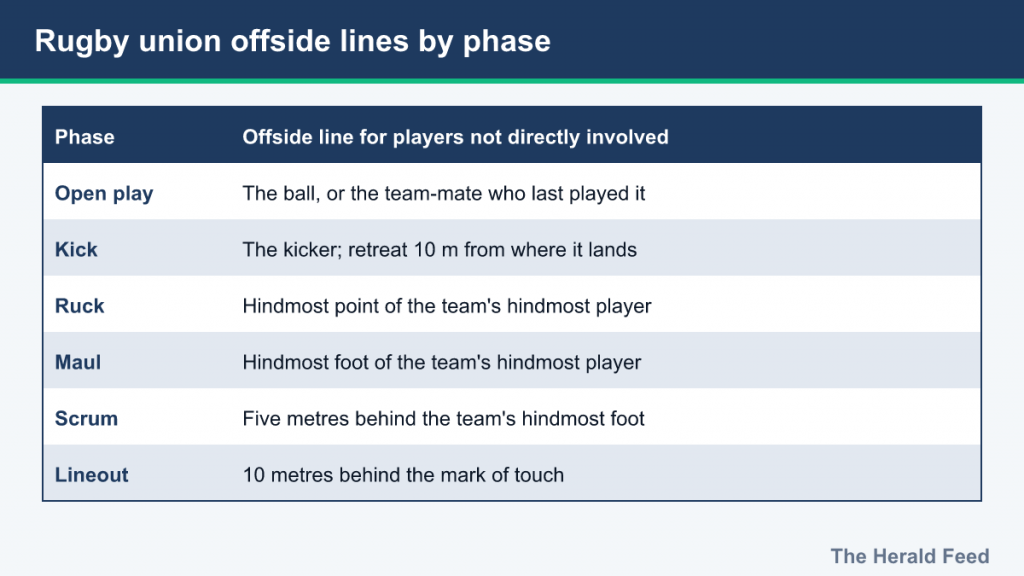
| Phase | Offside line for players not directly involved |
|---|---|
| Open play | The ball (or the team-mate who last played it) |
| Kick | The kicker; offside players must retreat 10 metres from where the ball lands or is caught |
| Ruck | Hindmost point of the team’s hindmost player in the ruck |
| Maul | Hindmost foot of the team’s hindmost player in the maul |
| Scrum | Five metres behind the team’s hindmost foot |
| Lineout | 10 metres behind the mark of touch |
Common Penalties and What to Look For
- Offside at the breakdown: defenders creeping in front of the last feet of the ruck to rush the scrum-half. Watch the assistant referee, who often flags this.
- Not retiring from a kick: a chaser standing inside 10 metres of the catcher instead of retreating.
- Blocking: an offside attacker standing between a defender and the ball-carrier, preventing a tackle.
- Early from the scrum or lineout: a back line moving up before the ball is out of the scrum or the lineout has ended.
- Loitering: a player lying or standing in an offside position and getting in the way, even without touching the ball.
Because offside is about position at a precise moment, referees rely heavily on their assistant referees and, at professional level, on television replays for scoring situations. Even so, it remains a judgement call in many cases, and you will regularly see one team’s coach convinced that the opposition got away with it all afternoon.
FAQ
Is a player standing offside automatically penalised?
No. Being in an offside position is not an offence by itself. The player is penalised only if they interfere with play, move towards the ball, or fail to retire when the law requires it.
Why are some offside decisions a scrum instead of a penalty?
Accidental offside is sanctioned with a scrum. For some open-play offside offences, the non-offending team can also choose a scrum instead of a penalty.
Can a player be offside in their own in-goal area?
Yes. Law 10 says a player can be offside anywhere on the playing area.