The LBW Rule in Cricket Explained Simply
Leg before wicket, step by step: where the ball lands, where it hits the pad, whether it would hit the stumps, the no-shot exception and how DRS reviews work.

Leg before wicket — LBW — is the dismissal that causes more arguments than any other in cricket. Bowled and caught are easy to see. LBW asks the umpire to make several judgements in a fraction of a second, including one about something that never actually happened: whether the ball would have gone on to hit the stumps if the batter’s leg had not been in the way.
The good news is that the rule itself is logical once you break it into steps. This guide walks through Law 36 of the MCC Laws of Cricket, explains the “no shot offered” exception, and shows how ball-tracking and umpire’s call work when a decision is reviewed. If you are new to the game, our beginner’s guide to cricket rules covers the other main dismissals.
Why the LBW Law Exists
The stumps are the target. If batters could simply stand in front of them and block every ball with their pads, bowlers would have almost no way of getting them out. LBW stops a batter from using their body, rather than the bat, to protect the wicket.
But the law is also designed to be fair to batters. A ball that lands well outside the leg stump, or hits the batter outside the line of the off stump while they are genuinely trying to play it, is treated differently. Those conditions are where the complexity comes from.
The Five Conditions of Law 36, Step by Step
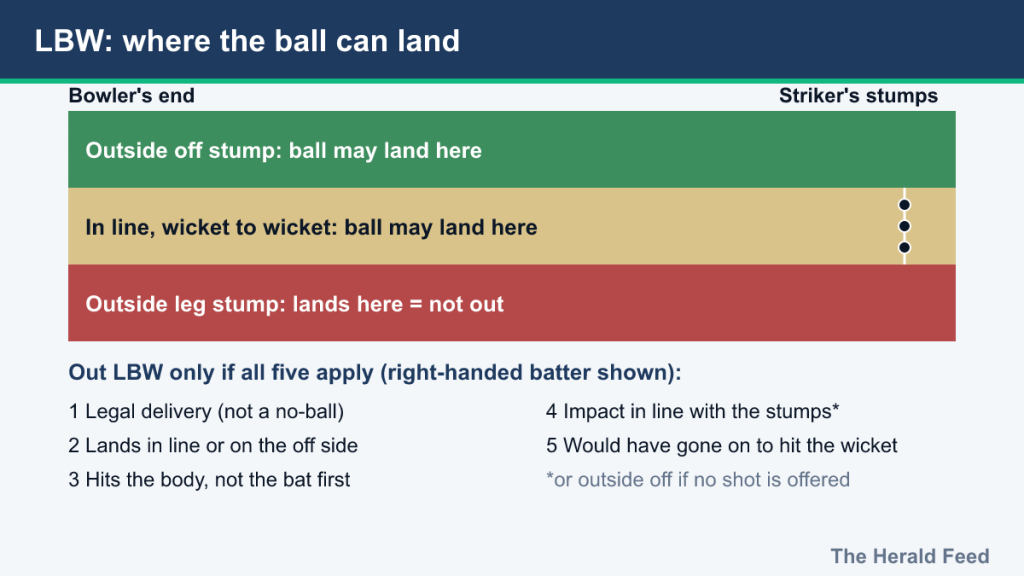
Under Law 36, the striker is out LBW only if all of the following apply. If any one of them fails, the batter is not out.
1. The delivery is legal
The ball must not be a no-ball. A batter cannot be out LBW from a no-ball, however plumb it looks.
2. Where the ball lands
If the ball bounces before reaching the batter, it must first land either in line between wicket and wicket or on the off side of the striker’s wicket. If it lands outside the line of the leg stump, the batter cannot be out LBW, no matter what happens next. A full toss that hits the batter without bouncing skips this step.
One small wording change is worth knowing. In the 2026 edition of the Laws, which came into effect on 1 October 2026, the MCC replaced the word “pitching” with “landing” throughout, so that “pitch” only refers to the 22-yard strip. You will still hear commentators say “pitched outside leg”, and the meaning is the same.
3. The ball hits the batter, not the bat first
The ball must hit the striker’s body — usually the pad, but any part of their person counts — without having touched the bat first. If the ball hits bat and pad at the same moment, the Laws treat it as having hit the bat first, so the batter is not out LBW. An inside edge onto the pad is the most common way a batter survives an otherwise strong appeal.
4. Where the ball hits the batter (impact)
The point of impact must be between wicket and wicket — that is, in line with the stumps. It does not matter if the impact is above the height of the bails; what matters is whether the ball would have gone on to hit the wicket.
There is one important exception, covered in the next section: if the batter made no genuine attempt to play the ball with the bat, they can also be out when the impact is outside the line of the off stump.
5. The ball would have hit the wicket
Finally, but for the interception, the ball must have been going on to hit the stumps. This is the umpire’s prediction, and it is the hardest judgement of all. Height, bounce, the angle of delivery and any sideways movement off the pitch all matter. The Laws say to assume the ball’s path before the interception would have continued afterwards, and only the first interception counts.
The “No Shot Offered” Exception
Consider a bowler who lands the ball outside off stump and bends it back into a right-hander. If the batter tries to play a shot and is hit on the pad outside the line of off stump, they are not out. The law protects a batter who is genuinely playing the ball.
But if the batter simply thrusts the pad at the ball with the bat raised or tucked behind the pad — “padding up” — the protection disappears. Under Law 36.1.4, when the striker makes no genuine attempt to play the ball with the bat, the point of impact can be between wicket and wicket or outside the line of the off stump. The other conditions still apply: the ball must have landed in line or outside off, and it must have been going on to hit the stumps.
This exception is what makes leaving the ball a skill. Batters judge which deliveries they can safely leave by line; a ball that seams back sharply can catch out a batter who misjudges, and they cannot rely on being hit outside off for protection if they have not offered a shot.
Note on off side and leg side
Which side is “off” depends on the batter. For a right-hander, the off side is to their right as the bowler looks at them; for a left-hander it is reversed. The Laws fix the off side by the striker’s batting position at the moment the ball comes into play — so a batter who switches stance after the bowler starts the run-up, as with a switch hit, does not change which side is the off side for that delivery.
LBW Decisions at a Glance
| Situation | Out? |
|---|---|
| Ball lands outside leg stump, hits pad in line, going on to hit | Not out — landed outside leg |
| Ball lands in line, hits pad in line, going on to hit | Out |
| Ball lands outside off, hits pad in line, going on to hit | Out |
| Ball hits pad outside line of off stump, batter playing a shot | Not out — impact outside off |
| Ball hits pad outside line of off stump, no shot offered, going on to hit | Out |
| Ball hits bat and pad simultaneously | Not out — treated as hitting the bat first |
| Delivery is a no-ball | Not out |
| Everything in line but ball going over or past the stumps | Not out |
How Umpires Make the Call
Like nearly all dismissals, LBW must be appealed for: the fielding side has to ask before the umpire can give the batter out. The bowler’s-end umpire then runs through the conditions above in sequence. Experienced umpires look for clues: how far the batter had come forward (the further from the stumps the impact, the more uncertain the prediction), how much the ball was bouncing on that surface, and whether the ball was swinging or seaming.
Distance down the pitch has long been a factor. A batter hit on the front pad a long way forward is harder to give out, because the ball has further to travel and more chance to deviate or bounce over the stumps. A batter hit on the back pad, deep in the crease, gives the umpire a much easier judgement.
Reviews, Ball-Tracking and Umpire’s Call
In international cricket, players can challenge an LBW decision using the Decision Review System (DRS). The third umpire then checks each condition with technology:
- No-ball check — whether the bowler’s front foot was legal.
- Edge detection — sound-based systems such as UltraEdge, and sometimes Hot Spot thermal imaging, to see whether the ball touched the bat first.
- Ball-tracking — systems such as Hawk-Eye show where the ball landed, where it struck the batter, and a projected path towards the stumps.
What umpire’s call means
Ball-tracking predicts a path, and predictions have margins of error. So where the projection is marginal, the on-field decision stands. This is known as umpire’s call. In broad terms, the original decision is overturned only when the technology shows the case clearly: for example, to change a not-out into out, at least half of the ball must be shown hitting within the wicket zone, and at least half of the ball must be in line at impact. If the projection shows less than that, the umpire’s original call is upheld.
Umpire’s call does not apply to where the ball landed: if it landed outside leg, the batter is not out, regardless of the margin. And the wicket zone used for reviews has been adjusted over the years; under ICC playing conditions introduced in 2025, it is the actual outline of the stumps and bails.
Importantly, when a review comes back as umpire’s call, the reviewing team keeps its review. That rule exists because the team was not proven wrong — the technology simply could not overrule the umpire.
Common LBW Myths
“You can’t be out LBW if you’re hit above the knee roll”
False. The Laws state the point of impact can be above the level of the bails. Height matters only because it affects whether the ball would have gone on to hit the stumps.
“You can’t be out if you’re a long way down the pitch”
Not in the Laws. Distance makes the prediction harder and in reviews may bring umpire’s call into play, but there is no rule against giving a batter out LBW down the pitch.
“If it hits the pad first and then the bat, it’s not out”
The opposite: only the first interception counts. If the pad is hit first, the bat touching it afterwards does not save the batter from LBW, though it can produce a catch if the ball carries to a fielder.