The Rugby Lineout Explained: Throwing, Lifting and Calls
How the rugby union lineout works: who throws in, the 5m and 15m lines, lifting, coded calls, not-straight throws, quick throws and the 50:22 kick.
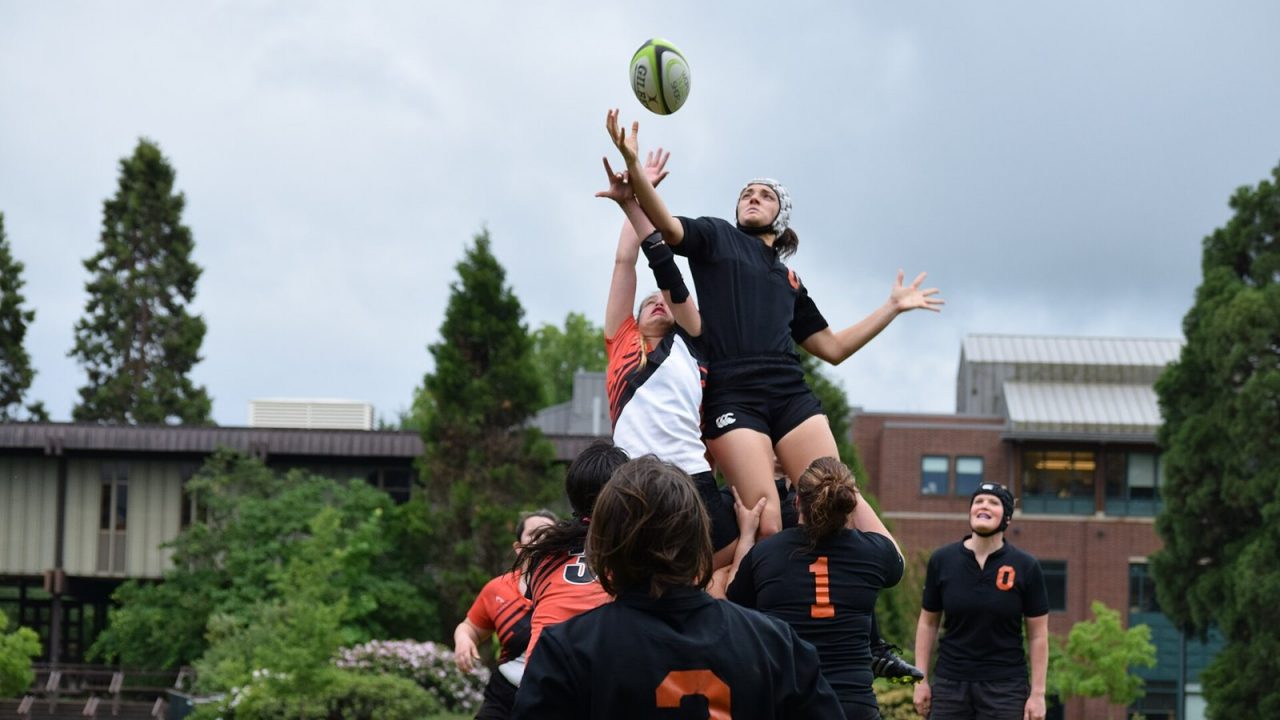
The lineout is rugby union’s way of restarting play after the ball goes into touch. At first glance it looks like controlled chaos: two lines of forwards, a hooker standing on the touchline with the ball above their head, players suddenly hoisted two or three metres into the air. In reality, it is one of the most carefully rehearsed parts of the game, and one of the most important. A secure lineout gives a team a platform to attack; a lineout that keeps losing its own ball can sink a match.
This guide follows World Rugby Law 18 (Touch, quick throw and lineout) and explains when a lineout is awarded, who throws in, how the lineout is formed, the roles of thrower, jumpers and lifters, the codes teams use, and the common infringements.
When the Ball Is in Touch
Under Law 18.1, the ball is in touch when a loose ball touches the touchline or anything beyond it, or when a player carrying the ball touches the touchline or the ground beyond it. The touchline itself counts as “out.”
There are subtleties. A player standing in the field of play can catch or knock back a ball that has crossed the plane of the touchline, and it is not in touch. A player who jumps from the field, catches the ball and lands back in the field of play keeps it in play. These are the moments you see wingers performing acrobatic saves near the sideline.
Who Throws In?
The general principle is that the team that did not put the ball into touch throws in. The main exceptions and refinements come with kicks:
- Penalty kick to touch: the kicking team throws in, at the point where the ball crossed the touchline. This is why teams kick penalties to the corner and then set up a lineout drive.
- Kicked directly into touch from inside the kicker’s own 22 (or in-goal): the opposition throws in where the ball crossed the touchline — the kicker gains ground.
- Kicked directly into touch from outside the 22: the opposition throws in level with where the ball was kicked, or where it crossed the line if that is nearer the kicker’s try line — there is “no gain in ground.”
- Taken back into the 22: if a player picks up the ball outside their 22, or catches it before it reaches the 22 line, then carries it back inside and kicks it out on the full, they are treated as having kicked from outside the 22 — no gain in ground.
- Kick-offs and restart kicks that go directly into touch give the throw to the non-kicking team.
The 50:22
One special case reverses the normal rule. If a player kicks the ball from inside their own half and it bounces into touch inside the opposition’s 22 (an indirect kick to touch), the kicking team throws in. This “50:22” reward does not apply to kick-offs or restart kicks. It encourages defending teams to keep a player back to cover the kick, opening space elsewhere for attackers.
The Quick Throw
Instead of waiting for a lineout to form, a team entitled to throw in may take a quick throw. Law 18 sets conditions:
- It must be taken between the mark of touch and the thrower’s own try line — so you can throw backwards or straight, but not from further up the field.
- The throw must go straight or towards the thrower’s own try line, and travel at least five metres before touching the ground or a player.
- The thrower must have both feet outside the field of play.
- The same ball must be used, and it must not have been touched by anyone other than the thrower or the player who carried it into touch.
- A quick throw is not allowed once a lineout has formed.
Quick throws are a favourite of alert wingers and scrum-halves, catching a defence before it has reorganised.
Forming the Lineout
A lineout forms on the “mark of touch” — where the ball went out, or the point the law specifies — but never within five metres of a try line.
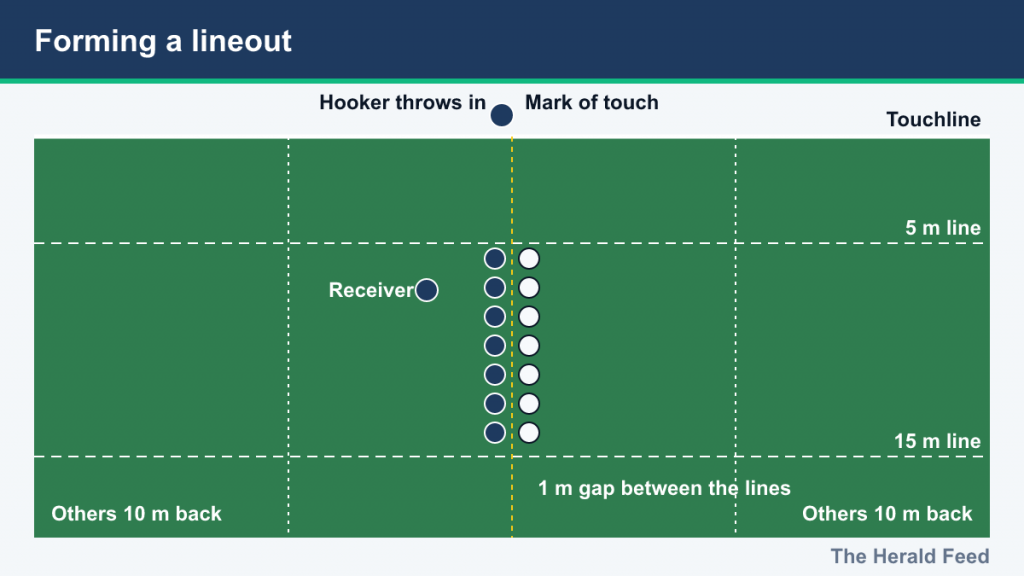
- Two lines: each team forms a single line, parallel to the mark of touch and half a metre from it on its own side, so there is a one-metre gap between the two lines that must be kept until the throw.
- Where: players in the lineout stand between the 5-metre line and the 15-metre line, both measured in from the touchline.
- Numbers: at least two players from each team must take part. The throwing team decides the maximum number; the opposition may have fewer, but not more.
- Receiver: each team may have one receiver — usually the scrum-half — standing back from the line, ready to collect the ball.
- Timing: under the current global law trial wording, teams must form the lineout within 30 seconds.
Everyone else must stay at least 10 metres back from the mark of touch until the lineout ends — see our guide to offside in rugby union for those lines.
The Throw: The Hooker’s Hardest Job
In most teams the hooker throws in, which is why lineout accuracy is a core part of the position — our guide to rugby union positions covers the role. The thrower stands on the mark of touch with feet behind the touchline and must not step into the field until the ball is thrown.
Straight and five metres
The throw must be straight along the mark of touch and must travel at least five metres before touching the ground or a player. A throw that drifts towards one team’s side is “not straight.” If the throw is not straight, the opposition is offered the choice of a lineout or a scrum. Other throw offences, such as pretending to throw or delaying the throw, are sanctioned with a free-kick.
Jumping, Lifting and Competing
Since lifting was legalised, the lineout has become an aerial contest. Jumpers — usually the locks and some back-rowers — are lifted by team-mates, typically the props, to catch the ball at the top of the jump.
- Lifters may pre-grip the jumper before the throw, but not below the shorts from behind or below the thighs from the front.
- Players must not jump or be lifted before the ball leaves the thrower’s hands.
- Once the ball is won, lifters must lower the jumper safely.
- No player may make contact with an opponent before the throw, and a jumper in the air must not be brought down.
The defending team can contest by lifting its own jumper to try to steal the ball, or can choose not to compete, keeping its forwards ready to defend a maul.
Calls and Codes
Because the throwing team knows where the ball is going and the opposition does not, lineouts depend on secrecy. Teams use coded calls — numbers, words, combinations — to tell players:
- which jumper the ball is going to (front, middle or back);
- whether players will move before the throw, shuffling positions to create a gap;
- what happens after the catch — a driving maul, a tap-down to the scrum-half, or a “peel” where a forward runs around the end of the lineout.
The lineout caller, often a lock, reads the defence and picks the call. Shorter lineouts — with only a few players in the line — create space for backs and moving targets for the throw.
When the Lineout Ends — and the Maul
The lineout ends when the ball or the player holding it leaves the lineout, when the ball goes beyond the 15-metre line or into the area between the touchline and the 5-metre line, when a ruck or maul forms and moves beyond the mark of touch, or when the ball becomes unplayable.
The classic follow-up is the driving maul: the jumper is brought back to the ground holding the ball, team-mates bind on, and the pack drives towards the try line. How that maul works — and how it can legally be defended — is covered in our ruck and maul explainer.
Common Lineout Infringements
| Offence | Typical sanction |
|---|---|
| Throw not straight | Opposition choice of lineout or scrum |
| Not keeping the one-metre gap | Free-kick |
| Lifting or jumping before the throw | Free-kick |
| Contact with an opponent before the throw | Penalty |
| Bringing down a jumper in the air | Penalty |
| Non-participants not 10 metres back | Penalty |
Frequently Asked Questions
Why do some lineouts have only two or three players?
The throwing team chooses how many players take part, as long as there are at least two from each side. A short lineout makes it easier to win the ball cleanly and leaves more space in midfield for the backs. Because the defending side cannot have more players in the line than the throwing side, a short lineout also pulls defenders out of the line and into the backfield.
Does the hooker always throw in?
The laws do not say who must throw; any player may do it. In practice, hookers throw in at almost every level, because the role is part of the specialist skill set of the position, while wingers or scrum-halves often take quick throws.
What happens if the throw is not straight twice?
If the opposition chooses a lineout after a crooked throw and their own throw is also not straight, Law 18 awards a scrum to the team that threw in originally.
Can a lineout be formed near the try line?
Not within five metres of it. If the ball goes into touch closer than that, the lineout is formed five metres out — which is why attacking lineouts near the line are so often taken at the five-metre mark.