Rugby League Rules: A Beginner’s Guide to the 13-a-Side Game
How rugby league works: 13 players, sets of six tackles, the play-the-ball, scoring, 40/20 kicks, scrums, the sin bin, the Bunker and interchanges.
Rugby league is built around a simple, relentless rhythm. A team gets six tackles to move the ball up the field and score; if it fails, the ball goes to the other side, who get their six. That structure makes league one of the easiest football codes to follow once you know the basics, and one of the most physically demanding to play.
This guide explains how a game of league works, using the international Laws of the Game published with the NRL’s interpretations, and notes where competitions such as the NRL in Australia and the Super League in Europe apply their own variations. If you already know rugby union, our guide to the differences between union and league is a quick way in.
Where the Rules Came From
League began as a breakaway. In August 1895, clubs from the north of England met at the George Hotel in Huddersfield and formed the Northern Rugby Football Union after the Rugby Football Union refused to let them compensate players for wages lost to matches. Over the following years the new body rewrote the laws to make the game faster and more attractive to paying crowds: teams were cut to 13, lineouts disappeared, and the play-the-ball replaced the ruck.
The tackle count came much later. Limited tackles were introduced in 1966, with the limit set at four in 1967 and raised to six in 1971 — the “set of six” that defines the modern game.
Teams, Positions and the Field
Under the laws, each team has no more than 13 players on the field at any time. Shirts are numbered 1 to 13 by position:
- 1 — Full-back
- 2 and 5 — Wings (right and left)
- 3 and 4 — Centres (right and left)
- 6 — Five-eighth or stand-off
- 7 — Halfback or scrum-half
- 8 and 10 — Props
- 9 — Hooker
- 11 and 12 — Second-row forwards
- 13 — Lock (loose forward in the UK)
A match must be abandoned for safety reasons if a team has fewer than nine players taking part. The 20-metre and 40-metre lines at each end matter most for newcomers, because several restarts and kicking rules depend on them.
Scoring
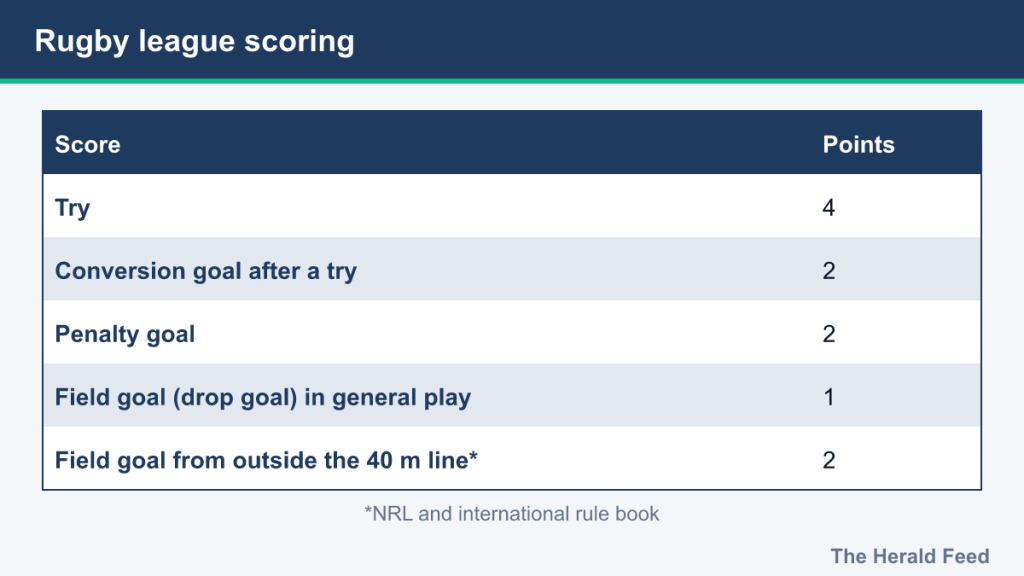
Under the rule book, points are scored as follows:
| Score | Points |
|---|---|
| Try (grounding the ball in the opposition in-goal) | 4 |
| Conversion goal after a try | 2 |
| Penalty goal | 2 |
| Field goal (drop goal) in general play | 1 |
| Field goal from outside the opposition 40-metre line (NRL and international rule book) | 2 |
A penalty try is awarded between the posts when foul play by the defending team stops a try that would otherwise have been scored. The rule book also describes the “eight-point try”: if a try-scorer is fouled, the attacking team can be awarded a conversion and a penalty kick, turning four points into a possible eight.
After points are scored, the team that conceded them kicks off from the centre of halfway to restart the game.
The Set of Six and the Play-the-Ball
Six tackles
The defining law of league is the tackle count. A team in possession is allowed five successive play-the-balls; on the sixth tackle, the ball is handed over to the opposition. A handover also happens if the team in possession commits an accidental breach on the last tackle, if a player is held up in-goal on the last tackle, or if the ball is kicked directly into touch on the full in general play.
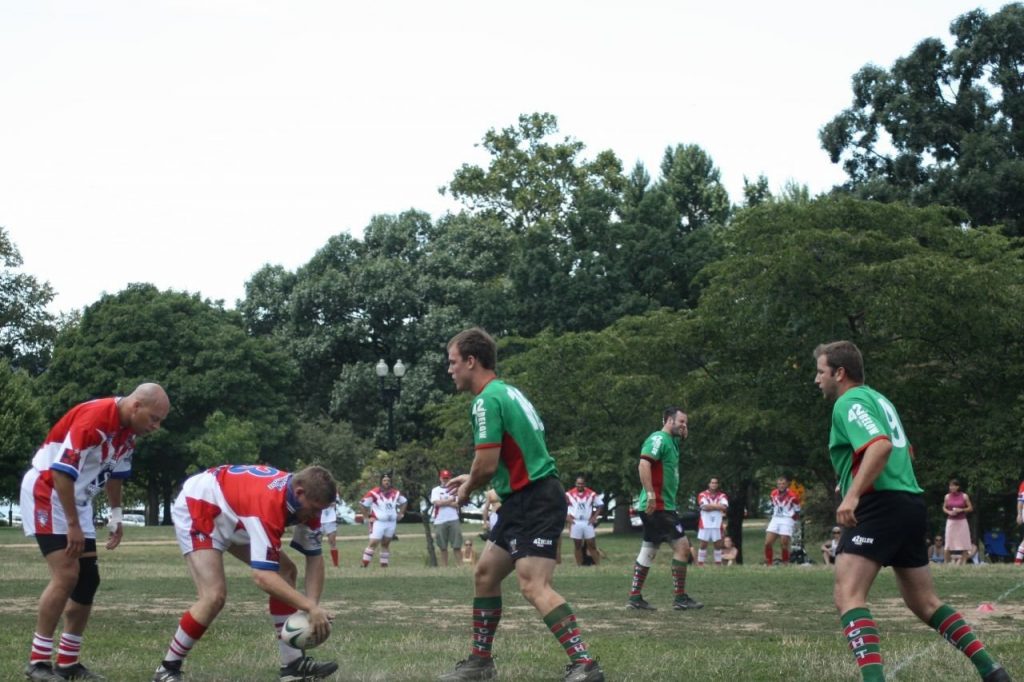
Most teams use their first four or five tackles to gain metres with powerful runs, then kick on the last tackle — either for territory or as an attacking grubber or bomb near the line. If the defending team touches the ball, for example by charging down a kick, the tackle count resets and the attacking side starts a fresh set.
The play-the-ball
After each completed tackle, play restarts with a play-the-ball. The tackled player must be released immediately. They regain their feet where they were tackled, face the opposition goal line, place the ball on the ground and heel it backwards. A team-mate standing directly behind, the acting halfback or dummy-half, collects it.
One defender, the marker, may stand directly opposite the tackled player. Every other defender must retreat ten metres from the play-the-ball, or to their own goal line, and may not move forward until the ball has cleared the ruck. That ten-metre gap is what gives attacking teams a running start on every tackle.
Once a tackle is completed, no player may try to take the ball from the tackled player. Stripping the ball is allowed only before the tackle is complete and only when a single defender is making the tackle.
“Six again”
When the defending team commits certain infringements at the ruck — slowing down the play-the-ball or not retreating ten metres — the referee often signals “six again” rather than awarding a penalty. The tackle count restarts, giving the attacking team a new set. For 2026, the NRL changed the threshold so that this applies to certain infringements beyond the 20-metre line, replacing the previous 40-metre threshold. Professional fouls and repeated infringements still bring a full penalty, and the offender may be sent to the sin bin.
Kicking Rules: 40/20 and 20/40
Kicking in league is mainly about territory, and two rules reward long, accurate kicks:
- 40/20: if a player kicks in general play from inside their own 40-metre zone and the ball bounces into touch inside the opposition’s 20-metre zone, the kicking team restarts with possession — a tap kick 20 metres in from where the ball crossed the touchline.
- 20/40: under NRL interpretations, a kick from inside a team’s own 20-metre zone that bounces into touch between the opposition’s 40-metre line and goal line earns the same reward.
Both rules force defending teams to keep players back to cover the kick, which opens up space for attack. A kick that goes directly into touch on the full gives the opposition a handover where the ball was kicked.
When the attacking team kicks the ball dead over the opposition’s dead-ball line, or a defender catches a kick on the full in their own in-goal, play restarts with a 20-metre optional kick by the defending team.
Scrums in League
League has scrums, but they are very different from union. No more than six players from each team form the scrum — normally three front-rowers, two second-rowers and the lock, in a 3–2–1 formation. Scrums are used to restart play after a knock-on, forward pass or the ball going into touch, and in the modern professional game they are rarely contested.
Under NRL interpretations, the team with the feed can choose where the scrum is set: ten metres in from touch, 20 metres in, or in the centre of the field. The choice lets attacking teams pick the space they want to attack from.
Discipline: Penalties, the Sin Bin and Send-Offs
Penalties are awarded for offences such as offside, obstruction, foul play and stealing the ball after a tackle. A team awarded a penalty can kick at goal for two points, take a quick tap and run, or kick for touch. After a penalty kick into touch, the kicking team restarts with a kick taken 10 metres in from where the ball went out — in practice a tap that begins a fresh set deep in opposition territory. That is why teams so often kick for touch rather than for goal.
For misconduct, the referee may caution a player, temporarily suspend them for ten minutes — the sin bin — or dismiss them. A dismissed player takes no further part in the match.
Officials and the Bunker
A match has one referee and two touch judges. In professional competitions, a video referee reviews try-scoring decisions; in the NRL this is done by the centralised Bunker, which also reviews foul play.
The NRL also has a Captain’s Challenge. The captain can challenge a referee’s decision that stops play and leads to a structured restart — a scrum, penalty, handover, 20-metre restart or goal-line drop-out — within ten seconds. Each team is allowed one unsuccessful challenge per match. Some decisions, such as ten-metre offside, ruck infringements and forward passes, cannot be challenged.
Interchanges, Time and Drawn Games
League teams use interchange players rather than a fixed number of replacements. The international laws leave it to each competition to decide whether interchanges are limited or unlimited. For 2026, the NRL allows teams to interchange four players, up to eight times per match, from a bench of six players numbered 14 to 19. Other competitions set their own limits.
Under the laws, a game normally lasts 80 minutes, with the teams changing ends at half-time. In the NRL, a regular-season match level at full time goes to golden point: up to ten minutes of extra time, five each way, in which the first team to score wins. If no one scores, the game is a draw. Finals matches play ten minutes of extra time first and then golden point until there is a winner.
NRL, Super League and International Variations
League is governed internationally by International Rugby League, and the core laws are shared. But competitions add their own interpretations, and these change from season to season. The NRL’s interpretations include the 20/40, scrum placement, the six-again rule and the Captain’s Challenge; other competitions, including the Super League, adopt some innovations and not others, and set their own interchange limits and video-review procedures.
For a newcomer, the safest approach is to learn the shared core — 13 players, sets of six, the play-the-ball, four-point tries — and treat the competition-specific rules as details to pick up as you watch.