


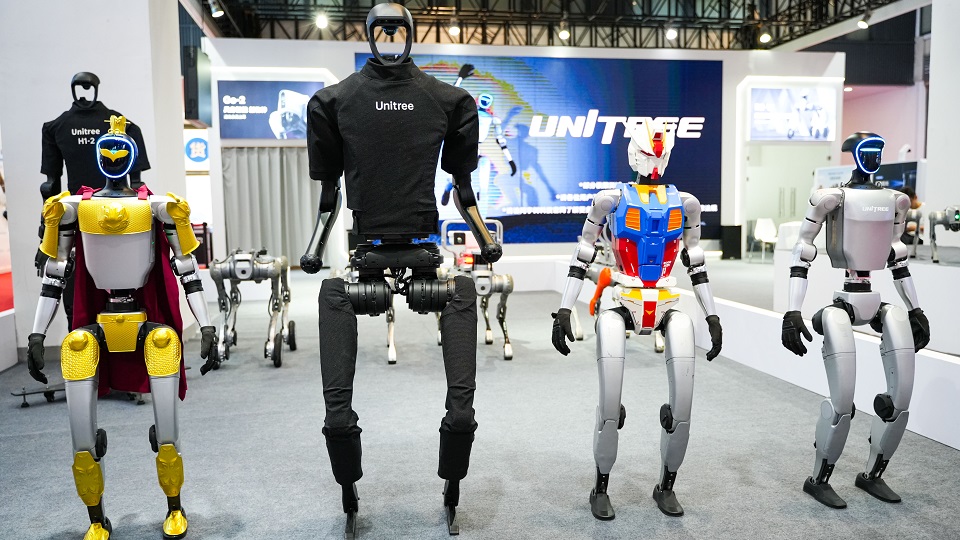
Unitree Robotics, one of China’s leading humanoid robot manufacturers, is reportedly preparing for an initial public offering that could value the company at approximately $9 billion. The ambitious IPO plans underscore the explosive growth of the robotics sector in China and highlight the increasing global competition in the development of advanced humanoid machines. What makes this IPO particularly noteworthy is the company’s strategic partnership with DeepSeek, the artificial intelligence developer that has recently gained international attention for its breakthrough AI models that rival Western competitors at a fraction of the development cost.
The convergence of cutting-edge robotics and sophisticated artificial intelligence represents a pivotal moment in the technology industry. Unitree’s collaboration with DeepSeek positions the company at the forefront of this technological revolution, combining physical robotic capabilities with advanced AI-driven decision-making and learning systems. Industry analysts suggest that this strategic partnership could accelerate the development of commercially viable humanoid robots capable of performing complex tasks in various industries, from manufacturing and logistics to healthcare and domestic assistance.
Unitree’s Rise in the Global Robotics Market
Founded in 2016 in Hangzhou, China, Unitree Robotics has rapidly established itself as a formidable player in the global robotics industry. The company initially gained recognition for its quadruped robots, including the popular Go1 and Aliengo series, which offered performance comparable to Boston Dynamics products but at significantly lower price points. This aggressive pricing strategy, combined with consistent technological improvements, allowed Unitree to capture substantial market share and attract attention from investors worldwide. The company’s transition into humanoid robotics represents a natural evolution of its technical capabilities and market ambitions.
The Chinese robotics market has experienced unprecedented growth in recent years, driven by government support, significant private investment, and increasing domestic demand for automation solutions. China’s “Made in China 2025” initiative specifically identified robotics as a strategic priority, leading to substantial funding for research and development in the sector. Unitree has been a primary beneficiary of this supportive ecosystem, leveraging both public and private resources to accelerate its technological development and expand its production capabilities.
Strategic Investment from DeepSeek
The involvement of DeepSeek as a strategic investor adds a significant dimension to Unitree’s value proposition. DeepSeek made headlines globally in early 2024 when it released AI models that demonstrated capabilities approaching those of leading American AI systems while reportedly requiring dramatically less computing power and development resources. This efficiency-focused approach to AI development aligns well with Unitree’s own strategy of delivering high-performance robotics at competitive prices. The partnership suggests that future Unitree robots may incorporate DeepSeek’s advanced AI capabilities, potentially enabling more sophisticated autonomous behaviors and human-robot interactions.
The synergy between Unitree’s hardware expertise and DeepSeek’s software prowess could prove transformative for the humanoid robotics industry. Historically, the development of truly capable humanoid robots has been hindered by limitations in both physical mechanics and artificial intelligence. By combining strengths in both domains, the partnership addresses both challenges simultaneously. Industry observers note that this integrated approach mirrors strategies employed by leading technology companies globally, where hardware and software development are increasingly intertwined to create more seamless and capable products.
Market Implications and Future Outlook
The $9 billion valuation target places Unitree among the most valuable robotics companies globally and reflects investor confidence in the long-term potential of humanoid robots. While the commercial deployment of humanoid robots remains in relatively early stages, projections from various research firms suggest the market could reach hundreds of billions of dollars by 2035. Major technology companies including Tesla, with its Optimus robot, and various Japanese and Korean manufacturers are also racing to develop commercially viable humanoid robots, intensifying competition in the sector. Unitree’s successful IPO could provide the capital necessary to accelerate its research and development efforts and maintain its competitive position in this rapidly evolving market.
The timing of Unitree’s IPO preparations coincides with increasing global interest in Chinese technology companies, despite ongoing geopolitical tensions. Investors appear to be recognizing the genuine technological capabilities of Chinese firms in sectors ranging from artificial intelligence to advanced manufacturing. For Unitree, a successful public offering would not only provide access to capital markets but also enhance the company’s visibility and credibility on the international stage. As the robotics industry continues to mature and humanoid robots move from research laboratories to real-world applications, companies like Unitree are positioning themselves to play central roles in what many consider the next major technological revolution.
Expert Opinion: Unitree’s IPO represents a watershed moment for the humanoid robotics industry, signaling that institutional investors now view these technologies as commercially viable rather than purely experimental. The DeepSeek partnership could prove decisive, as the integration of energy-efficient AI with affordable robotics hardware may finally unlock mass-market applications. We expect this IPO to trigger increased M&A activity in the sector as larger technology conglomerates seek to acquire similar capabilities before the market becomes too competitive.